.avif)
📌 Key Takeaways
Active amenity management transforms underused spaces into retention tools through systemized booking, light programming, and consistent promotion.
- Passive Means Reactive Chaos: Without clear booking rules and centralized systems, staff field endless questions while amenities sit empty.
- Self-Serve Booking Cuts Interruptions: Residents reserve spaces instantly through one app, eliminating phone calls and manual coordination.
- Light Programming Beats Event Overload: One recurring monthly event with predictable rhythm outperforms ambitious calendars that burn out teams.
- Measurement Reveals What Works: Tracking utilization rates, repeat participation, and staff coordination time exposes underperforming spaces quickly.
- Start With One Flagship Space: Activate your highest-potential amenity first, document simple rules, then expand the system gradually.
Empty amenities drain budgets; used amenities drive renewals.
Class A property teams seeking operational efficiency and measurable resident engagement will find a practical activation framework here, preparing them for the detailed implementation guide that follows.
The clubhouse sits empty on a Tuesday evening. The pool deck chairs haven't moved in days. Meanwhile, the front desk fields another call asking about guest suite availability, and someone on the team digs through a spreadsheet to figure out who reserved the conference room last weekend.
Sound familiar?
For many Class A multifamily communities, this pattern plays out quietly. The amenities look impressive on paper, but actual usage tells a different story. The problem isn't the spaces themselves. It's how they're being managed.
Understanding the difference between passive and active amenity management can help property teams move from availability to consistent usage, without adding chaos to already-stretched schedules.
The Fast Answer: Active vs. Passive Amenity Management
Active amenity management is a proactive approach to operating shared spaces and services that emphasizes programming, promotion, and systemized booking. Passive management focuses on availability and upkeep, assuming usage will happen on its own.
Think of it this way: passive management is an "open door policy." Active management is being the cruise director for a stationary ship. You plan, promote, and coordinate so people actually show up and participate.
For Class A communities where residents expect seamless experiences, this distinction matters. The approach you choose shapes everything from staff workload to resident satisfaction to whether those amenities contribute to retention or just sit there as expensive square footage.
What Passive Amenity Management Looks Like in Real Life
Passive amenity management operates on a simple premise: if you build it, they will come. The team keeps spaces clean, equipment maintained, and doors unlocked. Beyond that, usage is left to chance.
A clubhouse sits empty most weeknights, but the team still fields questions, key handoffs, and last-minute reservation requests. Rules exist somewhere, maybe in a move-in packet from three years ago. When conflicts arise over double-bookings or noise complaints, staff scramble to mediate without clear policies to reference.
Common signs your community may be operating passively:
- Amenity spaces are available but consistently underutilized
- Residents ask the same questions repeatedly because information isn't centralized
- Booking happens through phone calls, emails, or paper sign-up sheets
- Staff time gets consumed by coordination rather than oversight
- No consistent data exists on which amenities get used and when
- Programming happens sporadically, often driven by individual initiative rather than a system
This approach isn't necessarily wrong. For some communities with limited resources or simpler amenity offerings, passive management may be sufficient. But for Class A properties where resident expectations run high, passive management often leads to a gap between what's promised and what's experienced.
What Active Amenity Management Looks Like
Active management treats amenities as operational assets that require intentional oversight, not just maintenance.
With active management, that empty clubhouse becomes predictable. Residents self-book through a centralized system, events fill the calendar based on a planned cadence, and staff time shifts from firefighting to strategic oversight.
Concrete examples of active management in practice:
Self-serve reservations with clear rules. Residents can book spaces instantly through a resident app without calling the office. Capacity limits, time windows, deposit requirements, and usage guidelines are published and enforced consistently.
Light programming cadence. Rather than elaborate monthly galas, active management might mean a standing yoga class every Saturday, a quarterly wine-and-cheese mixer, or resident-led clubs that use the space on a predictable schedule. The goal is rhythm, not spectacle.
Promotion rhythm. Weekly highlights go out reminding residents what's available. A monthly calendar shows upcoming events and open booking windows. The amenities stay top-of-mind instead of fading into the background.
Here's an insight worth pausing on: the "active" shift is often less about adding programming and more about reducing friction and tool sprawl so residents actually use what already exists. When booking requires three apps, two emails, and a phone call, even beautiful spaces go unused. Simplifying access can do more than adding events. For more on this dynamic, see The Hidden Cost of App Fatigue.
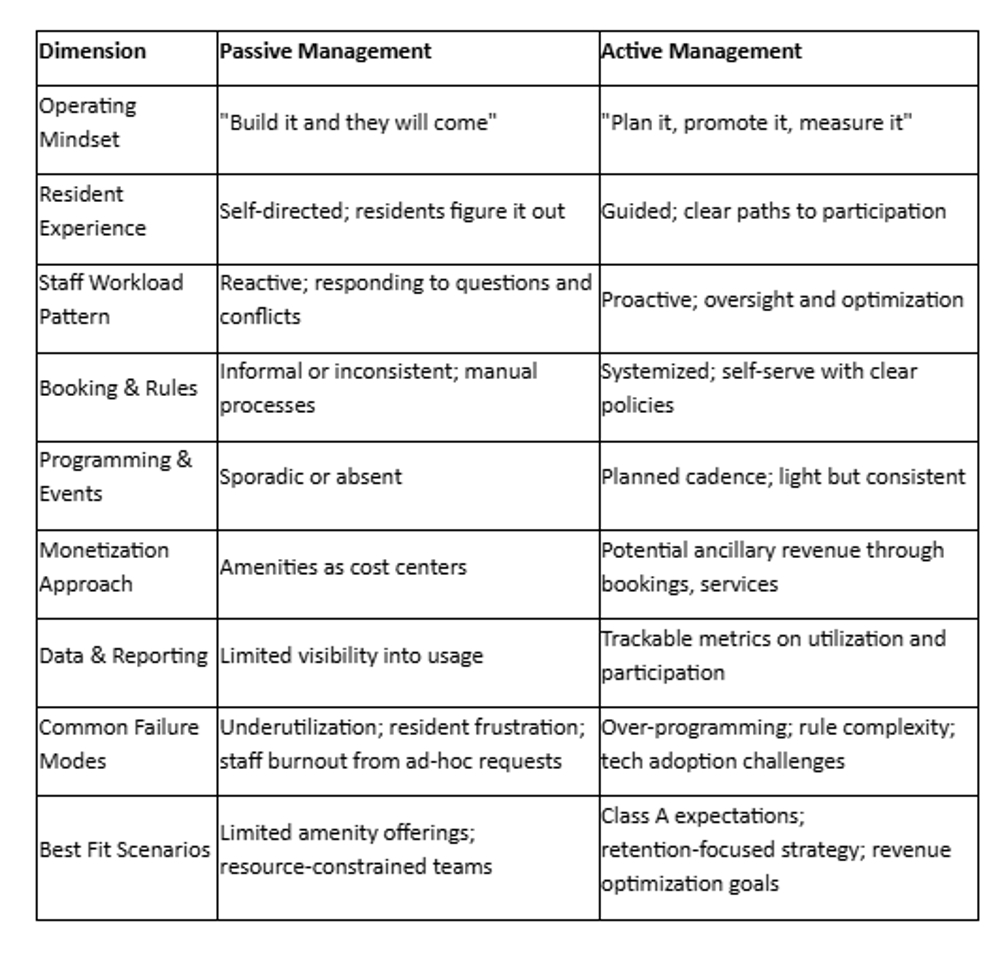
Passive vs. Active: Side-by-Side Comparison
The following table breaks down how these two approaches differ across key operational dimensions. For property teams evaluating their current model, this comparison can help identify specific areas where a shift might reduce friction and turn amenities into more reliable community touchpoints.
"An empty gym is an expense; a full gym is a retention tool."
Active management is ultimately a repeatable system. When the approach is consistent, amenities can become reliable touchpoints that residents associate with their community rather than spaces they forget exist.
How Active Management Can Help Different Stakeholders

The shift from passive to active management affects different roles in different ways. Understanding these impacts can help teams build alignment around the change.
For Property Managers: Fewer Last-Minute Interruptions
When rules and booking live in one accessible place, the "who has the key?" and "is the party room available Saturday?" questions drop significantly. Property managers spend less time as information brokers and more time on higher-value work. One common pattern teams report is that automating amenity reservations reduces the back-and-forth that fragments their days.
For Operations Directors: Standardized Rules and Fewer Process Gaps
Active management requires documenting what was previously informal. Booking rules, deposit amounts, capacity limits, cleaning checklists, and conflict resolution procedures become standardized across the portfolio. This consistency makes training easier and reduces the risk of policy drift between properties.
For Community Managers: Easier Programming Without More Tools
When events, RSVPs, and reminders run through one workflow, community managers can focus on the creative and relational aspects of their role rather than juggling multiple platforms. Events and experiences become easier to execute when the operational infrastructure supports them.
For Asset Managers: Better Measurement and Clearer ROI Story
Passive management makes it difficult to answer basic questions: Which amenities drive satisfaction? Are residents actually using what we invested in? Active management generates data. Usage patterns, reservation volume, and participation rates become visible, making it easier to justify investments or identify underperforming spaces. According to internal ElevatedOS data, communities using active management approaches may see potential increases in NOI and improvements in resident retention, though results vary by implementation. For a broader view of engagement outcomes, see the Resident Retention Platform.
How to Shift From Passive to Active Without Hiring More Staff
The good news: moving toward active management doesn't require a massive overhaul or new headcount. It requires a system.

Step 1: Pick one or two "flagship" spaces. Don't try to activate everything at once. Choose amenities with high potential and low complexity, perhaps the clubhouse and pool deck, or the fitness center and guest suite.
Step 2: Set simple rules and booking windows. Document capacity, hours, reservation limits, and any fees. Publish them where residents can find them without asking. Consistency matters more than comprehensiveness.
Step 3: Establish a monthly programming cadence. Start light. One recurring event per month is better than an ambitious calendar that fizzles. Consider partnerships with local vendors or resident-led activities that don't require heavy staff involvement.
Step 4: Promote consistently. A weekly email highlighting available bookings and upcoming events keeps amenities visible. The goal is rhythm, not volume.
Step 5: Track three metrics and adjust. Pick simple indicators like reservation count, event attendance, and resident feedback. Review monthly. Adjust based on what you learn.
This approach aligns with the broader principle that reducing app fatigue and consolidating tools can improve adoption more than adding features.
Compliance Reminder: Per fair housing laws, all residents must have equal access to the same services, tools, events, and features. Booking rules, programming access, and enforcement policies should be consistent and applied uniformly across the community. When exceptions are required, handle them through a defined process aligned with reasonable accommodation obligations.
Metrics That Indicate Your Amenities Are Working
Active management without measurement is just busy-ness. The following metrics can help teams understand whether their approach is actually working:
- Reservation volume and utilization rate: Are spaces being booked? What percentage of available time slots get used?
- Repeat participation: Are the same residents engaging, or is participation broad-based?
- Resident sentiment: Quick pulse surveys after events or periodic check-ins can surface issues before they become complaints.
- Ancillary revenue: For communities that charge for certain amenities or services, tracking this revenue provides a clear ROI signal.
- Staff time spent on manual coordination: If the team is still drowning in amenity-related requests, the system may need adjustment.
Common Risks and How to Avoid Them
Shifting to active management introduces new risks. Anticipating them helps teams avoid common pitfalls.
Risk: Overcomplicated rules. In an effort to cover every scenario, some teams create policies so complex that residents give up trying to understand them. Mitigation: Start with the minimum viable ruleset. Add complexity only when specific problems emerge. Publish rules in plain language and make them easy to find.
Risk: Perceived unfair access. Per fair housing laws, all residents must have equal access to amenities, booking systems, and programming. If systems appear to favor certain residents, trust erodes and legal risk increases. When exceptions are required, they must be handled through a defined process aligned with reasonable accommodation obligations. Mitigation: Ensure policies are transparent and consistently enforced across all residents. Avoid first-come-first-served systems that advantage residents with flexible schedules unless balanced with other access options. Document all accommodation requests and responses.
Risk: Event burnout. Teams sometimes interpret "active" as "constant programming," leading to exhaustion and declining participation. Mitigation: Quality over quantity. A lighter cadence with higher-quality touchpoints typically outperforms a packed calendar. Consider resident-led clubs or vendor partnerships that distribute the effort.
Choose an Operating Model, Not a Vibe
The difference between passive and active amenity management isn't about having more events or fancier spaces. It's about choosing a deliberate operating model for how shared spaces function in your community.
Active amenity management is not "more events." It is a repeatable operating system for shared spaces: promotion, self-serve booking, light programming, and measurement.
For Class A communities where resident expectations are high and competition for renewals is real, that system can become a resident retention platform in its own right. Empty amenities are expenses. Used amenities are retention tools.
The shift doesn't require a revolution. Start with one space, one system, one month of data. Build from there.
Ready to see what active management could look like for your community?
Calculate Your Potential Revenue | Subscribe to Our Newsletter
Frequently Asked Questions
What is amenity management in multifamily communities?
Amenity management refers to the operational oversight of shared spaces and services within a residential community, including gyms, pools, clubhouses, and guest suites. It encompasses everything from maintenance and access control to programming and utilization tracking.
What are examples of active amenity management?
Examples include self-serve booking systems that allow residents to reserve spaces without staff intervention, planned programming cadences with recurring events, consistent promotional communications about available amenities, and regular tracking of usage metrics to inform decisions.
How do you switch from passive to active amenity management without hiring more staff?
Start by focusing on one or two high-potential spaces rather than trying to transform everything at once. Implement simple, documented rules and a self-serve booking system to reduce manual coordination. Add light, sustainable programming and track a few key metrics monthly to guide adjustments.
Should you charge for amenities in Class A communities?
This varies by market, community positioning, and specific amenity type. Some communities include all amenities in rent to emphasize value, while others generate ancillary revenue through fees for premium spaces like guest suites or event venues. The key is ensuring any fee structure is transparent and consistently applied to all residents.
What metrics should you track to evaluate amenity performance?
Useful metrics include reservation volume and utilization rates, repeat participation, resident sentiment from surveys or feedback, ancillary revenue where applicable, and staff time spent on amenity-related coordination.
Our Editorial Process
We follow a clear editorial process to help ensure our content is accurate, useful, and aligned with the needs of multifamily operators.
- Research and input gathering: We start by compiling internal knowledge, customer feedback, and operational context from the multifamily industry.
- Draft development: Our team drafts the article with a focus on clarity, practical application, and consistency with ElevatedOS terminology and standards.
- Editorial review: Each draft is reviewed for readability, factual alignment, and brand voice before publication.
- Ongoing updates: We revisit and refresh content periodically to reflect product updates, market changes, and new operational best practices.
About the ElevatedOS Insights Team
The ElevatedOS Insights Team is our dedicated engine for synthesizing complex topics into clear, helpful guides. While our content is thoroughly reviewed for clarity and accuracy, it is for informational purposes and should not replace professional advice.