.avif)

📌 Key Takeaways
Need Finance to say yes to a unified platform—without guesswork or hype?
Treat PMS as the Operating Backbone: Evaluate it as a governed system that consolidates apps and manual handoffs into measurable workflows, elevating the purchase from a line item to an enterprise investment.
Quantify Total Cost of Fragmentation: Model hidden labor, reconciliation errors, context switching, and service variance to demonstrate that fragmentation costs often exceed license fees.
Use a Weighted, Decision-Gate Business Case: Define 5–8 criteria with agreed weights, compare TCF vs. unified scenarios on the same horizon, and set explicit go/no-go thresholds to align Operations and Finance.
De-Risk with Governance and Sequenced Integration: Assign decision rights and KPI ownership, run quarterly value reviews, and phase feature toggles with rollback points to reduce risk and speed value realization.
Prove NOI Impact with Auditable Proxies: Track cycle times, data-quality exceptions, amenity utilization, and SLA adherence instead of promising speculative ROI figures.
One login, one queue, one record—faster approval and steadier NOI.
Close the Gap Between Operational Reality and Financial Approval
Pressure is building.
A boardroom screen shows four dashboards from four different tools, none telling the same story. Month-end is tomorrow.
The Operations lead needs a yes from Finance now—not next quarter. The case must be defensible, numbers-ready, and de-risked. The destination is clear: a single operating backbone that cuts noise, consolidates work, and improves NOI in Class A communities.
Pull-quote: "The biggest leak is hidden labor and rework—not the line item."
According to the ElevatedLiving.com framework, a unified property management software platform is best evaluated as an organizational operating system, not a feature bundle. The goal is alignment: Finance's risk/return lens and Operations' efficiency/experience lens assessing one transparent plan.
What Modern Platforms Actually Consolidate
The challenge many property managers face is that residents are overwhelmed by app fatigue—downloading separate apps for rent payment, amenity booking, service requests, and community events. Leading properties are solving this by consolidating everything into a single, white-labeled resident app. This approach not only reduces friction for residents but also gives property managers deeper insights into engagement that traditional PMS systems don't provide.
A unified property management software platform serves as the operating backbone for Class A communities, consolidating fragmented apps and manual processes into governed, measurable workflows. By removing duplicate tools and handoffs, Operations gains time, accuracy, and consistency; Finance gains predictability, controllable costs, and cleaner data for NOI decisions. This shared foundation is what turns a PropTech purchase from a line item into an enterprise investment.
Modern platforms now offer hotel-style concierge services—from housekeeping to dog grooming—directly through the resident app, creating convenience that keeps tenants from looking elsewhere. By consolidating 7+ separate tools into one branded platform, properties eliminate resident app fatigue while reducing vendor management overhead for your team.
Property Management Software enables outcomes in amenity management that drive NOI and resident experience. Property management software solves pain points in Onboarding & Move-in/Move-out and Maintenance Management. It prevents problems in Package Management by reducing loss, errors, and workload. These relationships explain where operational leverage comes from.
The Hidden Cost of Fragmentation Outweighs License Line Items
The evidence pattern in multifamily is consistent: tool sprawl creates duplicated entry, context switching, and reconciliation errors. Finance sees license fees; the larger drain is invisible time and rework. In practice, fragmented stacks also degrade the resident experience platform signal—residents notice when amenity access, maintenance updates, or package notifications don't feel cohesive.
Understanding Total Cost of Fragmentation (TCF)
When your team juggles separate portals for access control, package management, amenity reservations, maintenance requests, and resident communications, the real cost isn't just license fees—it's the hidden overhead. Residents who need to download five different apps to book a fitness class, request maintenance, pay rent, reserve the guest suite, and schedule housekeeping are more likely to disengage entirely.
TCF vs. Unified Value (concise comparison checklist):
- Labor drag: duplicated data entry, swivel-chair work, delayed updates → unified queues and governed workflows
- Error risk: mismatched exports, stale records, manual reconciliations → single source of truth
- Service variance: inconsistent amenity rules and responses → standardized playbooks with measured SLAs
- Churn pressure: fractured resident touchpoints → one resident engagement platform
Decision frameworks that account for total cost of fragmentation (TCF) produce better alignment because they quantify the unpriced waste. For broader context on stakeholder alignment, see Harvard Business Review on building a stakeholder strategy to unify objectives across functions (evidence resource: HBR).
What Does Finance Need To See To Move Forward?
Three Critical Requirements
Comparability: apples-to-apples modeling of TCF vs. unified platform value
Risk treatment: explicit governance, integration plan, and decision rights
Forecastability: KPI cadence that connects effort to NOI levers
Governance reduces perceived risk when decision rights, accountabilities, and controls are explicit. See PMI on project governance fundamentals (evidence resource: PMI).
How a Unified PMS Aligns Ops Efficiency With Finance’s Risk Lens
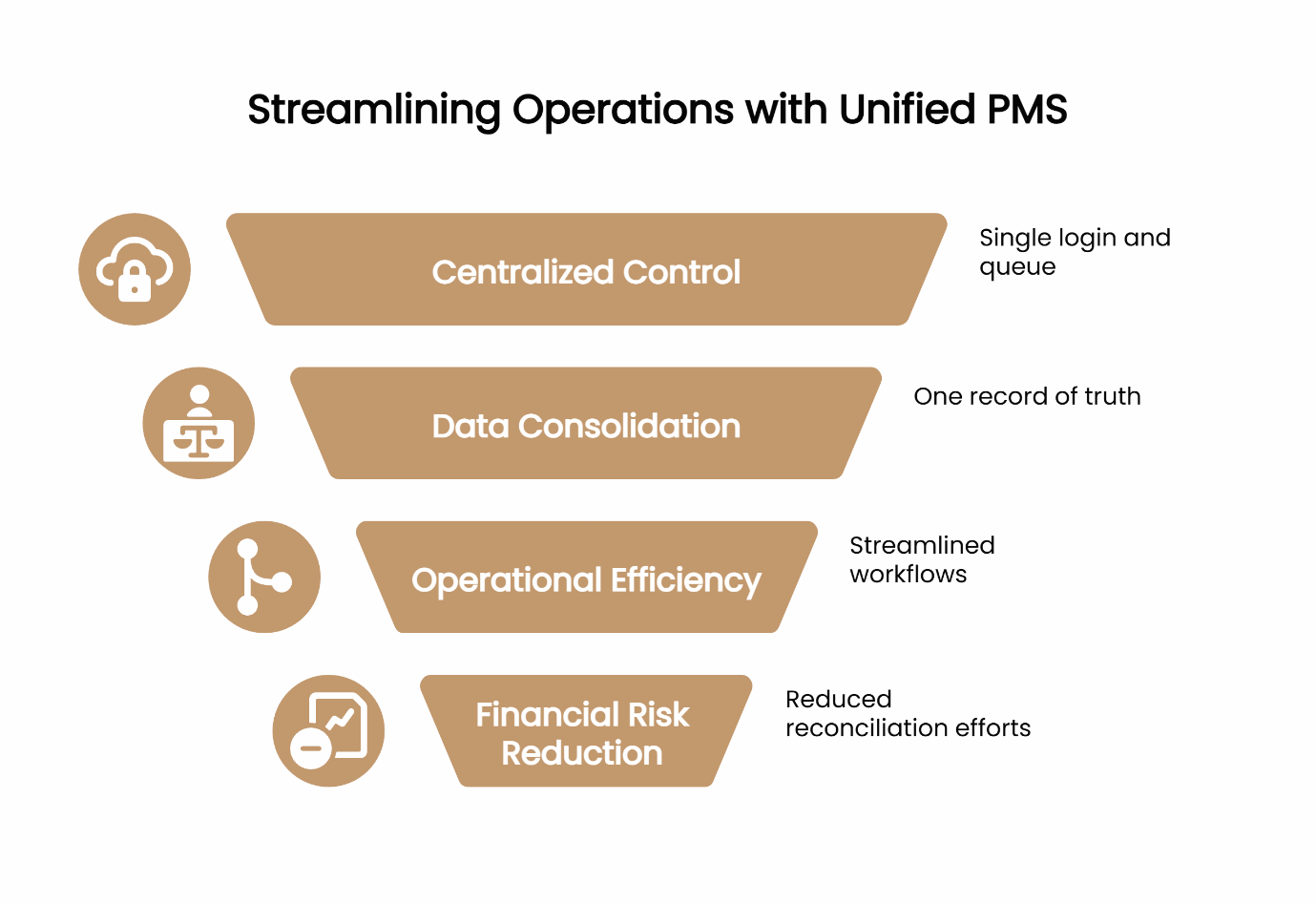
Start with the conclusion: an operating backbone improves predictability and reduces risk exposure. Then show the path. The alignment comes from making work observable and governed: one login, one queue, one record of truth.
Deep Dive: What "Unified" Actually Means
Definition: A unified PMS is the operating backbone that consolidates apps, workflows, and data across teams.
Analogy (illustrative): Think of the shift from isolated appliances to a smart home hub—central control and fewer points of failure.
Experience: Operations handles an amenity surge in one queue; Finance closes the month without reconciling three exports.
Action: Use the Business Case Template below to weight criteria, set thresholds, and agree go/no-go rules.
Integration That Actually Works
Professional event planning services managed by dedicated teams take the burden off property managers while creating the community experiences that drive retention. Instead of expecting your on-site staff to become event planners, graphic designers, and social media managers, a unified platform connects you with professionals who handle everything from marketing collateral to setup and breakdown—while tracking RSVPs and engagement metrics through the same system where residents book amenities and pay rent.
Properties using unified platforms gain valuable resident engagement insights that are not typically provided within traditional property management systems. These integrations allow seamless data flow between your existing ERP system and the unified platform, ensuring that resident data, lease information, and payment histories sync automatically—eliminating manual data entry and reconciliation errors.
Industry bodies regularly highlight technology's role in the multifamily resident experience, which ties to performance expectations at Class A communities (evidence resource: NMHC).
Which Metrics Prove NOI Impact Without Over-Promising?
Focus on Observable, Auditable Proxies
Cycle-time proxies: work order age, make-ready duration, amenity booking friction
Quality proxies: data integrity, export reconciliation exceptions, SLA adherence
Revenue levers: premium amenity utilization, reputation signals, renewal intention
Look, this is the part where most people get tripped up—promising savings they can't track. Anchor on observable, auditable proxies and link them to NOI conversations without inventing ROI figures.
When residents can book on-demand personal concierge services—from personal training to massage therapy, housekeeping to pet care—all through the same app where they manage their lease, properties see measurable increases in both ancillary revenue and renewal rates. The data shows exactly which services drive engagement and which amenities sit unused, allowing Finance to forecast revenue with confidence.
Multi-Stakeholder Business Case Template
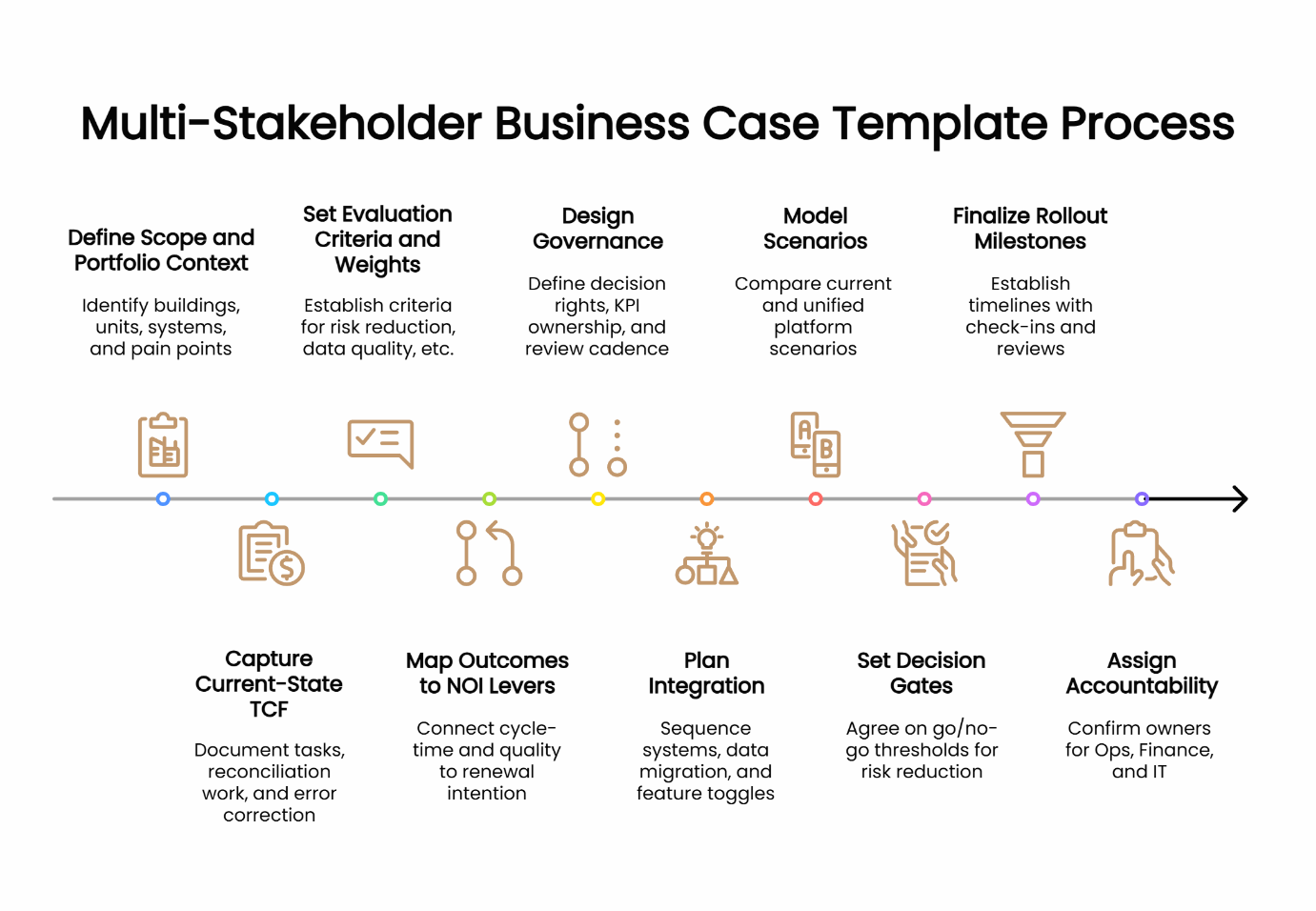
A unified PMS is a governed operating backbone that reduces risk and improves forecastability for Class A communities.
Use this numbered template to produce a decision-grade case:
1. Define scope and portfolio context. State buildings, units, current systems, and pain points (fragmentation, rework, experience variance).
2. Capture current-state TCF. Document duplicated tasks, monthly reconciliation work, context switching, and error correction. Include the number of separate apps residents currently need to download and the number of vendor relationships your team manages.
3. Set evaluation criteria (5–8) and weights. Illustrative set: risk reduction; data quality; resident experience; cycle-time improvement; total cost to operate; integration fit; governance clarity; change-management readiness.
4. Map outcomes to NOI levers. Tie cycle-time and quality proxies to renewal intention and service standards. Quantify potential ancillary revenue from on-demand services and premium amenity utilization.
5. Design governance. Define decision rights, KPI ownership, quarter-over-quarter review cadence, and security expectations.
6. Plan integration. Sequence systems, data migration, and feature toggles with rollback points. Specify which PMS integrations are required and confirm data synchronization requirements.
7. Model scenarios. Compare TCF (status quo with 7+ separate vendor relationships and apps) vs. unified platform (backbone with white-label branding) using the same time horizon and assumptions.
8. Set decision gates. Agree go/no-go thresholds (e.g., minimum risk reduction, required data-quality uplift, resident app consolidation targets).
9. Finalize rollout milestones. Establish quarter-based timelines with check-ins and value-realization reviews. Include resident onboarding communication plans and staff training schedules.
10. Assign accountability. Confirm owners for Ops, Finance, and IT for each workstream, including integration testing, data migration validation, and resident communication.
This template produces a board-ready, auditable case that reconciles Finance's risk/return lens with Operations' efficiency and experience goals.
Objections, Reframed: Finance, IT, and Ops
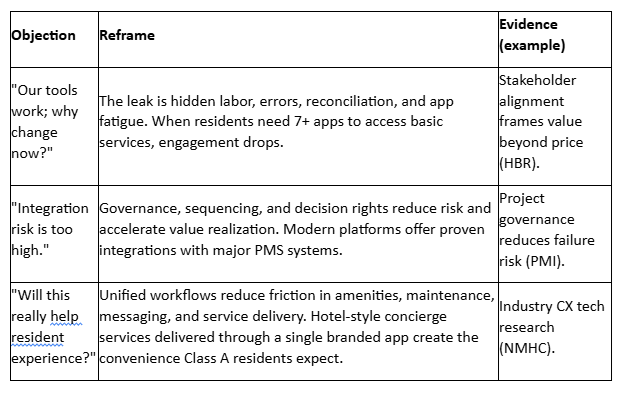
Expert Q&A (ElevateOS Insights Team)
Q: "How do we justify this if our current tools 'work'?"
A: Focus the case on hidden fragmentation costs (duplicated labor, errors, slow month-end, experience drag) and on risk reduction from data consistency and governance. Count how many separate apps your residents currently download and how many vendor relationships your team manages. That number alone often justifies consolidation.
Common Pitfalls To Avoid When Justifying a Unified PMS
Under-Measuring Fragmentation Costs
Only citing license fees ignores rework and churn indicators. Model TCF comprehensively—include resident app fatigue metrics, vendor management overhead, and reconciliation hours.
Vague Rollout Plans
Finance sees risk when integration and governance steps aren't explicit. Define decision rights and KPI owners from day one. Specify exactly how data will flow between your existing PMS and the new unified platform.
One-Stakeholder Case
Cases that don't reflect Finance + Ops + IT priorities stall approvals. Structure the case to answer each audience's lens. Operations needs to see workflow improvements and resident experience gains; Finance needs to see risk mitigation and NOI impact; IT needs to see integration architecture and security controls.
Myth & Fact
Myth: "Best-of-breed stacking always outperforms a unified platform."
Fact: In Class A operations, integration and governance costs compound quickly; unified platforms reduce waste and accelerate measurable outcomes. Properties report that residents overwhelmingly prefer one branded app over juggling multiple vendor apps—and the operational savings from managing one relationship instead of seven often exceed the cost of the unified platform itself.
What If… Planning for a Slipped Implementation Milestone
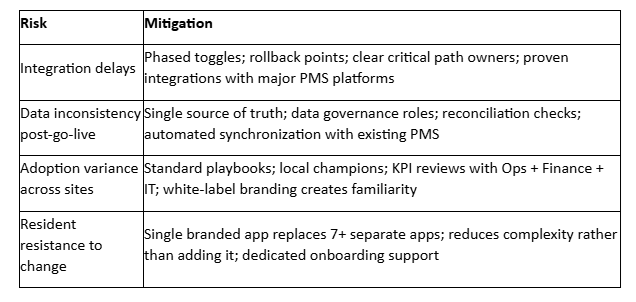
Delays happen; the risk is manageable with structure.
1. Re-baseline dependencies and critical path with Finance and IT.
2. Phase feature toggles to protect core workflows while new modules come online. For instance, migrate rent payment and maintenance requests first, then add amenity reservations and concierge services in subsequent phases.
3. Communicate a revised KPI cadence so month-end predictability remains intact.
Scene of the Crime → Witnesses → Suspect → Case Closed
Investigative Report (synthesized)
In the field, one often sees backlogs grow not from capacity shortfalls but from handoffs between tools. Finance reports the same phenomenon in forecasting when data arrives late or mismatched. IT identifies the prime suspect: uncontrolled integrations that create new failure points.
The case closes when a unified backbone replaces ad-hoc stacks with governed, measurable workflows—one login, one queue, one record. When residents access housekeeping, fitness classes, maintenance requests, amenity reservations, and package notifications all through the same white-labeled app that carries your property's branding, both operational friction and resident confusion disappear.
"This app was a game changer for our property management team. We use it at every property that we have and our residents love it. It has new features added all the time and the team behind ElevateOS is awesome to work with. Five stars all the way!"
— Nicole C (Google Reviews)
From Fragmentation To A Unified Living Ecosystem
The Operations lead returns to that boardroom screen. One platform. One data story. Month-end takes hours, not days; residents compliment smooth amenity access; Finance trusts the numbers. The transformation is tangible: from scattered tools to a Unified Living Ecosystem where Experience Flow is managed, measured, and improved.
The Platform Difference
Instead of residents downloading separate apps for each service, they access everything through one white-labeled app that carries your community's branding:
- Rent payment and maintenance requests integrate directly with your existing PMS
- Amenity reservations for fitness classes, guest suites, rooftop access, and event spaces
- Hotel-style concierge services including housekeeping, pet care, personal training, and massage therapy
- Professional event planning with your dedicated event manager handling marketing, setup, and breakdown
- Community engagement features including resident groups, local business perks, and neighborhood connections
This isn't just technology selection—it's operating model design. Or to be more precise, it's risk management that improves NOI by removing guesswork. No, it won't solve every challenge overnight—but with governance, weights, and decision gates, it will solve the right ones first.
Ready to Build a Decision-Grade Case?
- Schedule a Demo to see how a unified Property Management Software backbone operationalizes this framework
- Prefer a lighter first step? Calculate your potential revenue with a guided scenario model
Risk & Mitigation (Quick Reference)
Contextual Disclaimer
This article provides general information about evaluating unified Property Management Software investments for educational purposes. Individual circumstances vary significantly based on factors like portfolio size, integration landscape, and governance maturity. For guidance tailored to your community's operating model and approval process, consult with a qualified professional.
Our Editorial Process
Our expert team uses AI tools to help organize and structure our initial drafts. Every piece is then extensively rewritten, fact-checked, and enriched with first-hand insights and experiences by expert humans on our Insights Team to ensure accuracy and clarity.
About the ElevateOS Insights Team
The ElevateOS Insights Team is our dedicated engine for synthesizing complex topics into clear, helpful guides. While our content is thoroughly reviewed for clarity and accuracy, it is for informational purposes and should not replace professional advice.