.avif)
📌 Key Takeaways
Fragmented resident technology creates operational chaos that even well-intentioned property teams cannot overcome through effort alone.
- One Platform Replaces Operational Complexity: Consolidating rent payment, maintenance, amenities, packages, access control, and concierge services into a single branded app eliminates the coordination gaps that arise when residents and staff toggle between multiple disconnected systems.
- The Command Center Architecture Delivers Dual Benefits: Residents gain hospitality-grade convenience through one login for all building interactions, while property management teams access unified operational visibility that prevents service requests from slipping through fragmented workflows.
- Amenity Automation Accelerates Financial Returns: Moving conference rooms, guest suites, and fee-based spaces to automated booking with integrated payment typically increases utilization through reduced friction while eliminating manual coordination costs—delivering measurable ROI within the first 90 days.
- Security Architecture Becomes Foundational, Not Optional: Role-based access control, audit trails, proper data boundaries, and single sign-on protocols protect resident privacy while enabling the operational efficiency that unified platforms promise.
- The 30/60/90 Pilot Framework Validates Before Scaling: Starting with staff adoption, progressing to resident integration, and concluding with business case validation at one property establishes stable processes before portfolio-wide deployment—preventing the costly mistakes of premature expansion.
Unified platforms transform resident apps from utilities into operating systems that residents prefer using because convenience beats fragmentation.
Class A property managers and multifamily operators will find the strategic framework here, preparing them for the implementation details and operational considerations that follow.
Modern Class A Multifamily communities deserve technology that elevates the resident experience to hospitality-grade standards. When residents can manage their entire relationship with your property through one branded interface—paying rent, scheduling maintenance, booking premium amenities, and accessing concierge services—you're not just streamlining operations. You're securing asset value through predictable service delivery and deeper resident engagement.
Consider the difference a unified platform makes: A resident books the penthouse lounge for a private dinner with their personal chef, confirms guest access, and adjusts the lighting—all in under two minutes from their phone. The Property Management Team sees the reservation, access permissions, and service confirmations in one central dashboard, ensuring seamless execution. This is the hospitality standard that today's luxury communities can deliver through an all-in-one Command Center approach.
An All-in-One Resident App is a centralized, branded platform that unifies rent payment, maintenance coordination, package management, amenity reservations, access control, communications, and hotel-style concierge services—with one login for Residents and one operational dashboard for your Property Management Team. Think of it as the universal remote for your building, replacing the operational complexity of managing multiple separate vendor apps with one cohesive resident experience.
Elevating Service Through Unified Operations
When multiple disconnected systems handle daily interactions, even well-intentioned Property Management Teams face coordination gaps that affect service consistency. The challenge isn't technology adoption—it's technology fragmentation.
According to the 2024 NMHC & Grace Hill Renter Preferences Survey, technology convenience ranks among top priorities for renters selecting communities.[1] The survey reveals that high-speed internet and digital connectivity are non-negotiable for today's residents. While residents don't necessarily pay premium rents specifically for management apps, they do expect technology to work seamlessly as part of the overall value proposition. Properties offering integrated smart home features and reliable connectivity command stronger market positioning and can justify premium pricing as part of a comprehensive package.
The operational impact is measurable. When a simple request—checking package status, booking the fitness center, or scheduling maintenance—requires multiple logins and app switches, service delivery slows. Research on workplace productivity has documented that excessive context-switching between applications creates cognitive load and reduces efficiency for teams managing complex workflows. For Property Management Teams managing premium communities, this creates unnecessary operational complexity.
Consider the resident perspective. Someone paying premium rent expects to handle their building relationship through one intuitive interface—similar to how they manage banking, travel, or dining reservations. When residents must download separate apps for rent payment, amenity booking, package tracking, and community updates, each additional touchpoint creates another barrier to engagement. Multiple passwords, separate notification settings, and disconnected experiences undermine the premium positioning of Class A communities.
The NMHC 2023 Customer Experience Technology Report documented how tool sprawl across multiple resident touchpoints creates confusion and reduces platform adoption.[2] When residents can't easily access services available to all residents, usage declines. Amenity spaces go underutilized. Community events experience lower attendance. Technology investments deliver diminishing returns.
For Property Management Teams, operational complexity compounds. Every additional platform means duplicate data entry, separate vendor relationships, and potential coordination gaps between systems. This is why leading properties are orchestrating a different model—treating the resident app as the central operating system for the entire building rather than as another point solution. Understanding why multiple resident apps undermine your community's experience flow is the first step toward elevating service delivery.
The Command Center Model: One Platform, Hospitality-Grade Service
An all-in-one resident app functions as your building's Command Center—a single interface that unifies every resident-facing service while giving your Property Management Team complete operational visibility.
The architecture delivers both resident convenience and operational clarity. Residents access everything through one branded application with a single login: pay rent, submit maintenance requests, reserve amenities, track packages, view community announcements, and book hotel-style concierge services. All interactions flow through a unified dashboard that feels like using any premium consumer app.
For your Property Management Team, the back-end management portal provides real-time operational oversight. Work orders, amenity reservations, package deliveries, access events, and resident communications appear in one central view. This consolidation replaces checking multiple separate systems with one unified operations feed, ensuring nothing slips through coordination gaps.
Key Platform Capabilities:
• Consolidated Experience: Replaces multiple separate apps with one branded platform, reducing resident app fatigue while increasing engagement. Many Class A properties find themselves managing five to ten different resident-facing platforms, though specific configurations vary by property.
• Hospitality-Grade Services: Integrates hotel-style concierge offerings (housekeeping, fitness classes, pet care, lifestyle services) directly into the resident experience
• Professional Event Management: Dedicated event planning team delivers community experiences that strengthen resident connections
• Real-Time Visibility: Management portal provides instant oversight of all operations, from maintenance to amenities to service requests
This unified architecture enables consistent service delivery across every touchpoint. When all resident requests flow through a single system, your team establishes clear response standards and actually tracks them. A maintenance request receives the same operational attention and visibility as an amenity booking or package inquiry. Nothing gets lost in coordination gaps between disconnected systems.
The operations dashboard becomes what we call the Operations Control Room—a single screen showing your team exactly what needs attention, what's on track, and where service delivery might benefit from proactive intervention. Peak periods like move-in season or holiday package rushes become manageable because everyone works from the same real-time information.
This consolidation delivers immediate operational advantages. When a resident contacts your team about any matter, the staff member assisting them sees full context instantly—recent maintenance history, amenity usage patterns, package deliveries, communication preferences—all in one place. Interactions become more personalized and efficient because information isn't scattered across multiple systems.
The architecture scales gracefully as you add services or integrate building systems. Access control, smart home features, package management capabilities, and lifestyle concierge services—all accessible through the same familiar interface residents already use daily.
Selecting the Right Architecture for Your Portfolio
Property owners face a strategic decision when elevating resident technology: build a custom platform, acquire individual solutions and integrate them, or adopt a unified system designed for hospitality-grade multifamily service.
Building custom platforms offers maximum control but requires sustained investment in product development, security, regulatory compliance, and ongoing integration with property management systems and access control platforms. Most importantly, it diverts technical resources from core operations—managing premium communities—into running a software development organization.
The acquire-and-integrate approach appears efficient initially: selecting proven solutions for each function. The challenge emerges at the integration layer. When package tracking doesn't sync properly with communications, or amenity bookings can't trigger automated access control, coordination gaps frustrate residents and create additional work for Property Management Teams. The NMHC research on customer experience technology highlighted these integration challenges as a primary source of operational complexity.[2]
Each point solution also brings separate vendor relationships, contract terms, and technical requirements. Your team becomes the integration layer, manually bridging gaps between systems that weren't designed to work together.
The unified approach treats these challenges as architectural decisions to solve once, centrally. When evaluating unified platforms, focus on three key factors: total cost of ownership, integration reliability, and data governance boundaries.
Total cost of ownership extends beyond subscription fees to include implementation time, training requirements, ongoing vendor management, and staff time managing multiple systems. A unified platform may have higher visible pricing but lower actual cost when accounting for operational efficiency gains.
Integration reliability means understanding how data flows between systems. The platform should integrate natively with your property management system through standards-based protocols. NIST's Digital Identity Guidelines (currently evolving through Special Publication 800-63-4) provide frameworks for evaluating authentication and access control integration, emphasizing proper identity assurance levels for residential platforms.[4] As these guidelines continue development and industry adoption, they offer valuable reference points for evaluating security architecture.
Data governance boundaries determine what information the platform reads versus writes back to your source systems. Well-designed integration maintains your PMS as the authoritative source for financial and lease data while allowing the resident platform to orchestrate communication, service requests, and amenity management. We've explored these integration considerations in depth, including how single sign-on and proper data boundaries reduce implementation risk.
Security architecture is foundational. Look for platforms implementing role-based access control, detailed audit trails, and least-privilege principles—where users and integrations access only the specific data required for their function. Modern platforms should support single sign-on, reducing password complexity while improving security through centralized access management.
The decision ultimately reflects strategic priorities. Building and maintaining integrated systems requires sustained technical expertise. For most property management organizations, this lies outside core competencies. A unified platform lets you focus on resident experience and community operations while specialists handle technical complexity at scale.
Four Pillars of Premium Resident Experience
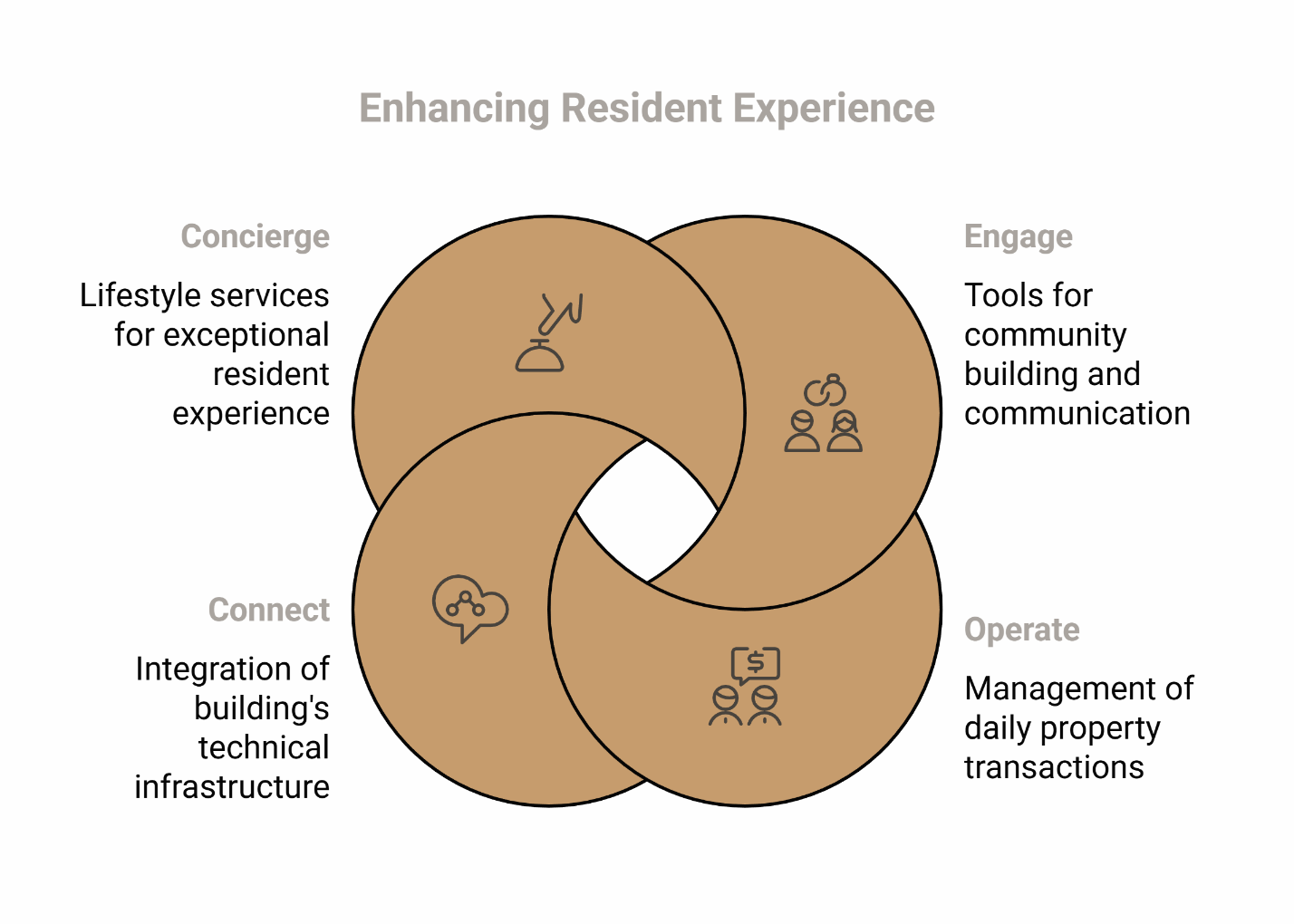
Effective unified platforms organize functionality around four core pillars that together deliver hospitality-grade service.
Engage encompasses tools that build community and maintain consistent communication. This includes social feeds where neighbors connect over shared interests, event calendars for resident activities and experiences, group messaging for community discussions, and announcement systems ensuring important information reaches all residents equitably. The engagement layer transforms your building from individual units into an actual community where people feel connected.
Operate handles fundamental transactions and requests of daily property life. Rent payment processing, maintenance request management, amenity reservations, document storage for lease agreements and community guidelines—these operational tools form the backbone of resident-property interaction. When these core functions work smoothly through one interface, residents experience notably less friction in daily routines.
The amenity reservation tool deserves particular attention as it often delivers fastest return on investment. Automating conference room bookings, guest suite reservations, and fitness class sign-ups eliminates coordination overhead while making amenities more accessible to all residents, increasing perceived value and justifying premium positioning.
Connect brings together the building's technical infrastructure into one interface. Access control integration means residents use the app to grant guest access or open parking gates. Package locker connectivity delivers instant notifications and retrieval codes. Smart home features—thermostats, locks, lighting—become manageable through the same app residents already use daily. This integration layer is where the platform truly becomes a Command Center, unifying physical and digital building systems.
Concierge elevates resident experience from functional to exceptional by incorporating lifestyle services directly into the platform. This includes hotel-style offerings like housekeeping, personal training through fitness programs, pet care services and handyman assistance—all available to residents and bookable through the same app used for rent payment. Rather than residents finding and vetting service providers independently, you're offering a curated marketplace of trusted vendors.
The concierge layer creates two strategic advantages. First, it generates ancillary revenue streams that directly improve net operating income. When residents book services through the platform, properties typically receive revenue participation. Second, it dramatically increases app engagement. Residents who might open a basic utility app once or twice monthly will engage multiple times weekly when it also handles their cleaning service, fitness classes, and pet care.
Understanding the Strategic Difference
To clarify the distinction between basic utility and true service differentiation:
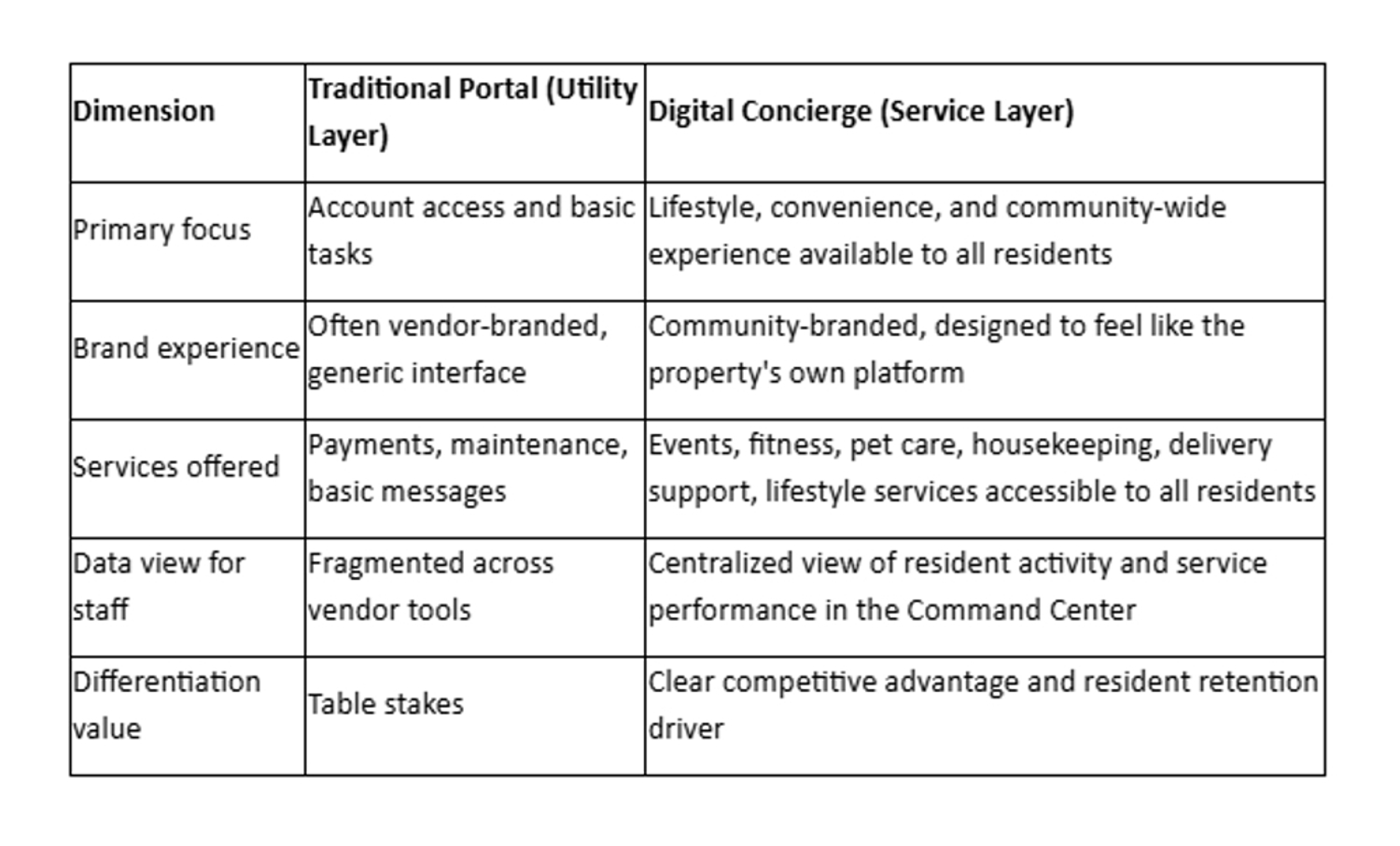
This is what we mean by treating the resident app as an operating system rather than a utility. The four pillars working together create an experience where residents genuinely prefer handling everything through your platform—not because they're required to, but because it's more convenient than alternatives.
Implementing Your Unified Platform: 30/60/90 Framework
Implementing a unified platform doesn't require enterprise-wide transformation on day one. Leading property groups pilot the system at one community, validate the model with measurable results, then standardize rollout across their portfolio.
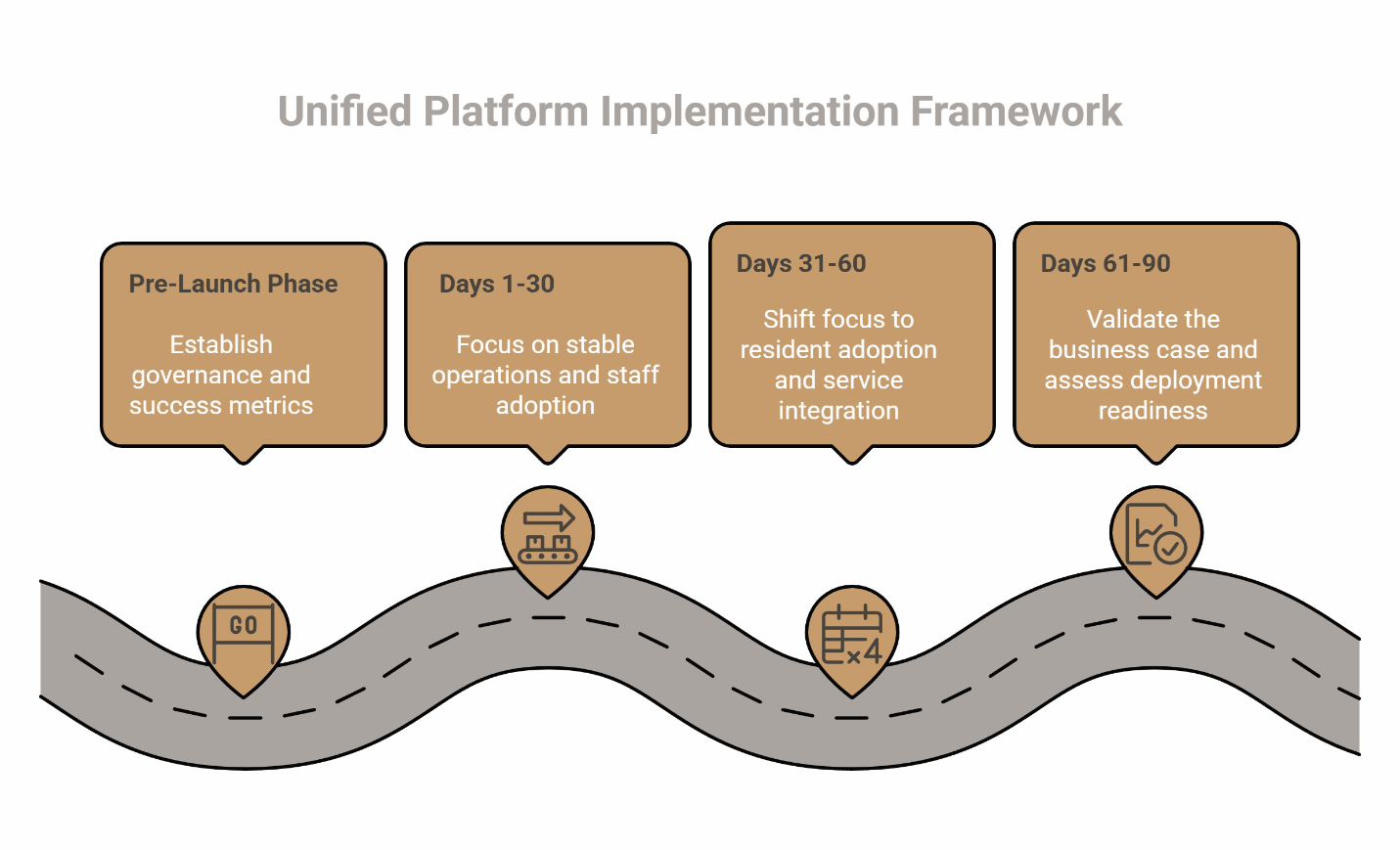
The pre-launch phase—before pilot activation—establishes successful implementations. This is when you define governance structures, establish service level standards, and set clear success metrics. Who owns service recovery when coordination gaps occur? What's the target response time for maintenance requests logged through the platform? How will you measure resident adoption and satisfaction?
These questions need answers before launch because changing them during execution creates confusion. Establish a steering committee with representatives from operations, IT, and property management. Give them clear decision-making authority so matters don't stall awaiting consensus from stakeholders not involved daily.
Days 1-30 focus on stable operations and staff adoption. Your on-site team masters the management portal before asking residents to change habits. Run daily check-ins to identify friction points. Do maintenance requests route correctly? Is the amenity booking workflow intuitive? Do staff members understand responding to package inquiries through the unified feed?
This first month perfects your resident communication strategy. Create simple guides showing residents how to download the app, set up accounts, and complete first key tasks. Focus on the three most common use cases—typically rent payment, maintenance requests, and package notifications—and make those workflows completely frictionless.
Days 31-60 shift focus to resident adoption and initial service integration. Track leading indicators: app download rate, percentage of rent payments processed through the platform, number of maintenance requests submitted digitally. These metrics reveal whether residents are actually shifting behavior.
This phase integrates the first wave of building systems—typically package lockers and basic access control. Each integration goes through testing where staff verify connections work reliably before promoting to residents. Nothing undermines platform credibility faster than residents following app instructions only to discover systems didn't sync properly.
Days 61-90 validate the business case. By now you should have sufficient data to calculate actual operational efficiency gains. How much time is your leasing team saving by not manually coordinating amenity tours? What percentage reduction have you seen in maintenance follow-up calls because residents check request status in-app? Has package-related confusion decreased now that residents receive real-time notifications?
This is when you assess portfolio-wide deployment readiness. The key question isn't whether everything is perfect—it won't be—but whether you've established stable processes for handling common situations and whether the core value proposition is clear to residents and staff.
At day 90, conduct a formal assessment. If the pilot property shows improved operational metrics, positive resident feedback, and your team feels confident managing the platform, begin standardized rollout. If significant matters remain unresolved, extend the pilot phase and address them before expanding. Properties moving from pilot to full portfolio deployment succeed by taking this disciplined approach.
Amenity Management: Accelerating Return on Investment
If you're seeking one area where a unified platform delivers immediate, measurable financial returns, focus on automating amenity management.
Traditional amenity booking—email requests, phone calls, or separate calendar systems—creates hidden operational costs. Staff time coordinating reservations, following up on payments, and handling scheduling conflicts represents real labor expense. Underutilization of premium amenity spaces represents lost revenue opportunity. Both stem from friction in the booking process.
When amenity reservations move into the resident app with automated booking and payment, utilization typically increases significantly. The reason is straightforward: convenience drives behavior. A resident who might not email to reserve the party room for a celebration will gladly book it when the process takes thirty seconds on their phone.
The financial mechanics work favorably. Guest suites, party rooms, and other fee-based amenities can generate meaningful revenue when properly marketed and made easily accessible to all residents. Properties often see bookings increase by double-digit percentages simply by reducing reservation friction. When you combine increased usage with automated payment collection—eliminating manual invoicing or payment follow-up—the operational efficiency gain compounds the revenue benefit.
Access control integration adds another strategic layer. When a resident books the conference room, the system automatically grants them access for that time block and revokes it afterward. This eliminates key exchange processes while improving security.
The amenity management module also provides valuable operational data. Which spaces are most popular and at what times? Are there patterns suggesting premium rates for peak hours? Is the yoga studio underutilized most afternoons, suggesting opportunity for fitness class programming?
This data-driven approach to amenity management transforms spaces from passive features into active revenue generators. You can test different pricing models, offer promotional rates during slower periods, and make informed decisions about which amenity investments deliver strongest returns.
For properties beginning their unified platform journey, starting with amenity management offers a strategic entry point. The integration is typically straightforward since it doesn't require deep connections to financial systems. The benefits become visible quickly to both staff and residents. And the positive experience builds momentum for expanding to other platform features.
Driving Platform Adoption Across Your Community
Technical implementation is half the equation. The other half is shifting resident and Property Management Team behavior so the unified platform becomes everyone's default choice for building interactions.
Start with authentication. Single sign-on integration with your property management system means residents set up accounts once and credentials work across all building systems. This seemingly small convenience dramatically improves adoption—one password, one login that works everywhere. For properties concerned about security, modern SSO implementations actually improve protection by centralizing access management and enabling stronger authentication methods.[4]
The onboarding experience for new residents is your highest-leverage moment. During lease signing, app setup should be a standard part of moving in—equivalent to receiving keys or parking passes. Train leasing staff to walk every new resident through downloading the app, completing their profile, and successfully executing one key task like scheduling their move-in inspection or submitting their first rent payment.
This hands-on approach during onboarding creates early success experiences that build confidence. A resident who successfully uses the app on day one will turn to it instinctively for future needs.
In-app announcements become your primary communication channel once you have critical mass. Rather than hoping residents read emails or check bulletin boards, you can send push notifications for important updates—building maintenance schedules, upcoming events, policy changes. The key is using this channel judiciously. Reserve push notifications for truly important or time-sensitive information.
Physical prompts throughout the building reinforce behavior. QR codes near amenity spaces that open directly to the booking page. Signs by package lockers directing residents to check the app for notifications. Door hangers after maintenance visits asking residents to confirm completion through the app. These environmental cues help residents build new habits.
Community features drive organic engagement. When residents can use the app to join interest groups—dog owners, runners, parents of young children—they start opening it for social reasons, not just transactions. This social layer transforms the app from a utility into a destination. Properties where resident-organized groups for everything from book clubs to fitness activities become highly active see daily app engagement far beyond basic property management tasks.
Events serve similar functions. When your property hosts resident activities—fitness classes, social gatherings, educational workshops—and promotes them through the app with easy RSVP functionality, attendance improves and the platform becomes associated with positive community experiences.
For staff adoption, change management is equally important. Your team will initially be tempted to accommodate residents who prefer old communication methods—handling amenity bookings via email or taking maintenance requests by phone. While some flexibility is reasonable during transition, you need to steadily shift expectations so using the platform becomes standard.
Train staff to gently redirect: "I can help you with that reservation right now, but for next time, you can book it yourself instantly through the app—let me show you how." This approach assists residents while reinforcing desired behavior. Over time, as staff experience the operational efficiency of unified workflows, they become the platform's strongest advocates.
Establishing Security and Operational Guardrails
Consolidating resident data and building systems into a unified platform creates significant convenience while concentrating operational responsibility. Proper security architecture isn't optional—it's foundational to protecting resident privacy and maintaining service predictability.
Role-based visibility forms the first protection layer. Leasing staff might need access to prospective resident information and tour scheduling but shouldn't view maintenance histories or financial records. Maintenance technicians need work orders and unit access but don't require visibility into payment information. The platform should enforce these boundaries automatically based on job function.
Audit trails provide accountability and service recovery capabilities. Every action—who accessed which records, what changes were made, when access occurred—should be logged and retained. This visibility serves multiple purposes: identifying potential security concerns, troubleshooting operational matters, and demonstrating compliance with data protection requirements.
Least-privilege principles extend to system integrations. When your resident platform connects to property management systems, access control hardware, or package lockers, those integrations should only read and write the specific data required for their function. A package notification integration doesn't need access to rent payment histories.
Single sign-on, implemented properly, actually improves security despite seeming counterintuitive. Rather than managing multiple passwords across various systems—which leads residents to reuse weak passwords—SSO centralizes authentication where you can enforce strong standards. Modern implementations support multi-factor authentication, adding verification layers for sensitive actions like updating payment methods.
Emerging frameworks for digital identity management provide guidance for implementing appropriate authentication assurance levels based on risk.[4] For routine tasks like checking package notifications, basic authentication suffices. For financial transactions or access control, stronger verification makes sense. The platform should apply these standards automatically based on action sensitivity.
Data encryption in transit and at rest protects information even if other security layers fail. When a resident submits a maintenance request from their phone, that data should be encrypted during transmission and remain encrypted in storage. This defense-in-depth approach means that a security event at one layer doesn't automatically compromise all information.
Regular security assessments—both automated scanning and periodic professional audits—help identify vulnerabilities before they're exploited. This is particularly important as the platform evolves with new features and integrations.
Resident transparency builds trust. Clear privacy policies explaining what data you collect, how it's used, and who has access help residents feel comfortable engaging with the platform. Giving residents control over certain aspects of their data—like communication preferences—respects their autonomy while enabling core platform functionality.
These security measures aren't obstacles—they're foundational to building a platform that residents and staff can rely on for sensitive transactions and personal information. Properties that prioritize security from the beginning avoid the far more expensive challenge of rebuilding trust after a security incident.
Assessing Your Portfolio's Readiness
Use this assessment to determine whether your communities would benefit from moving to a unified Command Center approach:
☐ Multiple Login Points: Do residents currently need three or more separate logins to handle basic building interactions?
☐ Duplicate Data Entry: Does your staff regularly enter the same information into multiple systems, or manually reconcile data between platforms?
☐ Service Coordination Gaps: Are there resident requests that sometimes slip through coordination gaps because they arrive through channels that aren't properly monitored?
☐ Manual Amenity Coordination: Do you still coordinate amenity reservations through email or phone rather than automated systems?
☐ Package Complexity: Do package-related inquiries consume significant staff time because notification and tracking systems aren't integrated?
☐ Access Control Friction: Do residents need to contact the office for temporary access codes or guest entry rather than managing through self-service?
☐ Scattered Communication: Do you struggle to reach all residents reliably because communication happens across email, text, physical notices, and different apps?
☐ Integration Coordination Gaps: Do you regularly discover that updates made in one system didn't sync properly to another, creating resident confusion or service gaps?
☐ Underutilized Amenities: Are premium amenity spaces sitting empty because the booking process is too complex?
☐ Staff Tool Complexity: Would your Property Management Team describe their daily work as constantly switching between too many different systems?
If you identified five or more areas for improvement, operational complexity from fragmented systems is likely affecting staff efficiency, resident satisfaction, and revenue opportunities. A unified platform approach would address these matters directly.
If you identified eight or more areas, fragmentation has become a significant operational challenge. Properties starting from this position typically see the most dramatic improvements after consolidating onto a unified Command Center.
Frequently Asked Questions
What makes a resident app a "Command Center" instead of just another portal?
A Command Center unifies all resident-facing services and staff operations into one branded interface with single sign-on access. Unlike traditional portals handling only basic transactions, a Command Center integrates rent payment, maintenance requests, amenity bookings, package management, access control, community communications, and hospitality-grade lifestyle services—all available to residents equitably. For staff, it provides a unified operations feed with consistent service standards across all touchpoints rather than requiring them to monitor multiple disconnected systems.
How does consolidation actually improve resident satisfaction?
Reducing tool sprawl directly addresses friction residents experience in daily interactions with your property. Research from the 2024 NMHC & Grace Hill Renter Preferences Survey shows that technology convenience ranks among top priorities when selecting communities.[1] The survey confirms that residents value high-speed internet and digital connectivity as fundamental expectations. When residents handle their entire building relationship through one familiar app—similar to banking or dining reservations—rather than juggling multiple logins and interfaces, their experience improves measurably. The convenience factor drives higher engagement with amenities and services available to all residents, increasing perceived value and strengthening retention.
Will a unified platform integrate with our existing property management system and access control?
Modern unified platforms use standards-based integration protocols designed specifically for Multifamily environments. The platform should connect to your PMS through documented APIs, maintaining your PMS as the authoritative source for financial and lease data while orchestrating communication and service coordination. For access control, look for platforms with pre-built connectors to major providers. Emerging digital identity frameworks provide guidance for evaluating proper authentication integration, emphasizing appropriate assurance levels for different functions.[4] The critical consideration is data boundaries—understanding exactly what the platform reads versus writes back to your core systems to prevent synchronization issues.
How do we demonstrate return on investment quickly?
Start with amenity automation. When you move conference rooms, guest suites, and other fee-based spaces to automated booking with integrated payment, you typically see immediate results: increased utilization from reduced booking friction, staff time savings from eliminating manual coordination, and improved revenue collection through automated payment processing. These benefits are measurable within the first 90 days and often generate sufficient return to justify the platform investment before you've even expanded to other features. The operational efficiency gains across maintenance, package management, and communication provide additional long-term value.
How are lifestyle concierge services made accessible to all residents?
Adoption of concierge services—housekeeping, fitness training, pet care, personal assistance—rises significantly when offered in-app rather than through separate vendor relationships residents must establish independently. These services are available to all residents equitably, with booking managed through policies ensuring fair access. The convenience of booking trusted, vetted providers through an interface residents already use daily for other building interactions removes friction that prevents many residents from seeking these services otherwise. Properties report that making concierge services easily accessible within the resident app both increases usage and generates ancillary revenue streams that directly improve net operating income.
Ready to elevate your portfolio's resident experience to hospitality-grade standards? Talk to our team about designing a unified resident service platform for your Class A communities. Schedule a strategic consultation to explore how consolidating operations into one Command Center can streamline your property operations, strengthen resident satisfaction, and unlock new revenue opportunities—or access our portfolio readiness assessment to evaluate your communities' current operational architecture.
Disclaimer: This article provides general information about unified resident experience platforms and property management technology. Specific implementation requirements, integration capabilities, and security considerations vary based on your property's existing systems, local regulations, and operational needs. Consult with qualified technology advisors and legal counsel to ensure any platform changes comply with applicable data protection, fair housing, and accessibility requirements.
Our Editorial Process
Content from the ElevateOS Insights Team is developed using a combination of internal expertise, customer feedback, and reputable third-party research. Articles are reviewed for clarity and accuracy at the time of publication, but technology, regulations, and market conditions change quickly. Where data or sources are cited, readers should verify whether more recent information is available.
About the ElevateOS Insights Team — Our team turns complex topics in multifamily operations, resident experience, and proptech into clear, practical guides. While every piece is carefully reviewed, our content is intended to support—not replace—the judgment of experienced property professionals and their advisors.
References:
[1] National Multifamily Housing Council & Grace Hill. (2024). 2024 NMHC & Grace Hill Renter Preferences Survey Report.
[2] National Multifamily Housing Council. (2023). Customer Experience (CX) Technology Report.
[3] National Institute of Standards and Technology. NIST Special Publication 800-63 Series: Digital Identity Guidelines. (Note: Revision 4 is currently under development and review as industry standards continue to evolve.)