.avif)

📌 Key Takeaways
Clubhouse activation requires operational systems, not additional staff—automate logistics, partner for programming, and empower resident-led clubs.
- Systems Beat Headcount: Self-serve booking rules, automated reminders, and vendor partnerships eliminate coordination friction without expanding payroll.
- Two-Week Setup, Three-Month Adoption: Implement the operational foundation in 14 days; community habits form over the following 60 to 90 days.
- Vendor Partnerships Need Risk Management: Collect Certificates of Insurance, require liability waivers for physical activities, and consult legal counsel before launching programming.
- Free Access Plus Paid Exclusivity: Keep daily clubhouse use free for all residents; charge only for private exclusive bookings to generate revenue without backlash.
- Five Formats Run Themselves: Resident-led book clubs, bring-your-own game nights, quiet coworking hours, potlucks, and vendor pop-ups require zero staff supervision.
Install the system in weeks; grow the culture in months.
Property managers at Class A communities seeking operational efficiency will find tactical implementation steps here, setting up the 14-day activation plan that follows.
The clubhouse sits empty. Again.
You walk past it every morning, noting the pristine furniture nobody sits on and the calendar with nothing but "Available" slots stretching into next month. The space was supposed to build community. Instead, it's become an expensive storage room with good lighting.
Here's what most property management teams get wrong: they assume an empty clubhouse means they need more staff to fill it. More event coordinators. More programming. More hours dedicated to planning, promoting, and cleaning up afterward.
That assumption is backwards.
"Clubhouse activation" means running governed, repeatable programming supported by self-serve systems that make the space easy to use, book, and love. Think of it like an operating system: if the rules are unclear, booking is clunky, and promotion is manual, the clubhouse will feel "off" no matter how hardworking your property management team is.
When you install that operating system, something shifts. The empty room with dusty board games becomes a calendar residents actually check. Private bookings generate revenue. Recurring events build the kind of social fabric that drives lease renewals.
You can implement the operational foundation in two weeks—the booking systems, vendor partnerships, and communication workflows that make activation possible. Community habit formation takes longer, typically 60 to 90 days as residents discover the new rhythm and recurring events establish themselves. The framework itself installs quickly; the culture it enables grows steadily.
The secret is a three-lever framework: Automate the logistics, Partner for programming, and Empower residents to lead.
Why Most Clubhouses Stay Empty (And It's Not About Staffing)
The real problem is friction combined with unclear ownership and inconsistent programming.
Consider what happens when a resident wants to book the clubhouse for a birthday party. They email the leasing office. Someone checks the shared calendar (assuming it's updated). Another email confirms availability. A third email explains the deposit process. Someone has to hand off a key or provide access. After the event, staff inspects the space.
That's six touchpoints for one booking. If any step breaks down, the resident gives up and books a restaurant instead.
Now multiply that friction across every potential use. Game nights that never get scheduled because nobody knows who's responsible. Fitness classes that happened once but never recurred because the instructor coordination fell apart. Interest groups that formed in the elevator but never found a consistent meeting space.
The clubhouse isn't underutilized because residents don't want community. It's underutilized because the path to using it requires too much effort from everyone involved.
The Three-Lever Self-Running Clubhouse Framework
Activating your clubhouse without adding staff requires working smarter across three distinct areas.
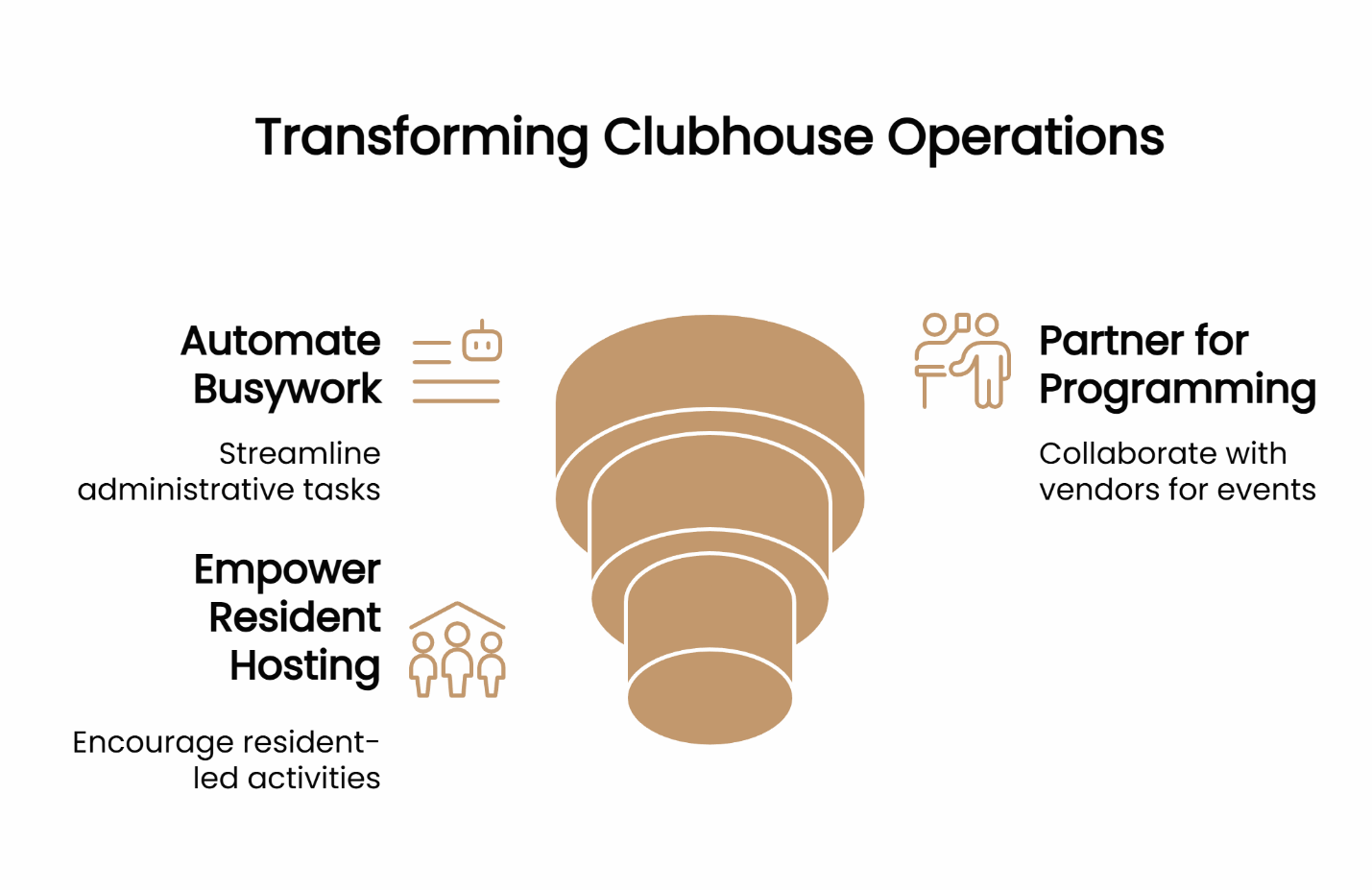
Lever 1: Automate the Busywork
Every manual task you eliminate is time your team reclaims. Booking rules should be self-serve, with clear time blocks, buffer periods between reservations, and automated deposit collection. Confirmation emails, reminder notifications, and post-event follow-ups should happen without anyone clicking "send."
A management portal that replaces spreadsheets and manual calendars transforms clubhouse operations from a coordination headache into a background process. Operational efficiency improvements allow property teams to redirect administrative hours toward higher-value resident interactions while maintaining consistent service standards.
For reservable spaces like party rooms, clubrooms, and guest suites, an amenity reservation tool creates consistent booking experiences that residents can navigate without assistance.
Lever 2: Partner for Programming
You don't need to become an event planner. You need vendors who want access to your residents.
Local fitness instructors, wine shops, pet stores, financial advisors, and wellness practitioners all share one goal: reaching potential customers in a trusted environment. Your clubhouse offers exactly that. They bring the content, expertise, and often the supplies. You provide the space and the audience.
This approach to events and experiences reduces the burden on on-site teams, delivering professional programming without professional event staff. The key is establishing a predictable cadence. Monthly wine tastings. Bi-weekly yoga sessions. Quarterly financial wellness workshops. Vendors commit when they know what to expect.
U.S. federal fair housing regulations address discrimination in terms, conditions, privileges, and access to services and facilities. Your vendor programming process should avoid selective access or inconsistent availability to ensure fair treatment for all residents.
Lever 3: Empower Residents to Host
Your residents include book lovers, board game enthusiasts, young professionals seeking networking, and parents wanting playdates. These people will organize themselves if you remove the barriers.
Create a simple process for resident-led clubs. Provide a recurring time slot. Handle the booking logistics automatically. Promote the groups through your community communication channels. Then step back.
"You don't need a party planner; you need a facilitator."
Properties that prioritize resident engagement often see stronger retention patterns, as residents who invest energy in building community become invested in staying. This amenity management approach turns shared spaces into community hubs by making participation effortless rather than adding staff supervision.
A 14-Day Activation Plan (No New Headcount)
This plan establishes the operational foundation. Resident adoption and community habit formation typically unfold over the following 60 to 90 days as recurring events establish themselves and word spreads. Adapt timelines based on your specific situation.

1. Audit the space (Days 1-2): Document capacity limits, furniture configuration options, technology available (Wi-Fi strength, screen connectivity), and noise considerations for adjacent units. Identify what's working and what creates friction. If the room is "flex space," define two standard layouts (social, coworking) so setup is predictable.
2. Install self-serve booking rules (Days 3-5): Define available time blocks, minimum booking windows, maximum duration, cleaning buffer periods, and deposit requirements. Decide where deposits apply—for example, "private booking" requires a deposit and agreement checkbox while "open lounge hours" requires nothing. An amenity reservation tool can handle this systematically. Learn how to automate amenity reservations step-by-step for detailed implementation guidance.
3. Publish a repeatable monthly calendar (Days 6-8): Start with two to three recurring formats. A weekly coworking block. A monthly social event. A bi-weekly fitness class. Consistency matters more than variety at this stage. Pick predictable, high-attendance formats: "First Tuesday: Game Night," "Every Wednesday: Quiet Coworking," "Third Saturday: Vendor Pop-up."
4. Launch with two low-lift events (Days 9-11): Choose formats with predictable attendance and minimal setup. Coffee and conversation on a Saturday morning. A weeknight game night where residents bring their own games. "Bring-your-own game night" plus "quiet coworking hours" is often enough to create early momentum.
5. Automate promotion and RSVPs (Days 12-13): Consolidate communication into one channel. Automated reminders reduce no-shows—research consistently shows measurable reductions in missed commitments when reminder systems are used. Waitlists capture overflow interest and demonstrate demand. Understanding why app sprawl hurts adoption and community engagement helps explain why consolidation matters.
6. Measure and adjust (Day 14 and ongoing): Track usage rates, no-show percentages, resident feedback, and revenue from paid bookings. Adjust time slots, formats, and promotion based on what the data reveals. Expect usage to build gradually over the subsequent two to three months as awareness spreads and habits form.
Five Self-Running Clubhouse Events (Zero Staff Supervision Required)
These formats work because residents handle the participation while your systems handle the logistics.
Resident-led book club: One resident volunteers to select monthly reads and facilitate discussion. You provide the recurring reservation and promote through community channels. Recurring, same day and time monthly creates reliable habits.
Game night (bring-your-own): Residents bring board games, card games, or video game consoles. No prizes, no structure, no staff presence needed. Just an open room at a predictable time. Low setup, social, and repeatable.
Potluck with community signup sheet: Residents coordinate dishes through a shared document. You provide the space and basic supplies (plates, napkins, serving utensils). Community members handle everything else. Clear cleanup rules plus shared responsibility make this sustainable.
Quiet coworking hours: Designate recurring blocks for laptop-friendly, low-conversation use. Remote workers and students will self-organize around reliable availability. Simple "house rules" and a predictable cadence are all you need.
Local vendor pop-up: A neighborhood bakery, florist, or artisan showcases products. The vendor handles setup, sales, and breakdown. Residents get convenient access to local businesses. You facilitate the connection and host the space while the vendor runs the experience.
Vendor Partnership Playbook
Make vendor programming predictable, compliant, and easy to repeat.
Successful vendor partnerships require understanding what both parties gain. Vendors want predictable access to potential customers in a trusted setting. They want enough lead time to prepare and promote. They want clarity on what you provide (space, basic setup, audience communication) versus what they provide (content, supplies, staffing).
You want programming that requires minimal coordination, adds value for residents, and maintains equal access for all community members. Fair housing considerations mean any vendor-provided services or events must be available to all residents equally, not offered selectively.
Offer vendors a monthly cadence and a clear "what we provide / what you provide" checklist so nobody improvises. Promote the opportunity consistently across the community, avoid "exclusive" access for a subset of residents, and use the same RSVP flow and space rules every time.
Risk Management Essentials
Vendor partnerships introduce liability considerations that automated systems cannot eliminate. Before any vendor operates in your clubhouse, establish clear risk management protocols:
Insurance verification: Collect current Certificates of Insurance (COI) from all vendors showing general liability coverage. Verify your community is listed as "additional insured" on the vendor's policy. Set expiration reminders to ensure continuous coverage.
Liability waivers: For physical activities (fitness classes, yoga sessions), require participants to sign waivers acknowledging inherent risks. Consult with legal counsel to ensure waiver language is appropriate for your jurisdiction.
Vendor agreements: Written agreements should specify setup procedures, cleanup responsibilities, insurance requirements, and cancellation policies. Clear documentation protects both parties when expectations aren't met.
Resident-led event considerations: When residents host events, especially those involving food (potlucks) or physical activity, consider requiring event-specific waivers or limiting certain high-risk activities unless proper coverage exists.
These precautions reduce exposure but don't eliminate it. Property management teams should review vendor programming approaches with insurance carriers and legal advisors to understand the full scope of potential liability in their specific circumstances.
Vendor Partnership Email Template
Subject: Monthly Pop-Up Opportunity in Our Clubhouse (Predictable, Resident-Friendly)
Hi [Vendor Name],
We run a recurring clubhouse calendar for our residents and are adding a monthly [type of pop-up] slot.
What we provide: reserved space, published time on our resident calendar, RSVP link, and standard clubhouse rules.
What you provide: the on-site experience (staffing, materials, cleanup of your setup area), current Certificate of Insurance naming our community as additional insured, and a simple description we can post.
Proposed cadence: [Day of week], [Time], once per month.
If you're interested, reply with: (1) preferred dates, (2) setup needs, (3) a 2–3 sentence description, (4) confirmation you can operate within our posted rules, and (5) current COI or timeline to provide one.
Thanks,
[Name], Property Management Team
Start with one or two vendor partners. Prove the model works before expanding.
Clubhouse Monetization Without Resident Backlash
Keep daily access free, charge only for private bookings, and make rules and pricing transparent.
The key to charging for clubhouse use without creating friction is transparency and fairness. Establish a clear distinction between free daily use and paid private bookings. During normal hours, the clubhouse remains accessible to all residents for casual use. Private reservations, which give exclusive access for events like birthday parties or family gatherings, carry a booking fee.
A simple split that feels fair:
- Free: Daytime open use, coworking hours, and scheduled community programming
- Paid: Private exclusive bookings (especially after-hours), with a deposit and clear cancellation policy
Publish your pricing openly. Include cleaning expectations in the booking confirmation. Collect deposits automatically and return them promptly when conditions are met. When the rules are clear and applied consistently, residents accept the system.
According to industry benchmarks, properties with well-managed reservable amenities can see meaningful increases in ancillary revenue. Results vary by community, but some properties report significant monthly income from spaces that previously generated nothing.
Consistency is the currency of luxury. A transparent, automated system feels premium. An inconsistent, manually-managed process feels frustrating regardless of price. A Class A clubhouse feels premium when policies are predictable and applied consistently to all residents.
What Success Looks Like
Track usage, reliability, time saved, and revenue with metrics that matter to both operations and ownership.
Utilization rate: What percentage of available hours get booked? Start wherever you are and aim for steady improvement. Expect this metric to build gradually over the first 60 to 90 days as awareness and habits develop.
Unique bookers: How many different households use the space monthly? Broader participation indicates genuine community value, not just one power user.
Repeat attendance: Are the same residents returning to recurring events? Repeat participation signals programming that resonates and habit formation.
No-show rate: High no-shows suggest friction in the process or misaligned expectations. Automated reminders and waitlists help.
Time saved: How many hours weekly does your team spend on clubhouse coordination? Effective amenity management that turns shared spaces into community hubs should reduce this over time. Some property teams report saving significant weekly hours after implementing systematic booking processes.
Revenue tracking: For fee-based bookings, track total monthly revenue, average booking value, and revenue per unit. Even modest per-unit monthly revenue adds up across a portfolio.
Simple revenue formula:
Monthly clubhouse revenue = (Paid bookings per month × price) − (refunds + cleaning credits)
Example: 10 paid bookings/month × $150 = $1,500. If you issue $150 in refunds/credits, net is $1,350.
Renter preference research continues to show that the lived experience and amenities influence decisions and perceived value, which is why clubhouse performance is not "nice to have."
Making Your Clubhouse Run Like a Hotel Amenity
The difference between an empty clubhouse and a thriving community hub isn't headcount. It's systems.
Hotels don't staff every amenity with dedicated personnel. They create clear processes, automate logistics, and let guests self-serve within defined parameters. Your clubhouse can work the same way.
Automate the booking friction away. Partner with vendors who bring programming without adding to your payroll—while managing the insurance and liability considerations responsibly. Empower residents to build the community they want to live in.
The operational foundation installs in two weeks. The community culture it enables develops over the following two to three months as residents discover recurring events, word spreads, and habits form. Not because you hired an event coordinator, but because you installed the operating system that lets community happen naturally.
If you want the clubhouse to run like a hotel amenity, you need systems that run themselves—and the realistic expectations that sustainable community building is a process, not an overnight transformation.
Ready to see what's possible? Calculate your community's potential amenity revenue or subscribe to our newsletter for more practical strategies that help small property teams deliver Class A experiences.
Disclaimer: Results vary by community based on factors including resident demographics, local market conditions, and implementation approach. The strategies outlined represent general principles that should be adapted to your specific situation and local regulations. Insurance and liability considerations require consultation with qualified legal and insurance professionals familiar with your jurisdiction and specific circumstances.
References
[1] National Multifamily Housing Council (NMHC), 2024 renter preferences research and insights on what renters value in communities. https://podcasts.apple.com/us/podcast/optimizing-resident-communication-insights-from-2024/id1551207222?i=1000664157391
[2] U.S. federal fair housing regulations (eCFR, 24 CFR § 100.65) addressing discrimination in terms, conditions, privileges, and access to services and facilities. https://www.ecfr.gov/current/title-24/subtitle-B/chapter-I/part-100/subpart-B