.avif)

📌 Key Takeaways
Amenity management transforms underused spaces into revenue-generating community hubs through consistent activation, not one-time renovations.
- Activation Requires Four Stages: Promotion, booking, usage, and feedback create a cycle that compounds engagement over time.
- Monetization Needs Optionality: Charge for exclusive use or premium services while maintaining free baseline access for all residents.
- Technology Should Consolidate: Unified platforms reduce app fatigue by replacing five separate systems with one resident experience layer.
- Fair Housing Is Mandatory: All residents must access the same amenities, services, and programming on equal terms without exception.
- Five Metrics Prove Value: Track utilization rate, booking-to-attendance ratio, revenue per unit, service requests, and resident sentiment monthly.
Intentional operations beat expensive features every time.
Property management teams at Class A communities will gain an actionable framework here, preparing them for the 7-step implementation playbook that follows.
The clubhouse sits empty. Again.
A property manager walks past the beautifully designed lounge, the state-of-the-art fitness center, the rooftop terrace with skyline views. These spaces cost hundreds of thousands to build. Yet most days, they feel more like museum exhibits than living, breathing parts of the community. Meanwhile, residents complain about juggling too many apps, owners ask pointed questions about ROI, and the team barely has bandwidth to keep up with daily operations.
This is the quiet frustration facing property management teams across Class A communities. The amenities exist. The potential is obvious. But something isn't clicking.
The missing piece isn't another renovation or a fancier coffee machine. It's a fundamental shift in how these spaces are operated. Multifamily amenity management is the strategic operation of shared community spaces to maximize utilization, satisfaction, and revenue without adding administrative burden. Think of it as being the cruise director for a stationary ship. The destination isn't changing, but the experience on board determines whether passengers rave about the journey or count the days until it ends.
By the end of this guide, you'll have a clear activation framework, a practical 7-step playbook you can implement this month, and a simple KPI scorecard to prove results to ownership. No theory. No fluff. Just operational tactics that work.
What Is Multifamily Amenity Management?
Multifamily amenity management goes far beyond keeping the gym clean and the pool chlorinated. It encompasses the entire lifecycle of how shared spaces create value for residents and the business.
This includes:
- Space operations: Scheduling, access control, maintenance, and cleanliness standards
- Services and programming: Fitness classes, resident events, concierge offerings, and vendor partnerships
- Rules and policies: Usage guidelines, reservation systems, guest policies, and fee structures
- Measurement: Tracking utilization, satisfaction, revenue contribution, and operational efficiency
The distinction matters. Maintenance keeps spaces functional. Management makes them valuable. A well-maintained fitness center that nobody uses is still a cost center. A strategically managed fitness center with group classes, personal training options, and a booking system that eliminates equipment hogging becomes a retention tool and potential revenue stream.
For Class A communities where residents expect a hospitality-level experience, this distinction is even more critical. Premium rents create premium expectations. Meeting those expectations requires treating amenities as experiences to be curated, not just facilities to be maintained. Research consistently reinforces that amenities and services influence resident decision-making and perceived value, especially when they are easy to use and feel intentional.[^1][^2]
Why Amenities Fail: The "Build It and They Will Come" Myth
Many property teams operate under a dangerous assumption: that beautiful spaces will automatically attract usage. This passive approach leads to predictable outcomes. Empty rooms. Wasted potential. Frustrated owners asking why that $50,000 renovation isn't moving the needle on resident satisfaction scores.
The reality is stark. Passive amenity management treats spaces as static features. Active amenity management treats them as dynamic programs requiring ongoing attention, promotion, and refinement.
Passive vs. Active Amenity Management
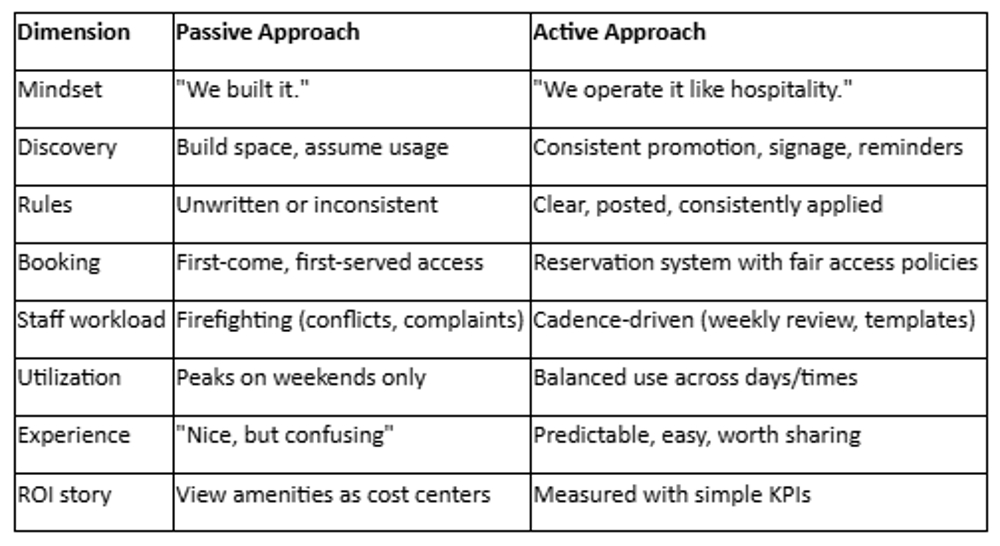
Consider a common scenario. A community invests in a stunning clubhouse with a catering kitchen, comfortable seating, and audiovisual equipment. Under passive management, the space sits unused most evenings because residents don't know they can reserve it, aren't sure of the rules, or assume it's complicated. Under active management, the same space hosts weekly wine tastings, monthly cooking demonstrations, and private resident events that generate booking fees while building community connection.
The difference isn't the space. It's the system around it.
The Community Hub Mindset: From Cost Center to Connection Engine
Shifting from passive to active requires more than new processes. It requires a mindset change. Amenities are the stage. The experience is the product.
This hospitality-first perspective reframes every operational decision. Instead of asking "How do we maintain this space?" the question becomes "How do we activate this space to deliver value?" The operational principle is simple: service standards matter more than features alone. Technology should be invisible; hospitality should be felt.
When a resident books the rooftop for a birthday dinner, they shouldn't wrestle with clunky software or chase down staff for access codes. The technology handles logistics seamlessly. What they remember is how easy it was, how the space exceeded expectations, and how their guests commented on what a great building they live in. That emotional connection, that sense of "this place gets me," drives lease renewals far more effectively than granite countertops.
This mindset also recognizes that community events and programming aren't nice-to-haves. They're operational tools for building the social fabric that makes residents reluctant to leave. A resident with three friends in the building renews at higher rates than one who doesn't know their neighbors. Amenities, properly managed, become the connective tissue that creates those relationships.
When the hub mindset is working, you'll notice fewer conflicts and complaints because expectations are clear, higher utilization across a wider range of residents (not just a small social subset), and higher perceived value that supports renewals and premium positioning.
The Amenity Activation Framework: Promotion → Booking → Usage → Feedback
Effective amenity management follows a continuous cycle. Each stage feeds the next, creating momentum that compounds over time. Activation is not a one-time launch but an ongoing loop.
Stage 1: Promotion
Residents can't use what they don't know about. Promote amenities like you would promote a service, with a cadence residents can count on. Yet many communities bury amenity information in move-in packets that get filed away and forgotten.
Effective promotion requires multiple touchpoints:
- In-app announcements that surface programming and availability where residents already spend time
- Physical signage in high-traffic areas like lobbies, elevators, and mailrooms
- Community groups where residents with shared interests can discover relevant offerings
- Email and text campaigns highlighting upcoming events or underutilized spaces
A practical approach: Use one weekly "What's happening in the community" message (email plus resident app notification), combined with simple in-building signage where decisions happen: elevator screens, lobby stands, and QR codes at the amenity door.
The goal isn't to bombard residents with messages. It's to ensure awareness reaches them through their preferred channel at relevant moments. Someone who never checks email might notice the lobby digital display. Someone who ignores signage might engage with a push notification about a fitness class that matches their interests.
Stage 2: Booking
Friction kills usage. Booking should prevent conflict, not create admin work. Every unnecessary step between "I want to use this" and "I'm using this" reduces participation.
An effective booking system includes:
- Clear rules so residents understand expectations before reserving (guest limits, noise guidelines, cleanup responsibilities)
- Frictionless reservations through a single platform rather than phone calls, emails, or paper sign-up sheets
- Fair access policies that prevent a few power users from monopolizing popular spaces
- Deposit and cancellation policies that protect the community while remaining reasonable
A reservable lounge works well with a standardized window (for example: 14 days out), clear duration limits, a consistent cancellation policy, and optional deposits only when there is real risk or staffing cost. Automated confirmations and reminders reduce no-shows and confusion.
The booking process also sets service expectations. When confirmation messages include what to expect, who to contact with questions, and any preparation needed, residents arrive ready to have a great experience rather than confused about logistics.
Stage 3: Usage
The moment of truth. Usage succeeds when the on-site experience matches what was promised. This is where operational excellence either validates or undermines all previous efforts.
If residents reserve the rooftop for an event, they should arrive to a space that is clearly labeled, ready (lights, sound, furniture layout), and supported by a simple "what to do if something goes wrong" plan.
Operational readiness checklist:
- Reset standards: Trash, surfaces, furniture arranged, supplies stocked
- Clear escalation path: Who handles access issues, noise complaints, or damage
- Vendor readiness (if applicable): Arrival time, setup area, contact info
- Accessibility basics: Clear paths, inclusive formats, consistent access
- Staff awareness so anyone on duty can answer basic questions or troubleshoot issues
Nothing destroys amenity momentum faster than a resident who excitedly books the media room for movie night, only to find broken equipment and no one available to help. Conversely, nothing builds loyalty faster than a team that anticipates needs and resolves issues before they become complaints.
Stage 4: Feedback
The cycle closes with learning. Feedback must be lightweight and tied to action. Every usage instance is an opportunity to understand what's working and what needs adjustment.
After a reservation or event, send a one-question pulse: "Was this amenity easy to use today?" plus an optional comment box. Review weekly and fix one thing at a time.
High-signal feedback loops:
- Post-booking pulse surveys (one or two questions, not lengthy forms)
- Event-specific feedback for programmed activities
- Informal observation by staff who notice patterns in usage and complaints
- Periodic broader surveys that assess overall amenity satisfaction
The key is acting on what you learn. Feedback that disappears into a spreadsheet never to influence decisions teaches residents that their input doesn't matter. Quick wins based on resident suggestions demonstrate responsiveness and encourage continued engagement.
Activation Playbook: 7 Steps You Can Implement This Month
Theory matters less than action. Here's a practical playbook for teams ready to transform their amenity operations starting now. You don't need a new department to activate amenities. You need a cadence.

A community manager can block 45 minutes each week to review bookings, top issues, and next week's promotions. The team runs the same templates each month, improving one friction point per cycle.
Step 1: Audit Your Spaces
Walk through every amenity with fresh eyes. For each space, assess current utilization (busy, moderate, or underused), physical condition, and flexibility for different uses. Focus on traffic plus flexibility plus revenue potential. A smaller, easy-to-run amenity that gets daily use can outperform a showpiece that sits empty.
Identify two or three "high potential" spaces where increased activation could deliver quick wins. These are typically spaces with decent traffic and enough flexibility to support varied programming.
Step 2: Define One Goal Per Amenity
Trying to optimize for everything optimizes for nothing. Pick one as primary: utilization, revenue, or connection. You can track others, but clarity prevents messy policies. For each priority space, choose one primary goal:
- Utilization: Get more residents using the space more often
- Revenue: Generate ancillary income through fees or services
- Connection: Build community through programming that brings residents together
A fitness center might prioritize utilization. A guest suite might prioritize revenue. A clubhouse might prioritize connection. Clarity on the goal shapes every subsequent decision.
Step 3: Establish Rules and Guardrails
Ambiguity creates conflict. Document clear policies covering hours of operation, reservation limits, guest policies, noise expectations, cleanup responsibilities, and consequences for violations. Post these visibly and include them in booking confirmations. Fair, consistent enforcement matters more than strict rules. Residents accept reasonable boundaries when applied equitably.
Keep policies readable: hours, capacity, guest guidelines, noise expectations, food and beverage rules, reservation window plus duration, cancellation and no-show policy, reset expectations, damage and issues process, and contact for help.
Step 4: Build a 30-Day Programming Calendar
Start simple. Use recurring formats: coffee socials, fitness blocks, coworking hours, pet-focused moments. Identify four to six repeatable, low-lift activities that activate priority spaces without overwhelming staff. Consider weekly fitness classes, monthly social hours, recurring interest-group meetups, or seasonal celebrations. The first month is about establishing rhythm, not perfection. A consistent Tuesday yoga class that runs reliably beats an ambitious programming slate that collapses under its own weight.
Fair housing note: When designing your programming calendar, ensure activities are scheduled at varied times (weekday/weekend, morning/evening) and in formats that allow all residents equal opportunity to participate. Programming should be accessible to residents with different schedules, abilities, and preferences.
Step 5: Add Vendor Partnerships
You don't need to do everything in-house. Treat partners like an extension of hospitality, not a random add-on. Resident lifestyle services through vetted vendor partnerships can dramatically expand offerings without adding staff burden. Fitness instructors, pet services, dry cleaning pickup, mobile car detailing, and personal services all represent potential partnerships. The right vendors handle delivery while the property captures value through convenience and, potentially, revenue share arrangements.
Equal access requirement: Any services provided through vendor partnerships must be available to all residents on equal terms. Partnership agreements should ensure fair pricing, consistent service standards, and equitable access regardless of when residents choose to participate.
Step 6: Set Pricing That Feels Fair
If monetization is a goal, pricing requires careful calibration. Charge when there is exclusive use, real cost, or clear incremental value. The section below covers this in detail, but the core principle is simple: residents accept fees when they perceive clear value exchange, optionality, and consistency. Mandatory fees for basic access breed resentment. Optional upgrades for premium experiences or private bookings feel appropriate.
Step 7: Create an Operating Cadence
Sustainability requires rhythm. Establish a weekly review covering bookings completed, feedback received, issues identified, and upcoming programming. This doesn't need to be lengthy. Fifteen minutes with the right dashboard can surface what matters. Monthly, assess progress against goals and adjust tactics. Quarterly, evaluate whether goals themselves need refinement.
Weekly: bookings, no-shows, top issues, next week's promotion. Monthly: policy review, pricing review, vendor performance, KPI snapshot.
Monetization Models That Don't Feel Like "Junk Fees"
Ancillary revenue from amenities represents genuine opportunity. Monetization works when it is a transparent value exchange, optional, and consistently applied. It fails when it feels hidden, inconsistent, or punitive. Industry discussions increasingly recognize that thoughtfully structured fees can benefit both operators and residents, making clarity and resident trust the main design constraint.[^3]
But execution matters enormously. The difference between legitimate value exchange and resident frustration often comes down to three principles.
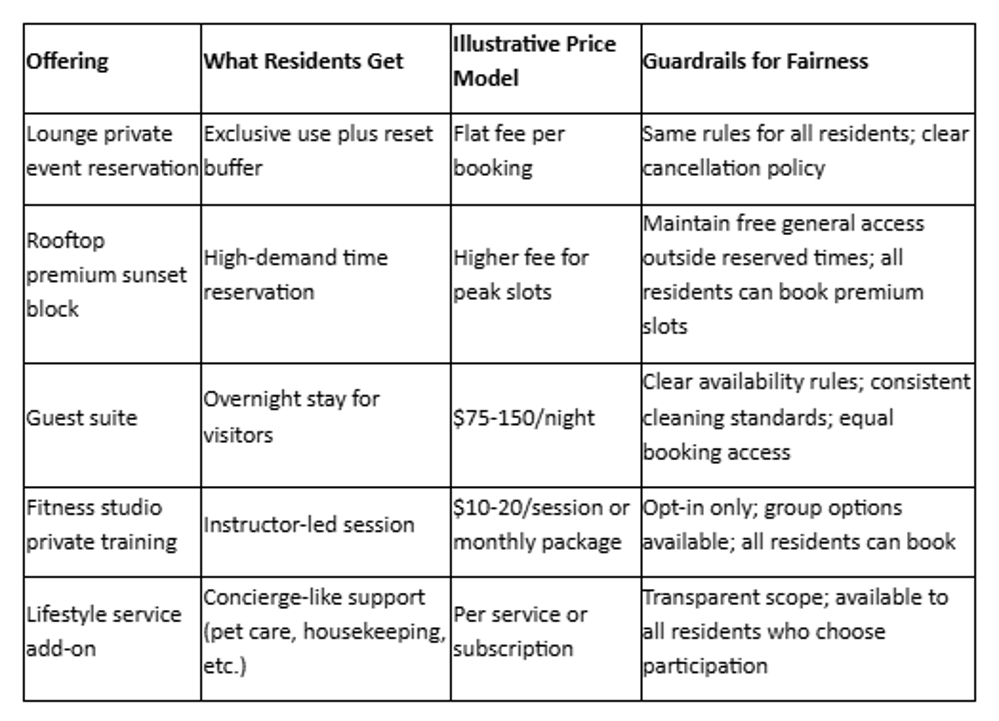
Optionality: Residents should have choices. Charging for basic gym access feels extractive. Offering premium personal training sessions as an optional add-on feels reasonable. The baseline experience remains strong and accessible to all residents; enhanced experiences carry appropriate premiums. Critical fair housing principle: All residents must have equal access to baseline amenities. Fees should only apply to optional premium services or exclusive-use reservations, never to fundamental community access.
Transparency: No surprises. If the guest suite costs $75 per night, that information should be clearly communicated before anyone books. Hidden fees or unclear policies destroy trust faster than they generate revenue.
Consistency: Rules apply equally to everyone. If the party room requires a cleaning deposit, every resident pays it regardless of tenure or relationship with staff. Perceived favoritism undermines community cohesion. Fair housing mandate: Pricing, policies, and access must be applied consistently to all residents without exception.
Sample Amenity Pricing Menu (Illustrative)
What Not to Do: Trust Killers
Certain monetization approaches consistently damage resident trust and community perception:
- Charge for amenities marketed as included during leasing. This breaks the fundamental value promise and creates immediate resentment.
- Implement fees without advance notice or resident communication. Surprise charges feel like bait-and-switch tactics.
- Apply different rules to different residents. Inconsistent enforcement or perceived preferential access destroys the sense of fairness essential to community and may violate fair housing requirements.
- Create fee structures so complex that residents can't understand them. Opacity breeds suspicion and reduces participation.
- Monetize in ways that make basic community participation feel transactional. Avoid charging for basic access to spaces that define the community experience.
- Add unclear "processing" fees that don't map to real cost or value. These are textbook examples of fees that feel extractive rather than value-based.
- Restrict access to services or programming based on factors other than voluntary participation. All residents must have equal opportunity to access amenities and services on the same terms.
The goal is creating genuine value that residents willingly pay for, not extracting maximum revenue through nickel-and-diming.
Technology Requirements: Reduce Admin Load and Avoid App Fatigue
Technology exists to remove friction for residents and eliminate busywork for staff. Technology should reduce friction for residents and remove busywork for the property management team. When it creates more complexity than it solves, something has gone wrong.
The core problem many communities face is point-solution sprawl. One app for rent payments. Another for maintenance requests. A third for package notifications. A fourth for amenity bookings. A fifth for event RSVPs. Each system made sense in isolation. Together, they create the "app fatigue" that frustrates residents and fragments operational data.
ElevateOS-reported results suggest that consolidating to a unified platform can reduce point solutions by up to 75%, though results vary by community.[^*] The principle matters more than the specific number: fewer systems mean less resident confusion, less staff training, and better data integration.
Minimum tech capabilities for amenity management:
- Reservations: Real-time availability, rules, buffers, automated confirmations
- Payments (if applicable): Simple checkout, receipts, refund rules
- Communication: Announcements plus reminders tied to bookings and events
- Feedback: Post-usage prompts and a simple dashboard of friction themes
- Reporting: Utilization and revenue snapshots without spreadsheet gymnastics
- Accessibility: Platform must work with assistive technologies and provide equal access to all residents
An effective amenity management platform should handle reservations and booking with real-time availability and automated confirmations, payments processing for fee-based amenities, communication through push notifications, email, and in-app messaging, feedback collection integrated into the post-usage flow, and reporting that surfaces utilization trends and revenue metrics.
Digital accessibility requirement: Any technology platform must ensure all residents can access booking systems, communication channels, and amenity information regardless of ability. This includes compatibility with screen readers, clear visual design, and alternative formats when needed.
For teams exploring automation in depth, resources on automating amenity reservations provide step-by-step implementation guidance.
The broader principle: technology should disappear into the background. When residents barely notice the systems because everything just works, technology is doing its job.
[^*]: Internal ElevateOS client data; individual results vary based on community size, existing systems, and implementation approach.
KPIs That Prove ROI (Without Overcomplicating Reporting)
Ownership and asset managers want evidence that amenity investments deliver returns. You need a small set of metrics that tell a clear story: utilization, experience quality, and financial impact. But measurement shouldn't require a data science degree or consume hours of staff time weekly.
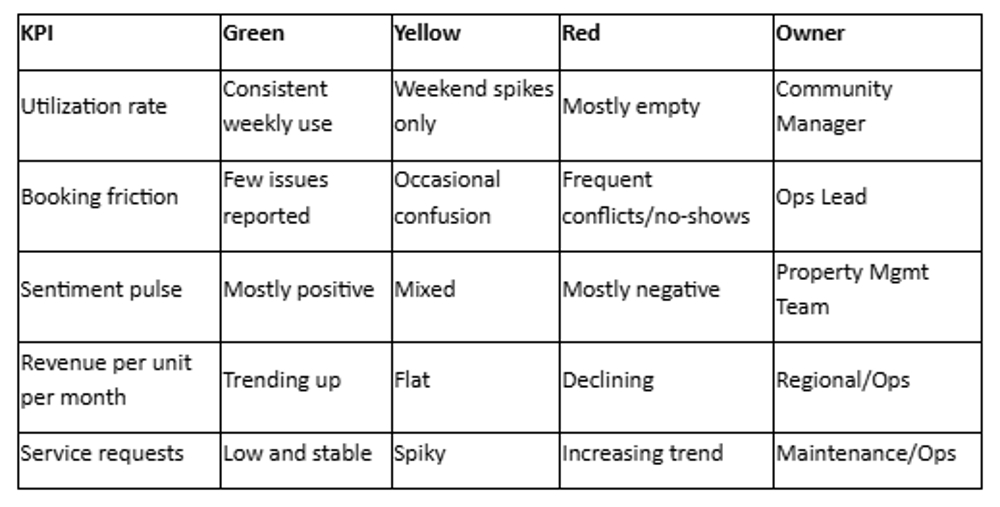
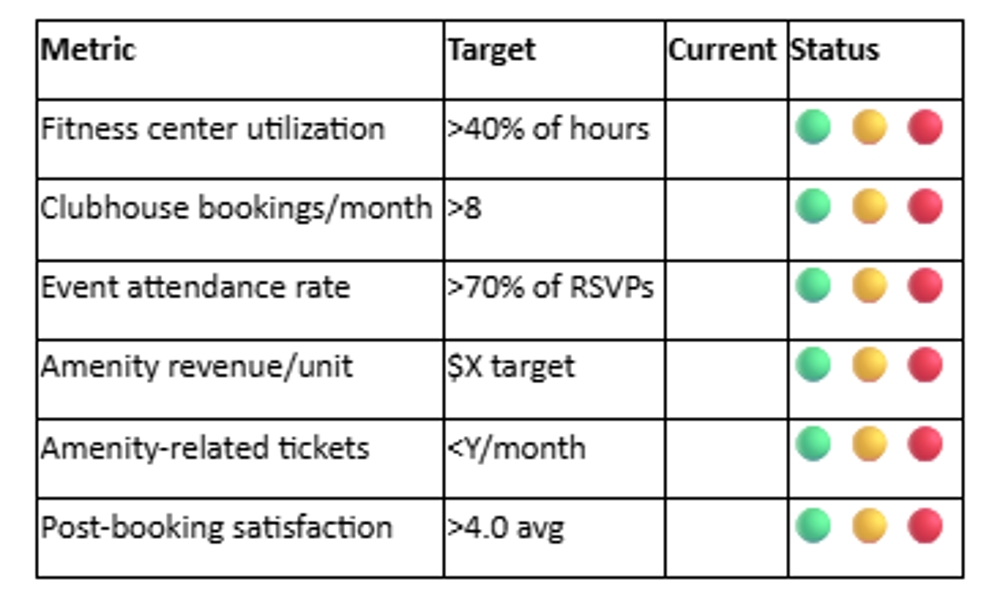
Focus on a small set of meaningful metrics rather than tracking everything possible. Instead of tracking 25 metrics, track five monthly and review friction weekly. Owners and asset managers want clarity, not dashboards for dashboards' sake. A simple scorecard approach works well, rating each metric as green (on target), yellow (needs attention), or red (requires intervention).
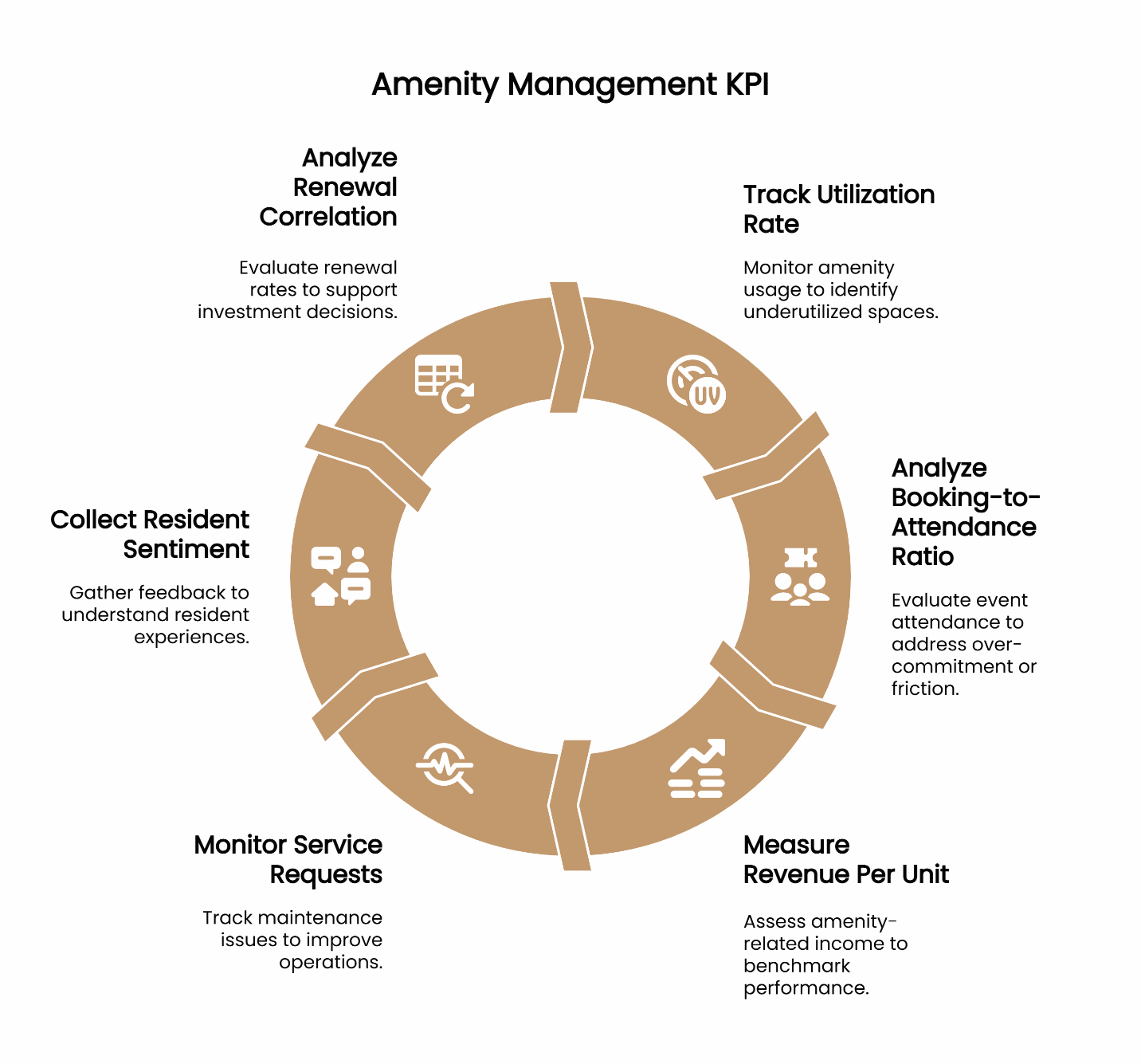
Core Amenity KPIs
Utilization Rate by Amenity: What percentage of available hours or capacity is actually used? An underutilized space represents either a promotion problem, a product problem, or both. Track monthly and look for trends.
Booking-to-Attendance Ratio: For programmed events, how many people who RSVP actually show up? Low ratios suggest either over-commitment by residents or friction in the attendance experience. High no-show rates also waste resources on preparation.
Revenue Per Unit Per Month: If monetization is a goal, track amenity-related income divided by total units. This normalizes across property sizes and provides a clean benchmark. ElevateOS-reported results show some clients achieving increases of $23 per unit per month, though outcomes vary significantly by community and implementation.[^*]
Amenity-Related Service Requests: Track maintenance tickets, complaints, and issues tied to amenity spaces. A declining trend indicates operational improvement. Spikes signal problems requiring attention.
Resident Sentiment: A single post-booking question ("How was your experience?" on a 1-5 scale) provides ongoing pulse data without survey fatigue. Aggregate monthly for trend analysis.
Renewal Correlation: While causality is difficult to prove, tracking whether high amenity users renew at different rates than low users provides directional insight. This requires longer-term data but can support investment cases.
For deeper exploration of measurement approaches, measuring amenity success offers additional frameworks.
KPI Scorecard Quick View
[^*]: Internal ElevateOS client data; individual results vary.
Compliance and Accessibility Basics
Amenity management operates within legal frameworks that require attention, though this guide cannot provide legal advice. Two areas deserve particular awareness and vigilance throughout your amenity operations.
Fair Housing Requirements: Federal, state, and local fair housing laws require that programming, services, and amenity access be available to all residents on equal terms. This is not optional or aspirational—it is a legal mandate.
All residents must have equal access to:
- Amenity spaces and facilities
- Booking and reservation systems
- Programmed events and activities
- Vendor services and partnerships
- Communication channels and promotional materials
- Fee-based optional services (when offered, they must be available to all residents who choose to participate)
This means avoiding any practices that could exclude or disadvantage residents based on protected characteristics. Design programming and policies so any resident could participate. When scheduling events, ensure varied timing to accommodate different schedules. When setting booking policies, apply them consistently to everyone. When communicating about amenities, use multiple channels to reach all residents.
If you introduce a new reservation process or event series, ensure it is communicated broadly, easy to access, and not structured in a way that excludes residents who don't fit a narrow schedule or communication channel. Apply policies consistently and transparently. Ensure access is inclusive and not "by invitation."
When in doubt about whether a policy or program raises fair housing concerns, consult qualified legal counsel immediately. The U.S. Department of Housing and Urban Development provides resources on fair housing requirements that offer foundational guidance.[^4]
Accessibility: Physical spaces and digital booking systems must accommodate residents with disabilities. This includes ADA compliance for physical amenities and ensuring that reservation platforms work with assistive technologies. Keep physical accessibility and clear pathways in mind. Design programming with varied formats when possible. Specific requirements depend on property characteristics and jurisdiction, making professional guidance valuable.
The operational principle: if a proposed activity, policy, or fee structure would effectively exclude certain residents from participating, reconsider the approach immediately. Equal access is both a legal requirement and a community-building imperative.
Quick-Start Templates
Amenity Audit Checklist
Use this for each amenity space during your initial assessment:
- [ ] Current average utilization (high/medium/low)
- [ ] Physical condition rating (excellent/good/fair/poor)
- [ ] Last significant update or renovation date
- [ ] Existing reservation or booking system (if any)
- [ ] Current rules and policies documented?
- [ ] Cleaning and maintenance schedule adequate?
- [ ] Staff training on this space current?
- [ ] Resident feedback received in past 90 days?
- [ ] Revenue currently generated (if applicable)
- [ ] Primary activation opportunity identified
- [ ] Fair housing compliance: Are policies and access consistent for all residents?
- [ ] Accessibility: Does space meet ADA requirements and accommodate all residents?
Sample Amenity Rules Template
Adapt this framework for specific spaces:
[Amenity Name] Usage Guidelines
- Hours: [Specify available hours]
- Reservations: [How to book, maximum duration, advance booking limits]
- Capacity: [Maximum occupancy for safety and comfort]
- Guests: [Guest policy, limits, resident responsibility]
- Conduct: [Noise expectations, prohibited activities, shared space etiquette]
- Cleanup: [Resident responsibilities before departure]
- Cancellation: [Policy and any associated fees]
- Violations: [Consequences for policy breaches]
- Equal Access: These rules apply consistently to all residents
30-Day Programming Calendar Starter
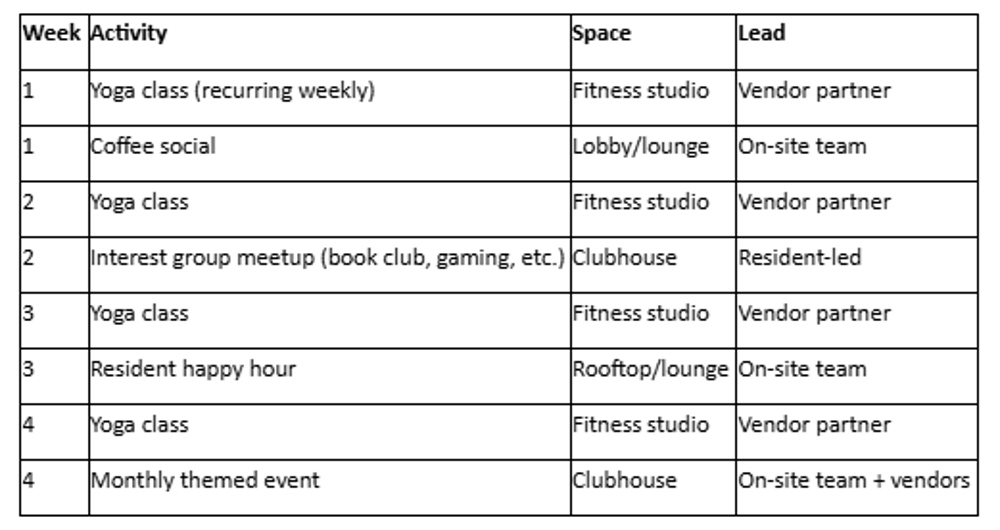
Programming note: Ensure activities are scheduled at varied times (weekday/weekend, morning/evening) to provide equal opportunity for all residents to participate.
KPI Scorecard Template
Frequently Asked Questions
What does amenity management include in a multifamily community?
Amenity management encompasses space operations (scheduling, access, maintenance), services and programming (classes, events, vendor partnerships), policies (usage rules, reservation systems, fee structures), and measurement (tracking utilization, satisfaction, and revenue). It's the difference between maintaining spaces and actively creating value from them.
How do I get more residents to use the clubhouse or lounge?
Start with clarity: define the space's purpose, post simple rules, and create one recurring activation per week. Increase visibility through multiple communication channels, reduce booking friction with simple reservation systems, and activate the space with programming that gives residents reasons to visit. Promote it on a consistent cadence and remove booking friction. Empty spaces often reflect awareness or accessibility problems rather than lack of interest.
Should we charge for amenity reservations?
It depends on the space, the market, and the value proposition. Charge when there is exclusive use or clear incremental value, and keep it optional, transparent, and consistent. Private bookings for events, premium services, and guest accommodations commonly carry fees. The key is ensuring fees reflect genuine value exchange, remain optional for enhanced experiences, are communicated transparently, and are available to all residents on equal terms. Basic amenity access must remain available to all residents without additional fees. Avoid surprise fees for fundamental community access.
What amenities are easiest to monetize?
Guest suites, private event spaces, premium fitness programming, and add-on services (pet grooming, personal training, spa services) typically offer the clearest monetization paths. Spaces with exclusive-use value (event-ready lounge/rooftop), guest suites, and opt-in services (fitness training, pet services, lifestyle add-ons) provide distinct value beyond baseline amenity access. Remember that any monetized offerings must be available to all residents who choose to participate.
How do we avoid double-bookings and last-minute cancellations?
Implement a centralized reservation system with real-time availability, automated confirmations, and clear cancellation policies. Use clear reservation windows, time caps, buffers, automated reminders, and a posted cancellation and no-show policy that is applied consistently to all residents. Refundable deposits for high-demand spaces reduce no-shows. Waitlist functionality captures demand when spaces are fully booked.
What are the best metrics for amenity success?
Start with utilization rate (percentage of available capacity used), booking-to-attendance ratio for events, revenue per unit if monetization is a goal, and simple satisfaction scores from post-usage feedback. Also track amenity-related service request volume. Avoid overcomplicating measurement; a few meaningful metrics beat dozens of ignored data points.
How do we keep amenity programming fair and inclusive for all residents?
Design programming that any resident could participate in regardless of background, ability, or schedule. Offer consistent access, communicate broadly, vary times and formats when possible, and apply rules consistently. Ensure physical and digital accessibility, apply rules and fees consistently, and regularly assess whether offerings reflect community diversity. Keep accessibility and equal access as non-negotiable design constraints. Federal fair housing laws require that all residents have equal access to the same services, tools, events, and features. When uncertain about fair housing implications, consult qualified counsel immediately.
Your Amenities Are the Stage. The Experience Is the Product.
Empty amenity spaces represent more than wasted square footage. They're missed opportunities for connection, satisfaction, and revenue. The path from underutilized cost center to thriving community hub isn't mysterious. It requires shifting from passive management to active activation.
The Amenity Activation Framework (Promotion → Booking → Usage → Feedback) provides the operational backbone. The 7-step playbook offers immediate action items. The KPI scorecard delivers accountability and evidence for stakeholders.
None of this requires massive budgets or expanded headcount. It requires intentionality, consistency, and a hospitality-first mindset that treats every amenity interaction as an opportunity to deliver value—value that is accessible to all residents on equal terms.
For teams ready to quantify the opportunity, tools like revenue calculators can model potential returns based on your specific community characteristics. And for those wanting to explore how unified platforms can reduce operational complexity while enhancing resident experience, the ElevateOS team welcomes conversations about what's possible. Learn more about ElevateOS and how an integrated approach connects amenity management for multifamily to events and experiences.
The amenities already exist. The residents are already there. The only question is whether those spaces will sit as expensive backdrops or become the vibrant hubs that define your community's character.
This guide is intended as a comprehensive starting point. For decisions specific to your unique situation, we always recommend consulting a qualified professional.
Our Editorial Process
Our expert team uses AI tools to help organize and structure our initial drafts. Every piece is then extensively rewritten, fact-checked, and enriched with first-hand insights and experiences by expert humans on our Insights Team to ensure accuracy and clarity.
About the ElevatedOS Insights Team
The ElevatedOS Insights Team is our dedicated engine for synthesizing complex topics into clear, helpful guides. While our content is thoroughly reviewed for clarity and accuracy, it is for informational purposes and should not replace professional advice.
[^1]: NMHC, 2024 NMHC & Grace Hill Renter Preferences Survey Report. https://www.nmhc.org/research-insight/research-report/nmhc-grace-hill-renter-preferences-survey-report/
[^2]: National Apartment Association, Greystar Reveals Amenity Trends. https://naahq.org/greystar-reveals-amenity-trends
[^3]: National Apartment Association, "Ancillary Income: Justified or Junk?" https://naahq.org/news/ancillary-income-justified-or-junk
[^4]: U.S. Department of Housing and Urban Development, Fair Housing Laws, Guidance, and Tools. https://www.hudexchange.info/programs/fair-housing/laws-guidance-tools/