.avif)
Multifamily Notification Fatigue: How to Reduce Resident Message Overload
Apartment communities need to communicate constantly—but sending more notifications does not automatically create better communication. Learn how multifamily teams can reduce resident notification fatigue, prioritize important messages, and create a communication experience residents are more likely to pay attention to.
Quick Answer: What Is Multifamily Notification Fatigue?
Multifamily notification fatigue happens when apartment residents receive so many announcements, push notifications, emails, reminders, alerts, and updates that individual messages begin to lose their impact. Residents may ignore low-priority communication, dismiss notifications automatically, or overlook important information because it looks like everything else they receive.
Key Takeaways
- More messages do not necessarily create better-informed residents.
- Community-wide broadcasts should be reserved for information relevant to most or all residents.
- Targeting messages by building, floor, resident, event, amenity, service, or workflow can reduce unnecessary notifications.
- Urgent operational communication should look and feel different from optional community content.
- Centralizing resident communication can reduce the confusion created by disconnected emails, portals, texts, notices, and apps.
- Property teams should measure communication quality—not simply how many messages they send.
One Connected Resident Experience
Make Resident Communication More Relevant
ElevateOS connects resident communication with events, amenities, services, requests, content, access, and community experiences through one resident engagement platform.
Explore the Resident Engagement PlatformWhy Notification Fatigue Is Becoming a Multifamily Problem
Modern apartment communities have more reasons to communicate with residents than ever before.
During an ordinary month, a resident might receive communication about:
- Maintenance requests
- Packages and deliveries
- Amenity reservations
- Community events
- Building access
- Guest policies
- Inspections
- Construction
- Water or utility interruptions
- Parking
- Resident services
- Surveys
- Renewal communication
- Community announcements
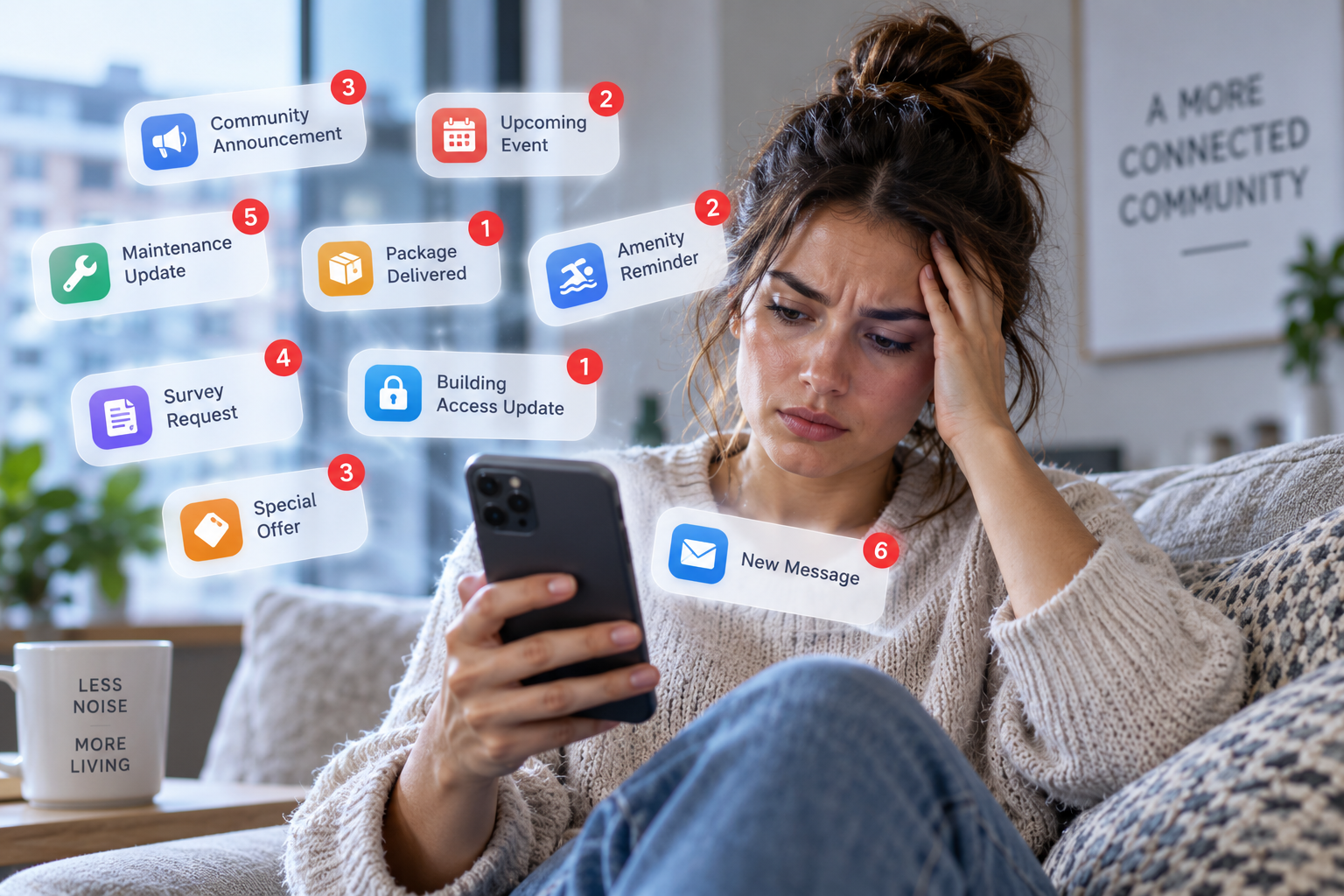
Each message may be legitimate on its own. The problem appears when residents experience all of those communications as one continuous stream.
A routine event reminder can appear next to an important maintenance notice. A package alert can arrive minutes before a building announcement. An email may repeat information residents already received through an app notification.
Eventually, residents may stop distinguishing between what is essential and what is optional.
That is the fundamental challenge of notification fatigue: when everything asks for attention, nothing automatically receives attention.
What Causes Resident Notification Fatigue?
Notification fatigue usually is not caused by one employee sending too many messages. It develops when communication is managed across disconnected people, systems, departments, and workflows.
1. Too Many Community-Wide Broadcasts
Mass communication is easy. Targeted communication requires more structure.
As a result, properties can fall into the habit of sending every announcement to every resident—even when the information only affects one floor, building, amenity group, or resident segment.
The resident eventually learns that many community notifications do not apply to them.
That creates a dangerous habit: ignoring first and deciding whether a message matters later.
2. Duplicate Communication Across Channels
A resident might receive the same information as:
- An email
- A push notification
- A text message
- A portal announcement
- A printed lobby notice
Multiple channels can be appropriate for critical information. But repeating routine messages across every available channel can train residents to view property communication as noise.
3. Every Message Appears Equally Important
A rooftop event invitation and an emergency water interruption should not have the same communication priority.
When urgent notices, operational updates, community content, events, promotions, and reminders all use similar formatting and notification behavior, residents have little help deciding what deserves immediate attention.
4. Poor Timing
Even a relevant message becomes less useful when it arrives at the wrong time.
A reminder may arrive too early and be forgotten. Another may arrive too late to act. Several departments may send separate updates within the same short period without realizing residents are receiving a cluster of notifications.
5. Disconnected Property Technology
Communication can become harder to coordinate when different resident workflows operate in separate systems.
One tool may send package alerts. Another handles maintenance. Another manages events. Another controls amenities. Another provides building access.
Each tool may communicate independently because none has visibility into the resident's complete digital experience.
A more connected property management software strategy can help operators reduce these disconnected resident touchpoints.
Why Resident Message Overload Matters
Notification fatigue is not simply a communications problem. It can affect resident experience and property operations.
Important Messages Have to Compete for Attention
The more low-value notifications residents receive, the harder it becomes for an important update to stand apart.
Properties should therefore protect the attention value of urgent communication instead of treating notifications as an unlimited resource.
Residents May Disengage From the App
A resident app becomes more valuable when residents associate it with useful, timely information and convenient actions.
If most notifications feel irrelevant, residents have less reason to pay attention when the next notification appears.
Property Teams Create More Follow-Up Work
Over-communication can paradoxically create under-communication.
When residents miss important information, onsite teams may receive more phone calls, emails, office visits, repeated questions, and requests for clarification.
The property sends more information but still has to explain the information manually.
How to Reduce Multifamily Notification Fatigue
The solution is not to stop communicating. It is to become more intentional about who receives each message, when they receive it, why they receive it, and what they should do next.
1. Create a Communication Priority System
Start by dividing communication into clear priority levels.
| Priority | Examples | Communication Approach |
|---|---|---|
| Critical | Emergency, safety, major utility outage, immediate access issue | High visibility and immediate delivery |
| Action Required | Inspection notice, scheduled maintenance, deadline, resident-specific task | Clear deadline and next action |
| Operational | Amenity closure, package reminder, routine service update | Target the affected residents |
| Engagement | Events, programs, surveys, services, community content | Coordinate frequency and personalize when possible |
This gives onsite teams a shared framework for deciding which communication deserves the strongest notification treatment.
2. Segment Before You Send
One of the simplest ways to decrease unnecessary notifications is to stop treating every resident as the audience for every message.
Depending on the communication, properties may segment residents by:
- Property
- Building
- Floor
- Unit
- Amenity usage
- Event registration
- Service usage
- Move-in stage
- Request status
- Resident lifecycle stage
If an elevator shutdown affects one building, residents elsewhere may not need the notification.
If an event reminder is intended for residents who registered, sending it to the entire property creates unnecessary noise.
Targeted communication makes each notification more relevant—and relevance is one of the strongest defenses against notification fatigue.
3. Give Every Message One Primary Purpose
A resident should be able to scan an announcement and immediately understand:
- Why am I receiving this?
- Does it affect me?
- What do I need to do?
- When do I need to do it?
Avoid burying essential information underneath lengthy introductions or combining several unrelated announcements into one notification.
4. Connect the Notification Directly to an Action
Notifications are more useful when they lead residents directly to whatever comes next.
For example:
- An event reminder should lead to event details.
- An amenity notice should lead to the reservation or amenity information.
- A service update should lead to the relevant request.
- A survey invitation should lead directly to the survey.
- A document reminder should lead to the required document or task.
Residents should not have to open a notification and then hunt through several menus to figure out what to do.
5. Consolidate the Resident Experience
Notification fatigue becomes harder to manage when residents interact with numerous unrelated platforms.
Consolidating communication, amenities, services, events, requests, documents, packages, and everyday resident workflows through a connected resident experience platform gives property teams a stronger foundation for coordinating communication.
It also gives residents one familiar digital destination instead of forcing them to interpret messages from multiple independent systems.
Everything. One App.
Reduce Communication Fragmentation
Give residents one connected destination for communication, events, amenities, services, requests, community information, and everyday property interactions.
Explore the ElevateOS Resident App6. Coordinate Communication Across Property Teams
Residents experience one community. They do not necessarily distinguish between messages created by leasing, maintenance, concierge, resident experience, management, or corporate teams.
Properties therefore need communication governance across departments.
A simple process might include:
- A shared communication calendar
- Defined priority levels
- Approved recurring templates
- Clear rules for community-wide announcements
- Defined ownership for urgent messages
- Standard audience segmentation
The purpose is not to create bureaucracy. It is to prevent residents from receiving several unrelated communications simply because different teams were working independently.
7. Use Automation Without Creating Automated Noise
Automation can make resident communication significantly more consistent.
It can support:
- Move-in reminders
- Package updates
- Maintenance status messages
- Amenity confirmations
- Event reminders
- Resident service notifications
- Follow-up requests
But every message that can be automated does not necessarily need to become a push notification.
Automation should remove repetitive staff work while preserving the resident's attention—not consume more of it.
8. Review Frequency at the Resident Level
Teams often evaluate communication campaign by campaign.
Residents experience it differently.
They experience the combined volume of every announcement, service message, maintenance update, event reminder, package alert, amenity notification, and community communication.
That means multifamily operators should periodically evaluate the total resident communication experience rather than optimizing each message in isolation.
What Should Apartment Communities Send as Push Notifications?
Push notifications are most valuable when information is timely enough that the resident benefits from seeing it quickly.
Potential high-value use cases include:
- Urgent building updates
- Unexpected service interruptions
- Time-sensitive access changes
- Resident-specific maintenance updates
- Package availability
- Upcoming reservations
- Resident-specific actions or deadlines
Less urgent content may be better suited to an in-app feed, community content area, event calendar, email digest, or another lower-interruption format.
Resident Notification Strategy Example
Consider a property hosting a resident fitness event on Friday while maintenance is also completing scheduled work on several floors.
A fragmented approach might look like this:
- Event announcement sent to everyone Monday
- Event email sent to everyone Wednesday
- Maintenance notice sent to the entire property Wednesday
- Event push notification sent to everyone Thursday
- Maintenance reminder sent to everyone Thursday
- Event reminder sent to everyone Friday
Residents who are not attending the event and are not affected by the maintenance work still receive most of those messages.
A more targeted approach could look like this:
- Promote the event through community content and an initial targeted announcement.
- Send subsequent event reminders primarily to registered or interested residents.
- Send maintenance notifications only to residents whose units or common areas are affected.
- Escalate communication only if the maintenance creates a wider operational impact.
The property is not necessarily communicating less important information. It is distributing that information more intelligently.
How to Measure Whether Residents Are Receiving Too Many Notifications
There is no universal number of notifications that automatically becomes “too many.”
A resident with an active maintenance request may legitimately receive several updates in one day. Another resident may not need any operational messages that day.
Instead of setting a single arbitrary message limit, operators can look for patterns across communication and resident behavior.
Communication Metrics
- Message views
- Resident responses
- Push-notification engagement
- Survey participation
- Event response rates
Resident Behavior Metrics
- Resident app adoption
- Active app usage
- Repeat app usage
- Amenity engagement
- Event participation
- Service engagement
Operational Metrics
- Repeated resident questions
- Communication-related complaints
- Calls following major announcements
- Missed resident actions
- Manual follow-up required after notifications
Communication metrics become more useful when viewed alongside engagement and operational outcomes.
A strong resident engagement platform can help operators think beyond simple message volume and instead evaluate how residents interact with communication, amenities, events, services, and the larger community experience.
Multifamily Notification Fatigue Checklist
Property teams can use the following questions to identify whether their communication strategy needs attention:
- Do we send community-wide messages when only a subset of residents is affected?
- Do residents receive duplicate versions of routine information across multiple channels?
- Can residents easily distinguish urgent messages from optional community content?
- Do different departments coordinate their communication schedules?
- Are reminders triggered by actual resident actions or sent indiscriminately?
- Does every message clearly explain what residents should do next?
- Can residents find detailed information without relying entirely on push notifications?
- Do we evaluate communication frequency from the resident's perspective?
- Do we measure resident engagement with communication?
- Can property teams manage communication and engagement through one connected system?
Several “no” answers may indicate that residents are receiving fragmented or unnecessarily repetitive communication.
How ElevateOS Supports a More Connected Resident Communication Strategy
ElevateOS helps multifamily communities connect communication with the broader resident experience rather than treating messaging as an isolated function.
Through a connected resident experience, properties can bring together communication with:
- Resident engagement
- Community events
- Amenity reservations
- Resident services
- Requests
- Community content
- Packages
- Onboarding
- Documents
- Access workflows
- Everyday property operations
Residents gain a more consistent place to discover information and take action, while property teams gain a better foundation for delivering targeted communication instead of relying primarily on mass broadcasts.
The objective is not simply to send fewer notifications.
It is to make each notification more relevant, useful, and actionable.
Better Communication. Better Resident Experience.
Create One Connected Resident Experience
Explore how ElevateOS connects communication, amenities, services, events, requests, content, engagement, and everyday community experiences in one platform.
Explore Resident Experience Explore Resident EngagementFrequently Asked Questions About Multifamily Notification Fatigue
What is multifamily notification fatigue?
Multifamily notification fatigue occurs when apartment residents receive so many alerts, announcements, reminders, emails, push notifications, and other messages that they begin paying less attention to them. The result can be lower engagement with routine communication and a greater risk that important information gets overlooked.
How can apartment communities reduce resident notification fatigue?
Communities can reduce notification fatigue by segmenting audiences, establishing message priorities, limiting unnecessary community-wide broadcasts, coordinating communication across teams, consolidating resident channels, and using automation selectively.
How often should property managers send resident notifications?
There is no single ideal frequency for every apartment community. Notification frequency should depend on urgency, resident relevance, required actions, and message type. A resident affected by a maintenance issue may need several updates, while an unaffected resident should not receive those messages at all.
What types of resident messages should be prioritized?
Safety information, building access changes, utilities, urgent maintenance, service interruptions, deadlines, scheduled work, and resident-specific required actions typically deserve the strongest visibility. Events and optional community content can generally use lower-priority communication workflows.
Can a resident app reduce notification fatigue?
A connected resident app can reduce fragmentation by creating one place for announcements, events, amenities, services, requests, documents, packages, and community information. Property teams still need an intentional communication strategy so the app does not become another source of excessive notifications.
What is targeted resident messaging?
Targeted resident messaging means sending communication only to residents for whom it is relevant. Audiences may be defined by property, building, floor, unit, event registration, amenity usage, service activity, move-in stage, request status, or another relevant resident segment.
Final Takeaway
The goal of multifamily communication should not be to maximize the number of messages residents receive.
It should be to make sure residents receive the right information, at the right time, through the right experience.
When properties segment audiences, prioritize urgent updates, coordinate communication, connect messages to actions, and consolidate resident workflows, notifications become more useful and less disruptive.
That creates a better experience on both sides: residents spend less time sorting through irrelevant communication, and property teams spend less time repeating information residents should already have.