.avif)
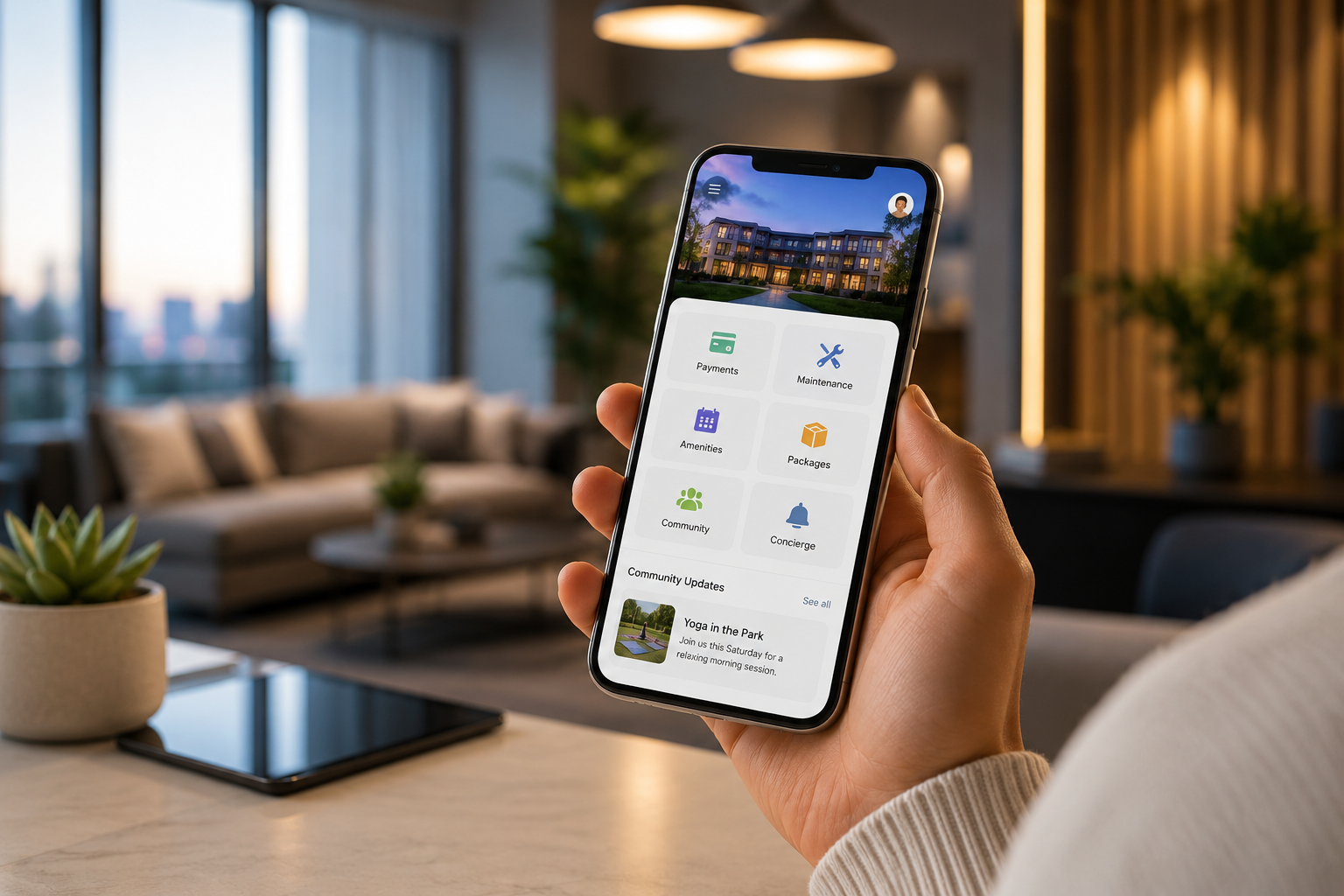
Multifamily Resident Journey Orchestration Software: How to Connect the Entire Resident Lifecycle
Multifamily resident journey orchestration software helps apartment operators connect the workflows, communication, services, amenities, requests, engagement, and follow-up that residents experience from move-in through renewal.
What Is Multifamily Resident Journey Orchestration Software?
Multifamily resident journey orchestration software is technology that coordinates resident-facing interactions and the property workflows behind them across different stages of residency. Instead of managing move-in, maintenance, communication, amenities, services, access, engagement, and renewal as disconnected processes, orchestration software helps teams create a more continuous resident experience with clearer ownership, automation, context, and next steps.
A resident does not experience an apartment community as a collection of departments or software systems.
They experience one property.
The move-in instructions they receive, the maintenance request they submit, the amenity they reserve, the package notification they open, the event they attend, the question they ask the front desk, and the renewal communication they eventually receive all contribute to the same relationship.
Operationally, however, those interactions may be managed by different employees, vendors, platforms, inboxes, portals, and workflows.
That fragmentation creates an emerging challenge for multifamily operators: how do you manage the resident journey as one continuous experience when the work behind it spans so many different systems?
Resident journey orchestration is designed to solve that problem.
Connect More of the Resident Journey Through One Platform
Explore how ElevateOS connects communication, requests, amenities, access, services, engagement, onboarding, and everyday resident interactions.
Explore the Resident Experience PlatformWhat Does “Orchestration” Mean in Multifamily Property Management?
Orchestration means coordinating multiple activities so they work together as part of a larger process.
In multifamily operations, that could mean connecting a resident action with the communication, staff tasks, approvals, reminders, services, and follow-up that need to happen afterward.
Consider move-in.
A move-in is rarely one task. It can involve documents, building access, elevator scheduling, parking instructions, amenity information, package procedures, utility guidance, orientation materials, resident app activation, services, and communication from multiple departments.
Without orchestration, each element may operate independently.
With orchestration, the property can treat them as stages within one resident journey.
Resident Journey Management vs. Workflow Automation
Workflow automation and resident journey orchestration are closely related, but they solve different levels of the operational problem.
| Area | Workflow Automation | Journey Orchestration |
|---|---|---|
| Primary focus | Completing a process efficiently | Connecting processes across the resident lifecycle |
| Example | Route a maintenance request automatically | Connect the request, status updates, resolution, feedback, and future resident follow-up |
| Scope | Individual workflow | Multiple workflows and lifecycle stages |
| Resident context | May be limited to the current request | Considers the broader resident experience |
| Objective | Reduce manual operational work | Create a coordinated end-to-end experience |
A property may therefore automate dozens of individual workflows without truly orchestrating the resident journey.
Orchestration starts when those workflows share enough context to create a logical next experience for both residents and staff.
Why the Multifamily Resident Journey Becomes Fragmented
Modern apartment communities can have an extensive technology stack.
One system may handle property records. Another handles payments. Another manages maintenance. Separate platforms can support amenities, access control, packages, events, services, communication, surveys, smart-home devices, and other resident needs.
Each platform can perform its individual job successfully while the overall resident experience remains disconnected.
Common signs of journey fragmentation include:
- Residents need several apps, portals, or logins.
- Staff repeatedly asks residents for information already provided elsewhere.
- Resident requests change ownership without clear handoffs.
- Different departments send overlapping or inconsistent communication.
- Employees cannot easily see previous resident interactions.
- Follow-up relies heavily on inboxes, spreadsheets, or memory.
- Resident engagement is managed separately from resident service.
- Renewal conversations begin without enough context about the resident's previous experience.
The result is not necessarily a failure of any single tool. It is a coordination problem between tools and workflows.
For operators evaluating a broader technology strategy, this is where a connected property management software experience and resident-facing platform can become especially valuable.
The 5 Stages of a Multifamily Resident Journey
Every portfolio defines its resident lifecycle differently, but a useful orchestration framework can be organized around five broad stages.
Move-In and Onboarding
Welcome communication, instructions, documents, building access, amenity orientation, reservations, services, community resources, and resident app activation.
Everyday Living
Maintenance, packages, amenities, access, visitors, property information, resident questions, building notices, and recurring community interactions.
Engagement
Events, amenities, resident services, community programs, fitness, wellness, local partnerships, surveys, announcements, and opportunities for residents to participate.
Service Recovery and Retention
Follow-up, unresolved issues, resident feedback, satisfaction signals, escalations, recurring concerns, and experiences that may influence future renewal decisions.
Renewal or Move-Out
Renewal communication, resident feedback, move-out processes, access changes, reservations, instructions, documentation, and the final impression a resident takes from the community.
One App Can Give Residents a More Consistent Front Door
See how an all-in-one resident app can bring everyday property interactions into a more unified mobile experience.
Explore the All-in-One Resident AppHow Resident Journey Orchestration Software Works
The specific architecture varies by platform, but a resident journey orchestration model generally connects several capabilities.
1. Capture resident context
The system begins with context such as the resident, household, unit, property, lifecycle stage, previous interactions, active requests, and relevant preferences or activity.
2. Detect an action or lifecycle event
A journey can move forward when something happens: a resident moves in, submits a request, reserves an amenity, reports a problem, registers for an event, reaches a particular lifecycle stage, or requires follow-up.
3. Determine the next appropriate workflow
Rather than leaving staff to manually decide every next action, the system can help direct the interaction into an appropriate operational workflow.
4. Assign responsibility
The next step may belong to maintenance, concierge, leasing, management, resident services, a vendor, or another member of the property team.
5. Coordinate communication
Residents should understand what is happening. Confirmations, reminders, status messages, instructions, and follow-up can remain connected to the operational workflow.
6. Track completion and exceptions
The platform can help teams identify work that is complete, delayed, reassigned, unresolved, waiting for another action, or in need of escalation.
7. Continue the resident journey
Completion of one interaction can inform what should happen next rather than ending as an isolated ticket or transaction.
Example: From Maintenance Request to Resident Journey
Imagine that a resident reports a maintenance problem.
In a basic ticketing model, the process may look like this:
- Resident submits maintenance request.
- Staff assigns the request.
- Technician completes the work.
- Ticket closes.
Journey orchestration asks a broader question: what does the resident need before, during, and after that workflow?
The experience could instead involve:
- The resident submits the issue through a familiar resident experience.
- The correct property workflow receives the request.
- The resident receives confirmation.
- The appropriate employee receives ownership.
- Updates are communicated as the request progresses.
- An overdue request becomes visible to the appropriate team.
- Repeated or unresolved problems can receive additional attention.
- The resident receives confirmation when the issue is resolved.
- The interaction becomes part of the broader resident history rather than disappearing inside a closed ticket.
The maintenance work may be the same. The difference is how completely the operational process supports the resident experience.
Resident Journey Orchestration Examples
Journey orchestration can be applied to many resident-facing processes.
| Resident Moment | Connected Workflows | Desired Outcome |
|---|---|---|
| Move-in | Instructions, access, services, amenities, documents, communication | A clearer first experience |
| Maintenance request | Submission, assignment, updates, escalation, resolution | Consistent service follow-through |
| Amenity use | Discovery, policies, booking, reminders, access | Less friction around shared spaces |
| Resident event | Promotion, RSVP, reminders, attendance, follow-up | Greater community participation |
| Resident complaint | Capture, ownership, response, escalation, resolution | Faster recovery and clearer accountability |
| Renewal period | Communication, engagement, service history, feedback, retention | A better-informed retention strategy |
Why Resident Journey Orchestration Matters for Multifamily Operators
Fewer disconnected handoffs
When a resident interaction requires several employees or departments, orchestration creates a clearer path between stages instead of forcing each person to reconstruct what happened before.
More consistent resident communication
Operational actions and resident-facing communication can remain connected, reducing situations where staff completes work but the resident receives no update.
Clearer ownership
Every stage can have a responsible person, team, workflow, or next action.
Better visibility into resident friction
Individual interactions can reveal more when viewed as part of a journey. Repeated requests, delayed responses, unresolved concerns, low engagement, or frequent support needs can become easier to recognize.
Greater operational consistency across a portfolio
Regional and portfolio teams can establish common resident-experience processes while allowing communities to preserve property-specific information, amenities, services, and branding.
Less reliance on staff memory
A resident journey should not depend on one employee remembering that a particular resident needs a callback, follow-up, document, reservation, introduction, or additional service.
Centralize Resident-Facing Operations
Learn how resident management software can connect communication, requests, amenities, services, engagement, and everyday property workflows.
Explore Resident Management SoftwareWhat Features Should Resident Journey Orchestration Software Have?
Operators evaluating resident journey technology should think beyond individual feature lists and examine whether the platform can actually connect the processes residents experience.
Important capabilities can include:
- Resident profiles: Connect relevant resident and household context with property interactions.
- Workflow management: Create repeatable processes for common resident needs.
- Task assignment: Establish clear responsibility for operational next steps.
- Automation: Reduce repetitive assignments, reminders, confirmations, and follow-up.
- Resident communication: Connect updates with the workflows generating them.
- Maintenance and service requests: Give residents clear digital request paths.
- Amenity management: Connect discovery, availability, policies, reservations, and related communication.
- Access and guest experiences: Bring compatible access workflows closer to the resident experience.
- Events and engagement: Support resident programming and participation.
- Resident services: Connect convenience and lifestyle offerings with everyday community life.
- Exception management: Make delayed, unresolved, or unusual workflows easier to identify.
- Portfolio visibility: Help regional teams understand workflows across multiple properties.
- Integrations: Connect the resident experience with relevant property and building technology.
A broader resident experience platform can provide the digital layer through which many of these resident interactions are delivered.
How to Build a Resident Journey Orchestration Strategy
Step 1: Map the actual resident journey
Document what residents experience from onboarding through renewal or move-out. Include both major lifecycle moments and routine interactions.
Step 2: Inventory every resident-facing system
Identify which systems currently manage communication, payments, maintenance, packages, amenities, access, events, services, documents, surveys, and engagement.
Step 3: Identify broken handoffs
Look for processes where residents or employees must manually move information from one system, department, or communication channel to another.
Step 4: Define ownership
Determine who owns each stage and what should happen when a task changes departments or requires management attention.
Step 5: Establish lifecycle triggers
Define the resident actions, property events, deadlines, or workflow conditions that should initiate another action.
Step 6: Connect communication to operations
Determine when residents should receive acknowledgments, reminders, progress updates, instructions, or confirmation.
Step 7: Design for exceptions
Not every resident journey follows the happy path. Determine what happens when work is overdue, a request repeats, a vendor does not respond, a resident remains dissatisfied, or an employee needs help.
Step 8: Measure the journey, not just individual tasks
Operational metrics remain important, but teams should also examine the cumulative experience residents are receiving.
Metrics for Measuring the Multifamily Resident Journey
There is no single resident journey metric. A useful measurement framework combines signals from multiple parts of the resident experience.
Communication: message engagement, acknowledgments, responses, and resident questions.
Service: request volume, response time, completion time, repeated issues, and follow-up.
Operations: overdue tasks, escalations, exceptions, handoffs, and unresolved work.
Engagement: app activity, amenity reservations, event participation, services, and community interactions.
Retention: resident feedback, satisfaction signals, reviews, renewals, and move-out reasons.
The objective is not simply to maximize every metric. It is to understand where operational friction is affecting the resident journey and where teams can create a more consistent experience.
Resident Journey Orchestration vs. a Resident Portal
A resident portal generally gives residents access to particular transactions such as payments, documents, or maintenance requests.
Journey orchestration addresses a broader operational question: what happens across systems and departments before and after the resident completes those transactions?
For example, allowing someone to submit a request is useful.
Orchestrating the journey means connecting the submission to ownership, communication, status, exceptions, resolution, and relevant follow-up.
This distinction is one reason multifamily operators are increasingly evaluating the resident experience as more than a portal.
A connected all-in-one resident app can serve as a consistent resident-facing destination while the workflows behind the experience coordinate what needs to happen next.
Can Resident Journey Orchestration Improve Resident Retention?
Resident retention is influenced by much more than the renewal offer.
Residents form an opinion of their community through hundreds of smaller experiences: how easily they find information, whether staff follows through, how quickly problems are acknowledged, how convenient amenities are to use, whether communication feels relevant, and whether the community consistently delivers value.
Journey orchestration cannot guarantee renewal.
It can, however, give property teams a stronger operating model for delivering those experiences consistently and identifying friction before renewal season arrives.
Operators focused specifically on this objective can also explore how a resident retention platform connects everyday resident experience with longer-term loyalty and retention.
Turn Disconnected Resident Touchpoints Into One Connected Experience
ElevateOS helps multifamily communities connect resident communication, maintenance, amenities, access, packages, services, onboarding, events, engagement, and daily property workflows through one resident experience platform.
Explore ElevateOS Explore Property ManagementMultifamily Resident Journey Orchestration FAQ
What is multifamily resident journey orchestration software?
Multifamily resident journey orchestration software helps apartment teams coordinate resident interactions and property workflows across stages such as move-in, daily living, maintenance, amenities, communication, engagement, service recovery, renewal, and move-out.
What is a resident journey in multifamily?
The multifamily resident journey is the complete sequence of experiences a resident has with an apartment community, beginning with onboarding and continuing through everyday living, service interactions, amenities, communication, engagement, renewal, and eventually move-out.
What is the difference between resident journey orchestration and workflow automation?
Workflow automation typically automates steps inside an individual process. Resident journey orchestration connects multiple workflows and interactions across the broader resident lifecycle so that one event can inform the next appropriate action.
What stages are included in the multifamily resident journey?
Common stages include move-in and onboarding, everyday living, resident service, maintenance, amenities, access, engagement, service recovery, retention, renewal, and move-out.
Can resident journey software connect multiple departments?
Yes. A connected platform can help coordinate workflows involving leasing, maintenance, concierge, resident services, property management, regional teams, vendors, and other stakeholders depending on the property's operating model.
Does resident journey orchestration replace property management software?
Not necessarily. Traditional property management systems often remain responsible for core property records, leasing, accounting, and transactions. Resident journey orchestration can complement those systems by connecting more of the resident-facing experience and the operational workflows surrounding it.
How can multifamily operators start improving the resident journey?
Start by mapping the resident lifecycle, identifying every resident-facing system, locating broken handoffs, defining workflow ownership, documenting communication requirements, and determining which recurring processes can be connected or automated.