.avif)

📌 Key Takeaways
Human-powered hospitality creates measurable ROI when technology coordinates logistics and people deliver memorable resident moments.
- Four ROI Streams Matter Most: Retention, ancillary revenue, operational efficiency, and brand perception all generate trackable returns that offset service delivery costs.
- Start With a 30-Day Pilot: Testing one or two high-demand services with clear standards proves the model before scaling across your portfolio.
- Consolidation Drives Adoption: Unified platforms that handle booking, communication, and service coordination eliminate app fatigue and increase resident engagement.
- Fundamentals Enable Differentiation: Hospitality creates competitive separation only after competitive pricing, responsive maintenance, and location fundamentals are firmly in place.
- Demographics Shape Revenue Potential: Urban luxury high-rises typically see stronger uptake of paid convenience services than suburban garden-style communities.
Technology disappears; hospitality resonates.
Property managers and operators of Class A multifamily communities will gain a practical framework for implementation here, preparing them for the detailed operational breakdown that follows.
The notification pings. Another maintenance request routed. Another package logged. Another amenity reservation confirmed.
Your property management software handles thousands of these micro-transactions every month. The dashboard glows green. Everything looks efficient on paper.
But operational efficiency alone doesn't tell the whole story of why residents renew. Yes, competitive pricing matters. Fast maintenance response times matter. Location matters. These fundamentals are non-negotiable in Class A communities.
Yet in markets where multiple properties meet these baseline expectations, something else creates separation. Consider one resident who stayed three extra years—not just because the rent was fair or repairs happened quickly, but because someone on your team remembered her dog's name, noticed she'd been traveling for work, and arranged a last-minute dog walking appointment without her asking.
That moment never showed up on a dashboard. It showed up on her renewal form, alongside all the other factors that made staying the obvious choice.
This is the gap that technology alone cannot close. Class A communities promise a lifestyle, not just a lease. Residents paying premium rents expect service that feels personal, proactive, and seamless. Software can route a request. It cannot make someone feel known.
Human-powered hospitality is the operating model that bridges this gap. Technology handles the logistics. People deliver the connection. The combination produces ROI that neither can achieve alone. What follows is a practical breakdown of how this model works, where the returns actually come from, and how to start small without hiring a large team.
What Human-Powered Hospitality Actually Means in a Class A Community
Human-powered hospitality in multifamily is resident-facing service delivered by people, coordinated through a unified platform. Think of it this way: technology is the reservation system; people are the stay.
The scope extends across the entire resident journey:
- Move-in support that anticipates questions before residents ask them and reduces first-week friction
- Package coordination that goes beyond scanning barcodes to actually solving delivery problems
- Service coordination like housekeeping, fitness, pet services, and wellness available through a single booking flow with clear confirmations and follow-through
- Events and experiences hosting that builds community rather than just filling calendar slots, turning space into community memory
- Service recovery when something goes wrong, transforming complaints into loyalty moments through fast resolution and genuine human response
One resident captured it simply: "Booking amenities like the gym or rooftop deck is a breeze—no more paper sign-ups or guessing availability."
That ease isn't accidental. It comes from combining a resident app that consolidates daily tasks with human oversight that catches what automation misses. The technology removes friction from the transaction. The people create the experience worth remembering.
All hospitality services are available to every resident under consistent policies with transparent opt-in rules and pricing. Access is never based on informal favoritism or selective availability—it is structured to ensure equal opportunity for all residents to participate.
Why the Tech Stack Alone Hits a Ceiling
More tools do not equal better experience. This is one of the most expensive misconceptions in property management today.
Consider what happens when residents need to navigate multiple apps for different services. One app for rent payments. Another for maintenance requests. A third for package notifications. A fourth for amenity bookings. A fifth for community updates. Each tool works fine in isolation. Together, they create cognitive overload and fragmented workflows that frustrate both residents and staff.
Property teams feel this fragmentation acutely. When a resident calls about an issue that spans multiple systems, staff members spend time toggling between platforms, re-entering information, and manually coordinating handoffs. The resident waits. The problem lingers. The experience suffers.
Technology excels at removing friction from predictable transactions. Submit a work order. Book a conference room. Pay rent online. These are valuable efficiencies.
But technology cannot create belonging. It cannot build trust through remembered details. It cannot turn a frustrated resident into a loyal advocate through genuine empathy. These outcomes require human judgment, emotional intelligence, and the kind of proactive care that no algorithm can replicate.
The ceiling appears when communities invest heavily in their tech stack yet still struggle with retention, engagement, and premium perception. The tools work. The experience doesn't feel special. Something essential is missing.
That something is the human layer.
The 4 ROI Buckets That Matter to Owners and Operators
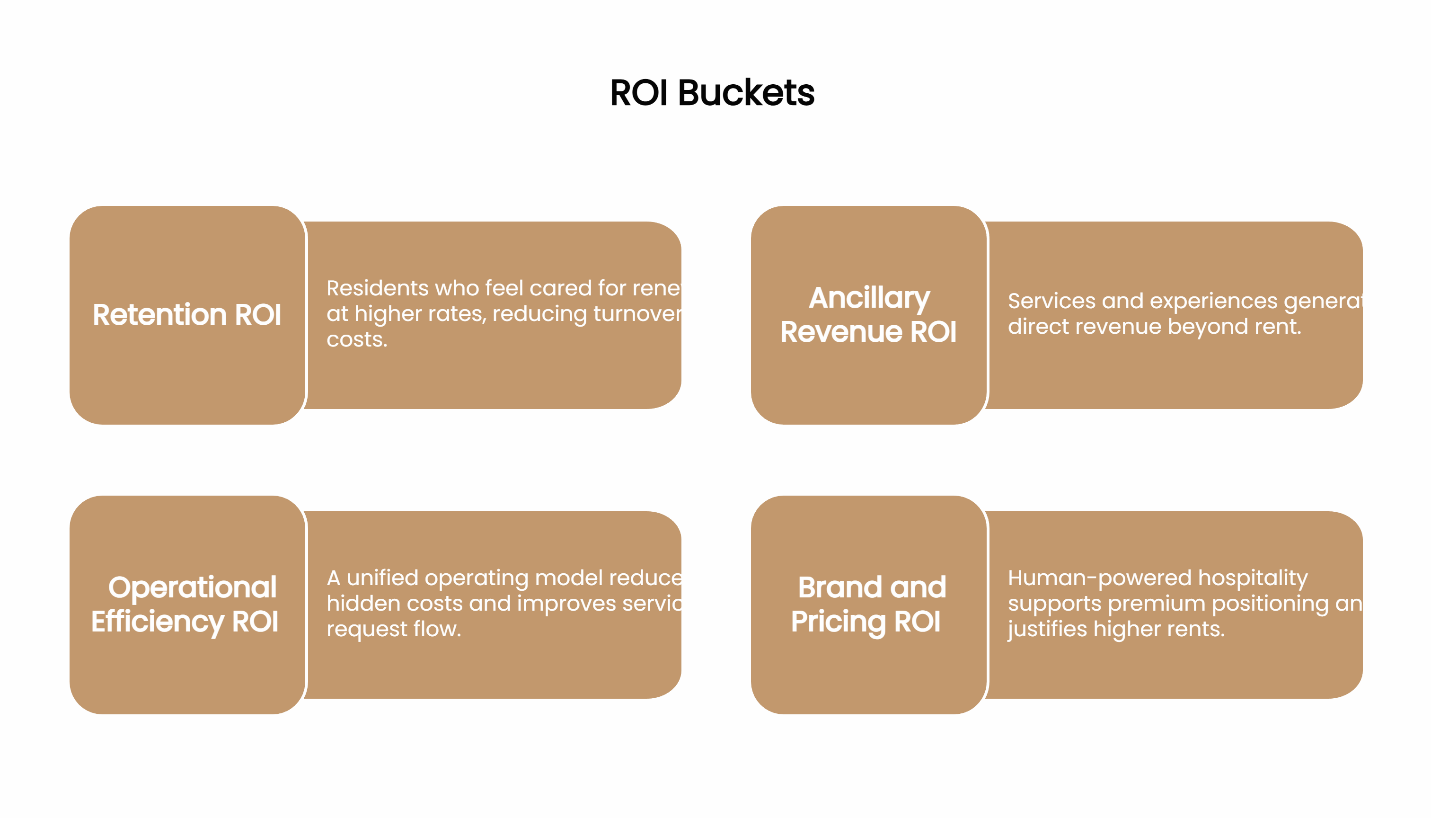
ROI from human-powered hospitality flows into four distinct categories. Each connects to metrics that owners and operators already track. No complex financial models required—just clear thinking about where value accumulates.
Retention ROI
Residents who feel cared for renew at higher rates. This is the most direct path to ROI because turnover is expensive. Every avoided move-out eliminates vacancy loss, turn costs, leasing commissions, and the risk of extended downtime between residents.
The estimation approach is straightforward: calculate your average turnover cost per unit, then track renewal rates among residents who actively engage with services and experiences versus those who don't. The gap reveals the retention premium that hospitality creates.
It's worth noting that renewal decisions are complex. Competitive rent pricing, responsive maintenance, and convenient location remain the foundation. Hospitality creates differentiation when these fundamentals are already in place—it becomes the reason residents choose to stay rather than exploring comparable options in the market.
Ancillary Revenue ROI
Services and experiences can generate direct revenue when managed and marketed well. Housekeeping, pet services, personal training, dry cleaning, and massage therapy represent potential income streams beyond rent.
The revenue potential varies significantly by property type and resident demographics. Urban luxury high-rises with higher-income residents typically see stronger uptake of paid convenience services. Suburban garden-style communities may see different patterns, with some services performing well while others gain little traction. Location, resident schedules, and competitive alternatives all influence whether residents will pay for on-site services.
When these services do gain adoption, the key is making them easy to discover, easy to book, and consistently delivered at quality standards residents trust. This works best when booking and communication happen in one place, such as resident-facing personal services and events and experiences programming.
The operational reality is that lifestyle services require careful management. Margins can be thin, coordination demands attention, and not every service will resonate with every resident population. Success comes from starting focused, measuring actual uptake, and expanding based on demonstrated demand rather than assumptions.
Operational Efficiency ROI
A unified operating model reduces the hidden costs of fragmentation. Staff spend less time troubleshooting tool conflicts, chasing updates across systems, and manually routing requests. Service requests flow cleanly from submission to resolution with clear ownership at each step.
Efficiency gains typically come from eliminating duplicate steps: fewer back-and-forth messages to coordinate availability, cleaner routing where requests go to the right owner the first time, fewer escalations caused by unclear responsibility, and better visibility into status and patterns.
This efficiency shows up in reduced labor hours per resolved issue, fewer escalations caused by coordination failures, and lower stress among property teams managing daily operations.
Brand and Pricing ROI
Class A assets earn their market position through multiple factors: location, physical finishes, amenities, management quality, and consistent service delivery. In competitive markets where several properties offer comparable physical products at similar price points, the resident experience becomes a meaningful differentiator.
Human-powered hospitality supports premium positioning by delivering on the lifestyle promise that Class A branding suggests. When residents consistently describe their community as "like living in a hotel" or "the staff actually knows me," that perception reinforces the decision to pay a premium over less attentive alternatives.
This doesn't mean hospitality alone drives rent levels—market supply and demand, comparable rents, and property fundamentals establish the pricing floor and ceiling. What hospitality does is help justify and protect positioning within that range, particularly when competing properties offer similar physical features. It becomes harder for residents to justify leaving when the service experience genuinely stands out.
Over time, consistent service, confident communication, and a community that runs smoothly helps maintain occupancy and reduces the need for aggressive concessions during lease-up or renewal periods.
Technology should be invisible; hospitality should be felt.
This is the operating principle that ties all four ROI buckets together. Residents shouldn't notice your tech stack. They should notice how easy everything feels and how well they're treated.
Interested in exploring how a unified resident experience model works? See how our management portal brings it together.
The Tech + Touch Operating Model
The platform runs logistics while the team delivers the moment.
A typical service request flows through this model in five stages:
- Booking – Resident requests service through the app
- Routing – Platform directs request to the right resource
- Confirmation – Automated scheduling and calendar updates
- Delivery – Service provider executes with attention to resident preferences
- Feedback loop – Resident reviews experience; data informs continuous improvement
Here's how it works in practice: A resident books a housekeeping appointment through the branded resident app. The platform confirms the booking, notifies the service provider, and adds the appointment to the resident's calendar. The housekeeper arrives on time because the system managed the scheduling complexity. But the experience becomes memorable because the housekeeper remembers this resident's preferences from previous visits and proactively handles a detail the resident didn't think to request.
After the service, the platform prompts for feedback. That feedback loops back to management, creating visibility into service quality that enables continuous improvement. The resident sees only seamless execution. Behind the scenes, technology and people collaborated at every step.
This model requires three elements working together:
Clear service standards that define what "good" looks like for each touchpoint. Without standards, quality varies based on who's working that day.
Intelligent routing that matches requests with the right resources based on timing, location, skillset, and capacity. The platform makes this efficient; humans make the final judgment calls.
Closed feedback loops that surface problems quickly and celebrate wins consistently. What gets measured gets managed. What gets celebrated gets repeated.
Amenity management follows the same pattern. The platform handles reservations, capacity limits, and automated reminders. Staff ensure the spaces are welcoming, address issues that arise during use, and create the feeling that someone cares about the resident's experience.
Operationally, this model benefits from clear roles and escalation paths. A unified hub keeps requests, communications, and reporting in one place so small teams can focus on delivery rather than coordination chaos.
How to Start Small: A 30-Day Pilot Without Hiring a Large Team
Transformation doesn't require a massive upfront investment. Start with a focused pilot that proves the model before scaling.
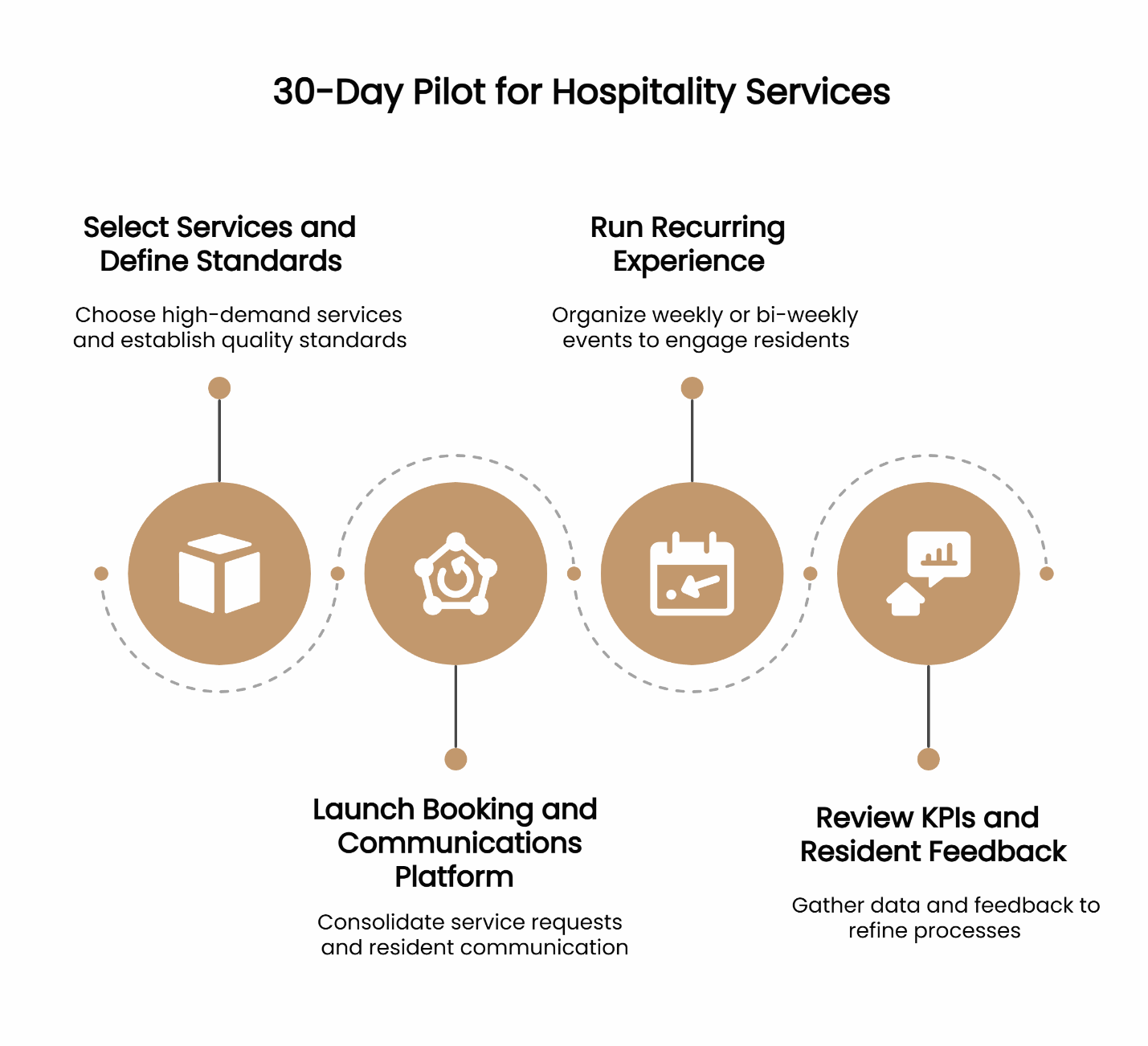
Week 1: Pick Your Services and Define Standards
Select one or two high-demand services where you can deliver consistent quality. Housekeeping and package handling are common starting points because demand is predictable and quality is measurable.
Write down what "excellent" looks like for each service. How quickly should requests be acknowledged? What does successful completion include? How will you handle problems? Define these standards clearly so delivery doesn't depend on whoever happens to be working that day.
Week 2: Launch Booking and Communications in One Place
Consolidate service requests and resident communication into a single platform. Eliminate the app-hopping that frustrates residents and fragments your team's attention. Even basic consolidation produces immediate relief for both sides.
Set up the booking workflow with automated confirmations and clear routing rules. Test the system with a small group of residents before opening it to the full community.
Week 3: Run One Recurring Experience
Add a weekly or bi-weekly experience that brings residents together. This doesn't require elaborate planning. A weekday coffee hour, a pet-friendly social in the courtyard, or a simple fitness class in the amenity space. The goal is creating a predictable touchpoint where residents interact with each other and your team in a relaxed setting.
Make the experience easy to discover and RSVP through the same platform handling service bookings. Track attendance and gather quick feedback after each event.
Week 4: Review KPIs and Resident Feedback
Gather data on adoption, satisfaction, and operational efficiency. What worked? What caused friction? Where did residents express delight or frustration? Use this feedback to tighten your processes before expanding scope.
Schedule a review meeting with your team to assess results against the goals you set in Week 1. Decide which elements to keep, which to adjust, and whether to expand to additional services.
This four-week cycle produces real learning with minimal risk. You'll know whether the model works for your community before committing to broader implementation.
All services and events are accessible to every resident under consistent rules, with transparent policies for sign-ups, capacity, and pricing from day one. This ensures equal opportunity and maintains compliance throughout the pilot and beyond.
Common Objections (And How to Answer Them)
"Our PMS portal already does this."
Property management system portals handle transactions. They process rent payments, log maintenance requests, and store lease documents. These are important functions. They are not hospitality.
Hospitality is experiential. It's the difference between submitting a service request and feeling confident that someone capable will handle it well. Portals don't create that feeling. People do, supported by technology designed for experience delivery rather than transaction processing. The question is not whether a request can be submitted; it is whether the community delivers a consistent, premium service moment end-to-end.
"People are expensive."
People are an investment with measurable returns. The four ROI buckets described earlier—retention, ancillary revenue, operational efficiency, and brand perception—all generate value that offsets and often exceeds the cost of human-powered service delivery.
The pilot approach also manages this concern directly. Start small, measure results, and scale based on evidence rather than assumption. Communities that run disciplined pilots typically find the business case becomes obvious within the first quarter. Use the four ROI buckets, run a small pilot, and prove value before expanding scope.
"Residents won't use it."
Adoption struggles usually signal a consolidation problem, not a demand problem. Residents resist downloading yet another app for yet another fragmented service. They embrace solutions that simplify their lives by bringing everything into one place.
When booking services, reserving amenities, communicating with management, and accessing community information all happen through a single intuitive interface, usage follows naturally. The key is reducing friction rather than adding another tool to an already crowded experience. When residents can complete daily tasks and book services through a unified experience, usage becomes a habit instead of a chore.
How to Measure Success: Simple KPIs You Can Track Now
Sophisticated analytics come later. Start with metrics you can capture immediately:
- Renewal rate trend: Track month-over-month and compare service-engaged residents versus non-engaged residents
- Amenity utilization: Measure booking volume and actual usage for key spaces
- Service attach rate: What percentage of residents book at least one service per quarter?
- Time-to-resolution: How quickly do service requests move from submission to completion?
- App adoption: What percentage of residents actively use the platform monthly?
- Resident pulse score: A simple 1-5 rating collected periodically asking "How satisfied are you with living here?"
These six metrics provide a baseline for understanding whether human-powered hospitality is creating measurable value. They're simple enough to track without dedicated analytics infrastructure yet meaningful enough to inform real decisions.
For teams looking for a practical implementation tool, consider a simple KPI scorecard using a traffic-light format (green/yellow/red) that can be reviewed weekly with the on-site team.
The goal isn't perfect measurement. It's directional clarity. Are things getting better? Where should you focus next? Which investments are paying off?
Frequently Asked Questions
Is concierge service worth it in multifamily communities?
For Class A communities competing on lifestyle rather than just location and finishes, concierge-style service creates meaningful differentiation. The worth depends on execution quality and alignment with resident expectations. Done well, it supports retention, generates ancillary revenue, and reinforces premium positioning. When designed as an operating model tied to outcomes like retention, ancillary revenue, and faster resolution times, value becomes measurable rather than aspirational.
What is human-powered hospitality in a resident experience program?
It's the combination of human service delivery and technology coordination that creates consistent, high-quality experiences across the resident journey. Technology handles logistics and removes friction. People deliver the personal touches, judgment calls, and relationship moments that residents remember. Specifically, it means resident-facing services delivered by people—concierge-style support, service partners, experience hosts—coordinated through a unified platform so delivery is consistent, measurable, and scalable.
How do services and experiences impact resident retention?
Residents who engage with services and community experiences develop stronger connections to their building and neighbors. These connections create switching costs that pure amenity access doesn't. Moving means losing not just a physical space but a lifestyle ecosystem that took time to build. Services and experiences increase the feeling of care, convenience, and belonging, which are common drivers of renewal decisions.
How can a small management team deliver hotel-level service?
By using a unified platform that automates coordination, routing, and communication, then focusing human attention on the moments that matter most. Small teams can deliver exceptional service when they're not drowning in administrative friction and tool fragmentation. Start by consolidating workflows, defining service standards, routing requests cleanly, and piloting one or two high-demand services first, then expanding based on KPI results.
What KPIs prove resident experience ROI?
Start with renewal rates, service revenue, time-to-resolution, and resident satisfaction scores. These metrics connect directly to financial outcomes and can be tracked without sophisticated infrastructure. More advanced analytics can layer in over time as the program matures. Specifically: renewal trends, time-to-resolution, service attach rate, amenity utilization, adoption and active usage, and a simple resident pulse score provide practical signals that matter.
Make Technology Invisible and Hospitality Unforgettable
The best technology disappears. Residents don't notice the platform routing their requests, syncing their calendars, or coordinating service providers behind the scenes. They notice that everything works, that someone always seems to anticipate their needs, and that living in their community feels genuinely different from anywhere else they've lived.
This is the operating system mindset. Technology powers the infrastructure. People deliver the experience. The combination creates ROI that neither achieves alone.
Class A communities face rising expectations from residents who compare their living experience to the best service they receive anywhere—hotels, airlines, premium retail. Meeting these expectations doesn't require unlimited budgets. It requires an operating model designed for hospitality rather than just property management.
Human-powered hospitality is not about adding headcount for the sake of it. It is about designing a resident experience operating model where technology coordinates the work and people deliver the moments residents remember. When done well, ROI shows up across retention, revenue, efficiency, and brand strength, even for small teams.
Start with a pilot. Measure what matters. Let the results guide your next steps.
Technology should be invisible; hospitality should be felt.
Ready to see how human-powered hospitality could work in your community? Schedule a demo to explore the model in detail.
Explore more about ElevateOS on our Better Business Bureau profile, connect with us on LinkedIn, or follow us on Instagram and Facebook.
About the ElevatedOS Insights Team
The ElevatedOS Insights Team is our dedicated engine for synthesizing complex topics into clear, helpful guides. While our content is thoroughly reviewed for clarity and accuracy, it is for informational purposes and should not replace professional advice.