.avif)
📌 Key Takeaways
Stop the churn-time scramble—standardize move-ins and move-outs with one platform.
Unify the Workflow: Centralize every onboarding and move-out task, owner, and due-by in a single source of truth to restore Experience Flow.
Enforce Ownership with Time-Bound Checklists: Assign one clear owner per step with explicit sign-offs and deadlines to prevent missed tasks and protect NOI.
Automate to Reduce Errors: Use reminders, approvals, and role-based permissions to reduce handoff risk, save staff time, and keep service consistent.
Prepare for Exceptions: Deploy surge templates, designate secondary owners, and activate access contingencies to handle peak weeks, PTO overlaps, and elevator outages without service degradation.
Measure What Matters: Track time to key handoffs, first-week ticket volume, on-time completion rates, and review sentiment to sustain standards across seasons.
Standardize now; deliver clear, consistent, auditable resident experiences.
Onboarding shouldn’t feel this chaotic.
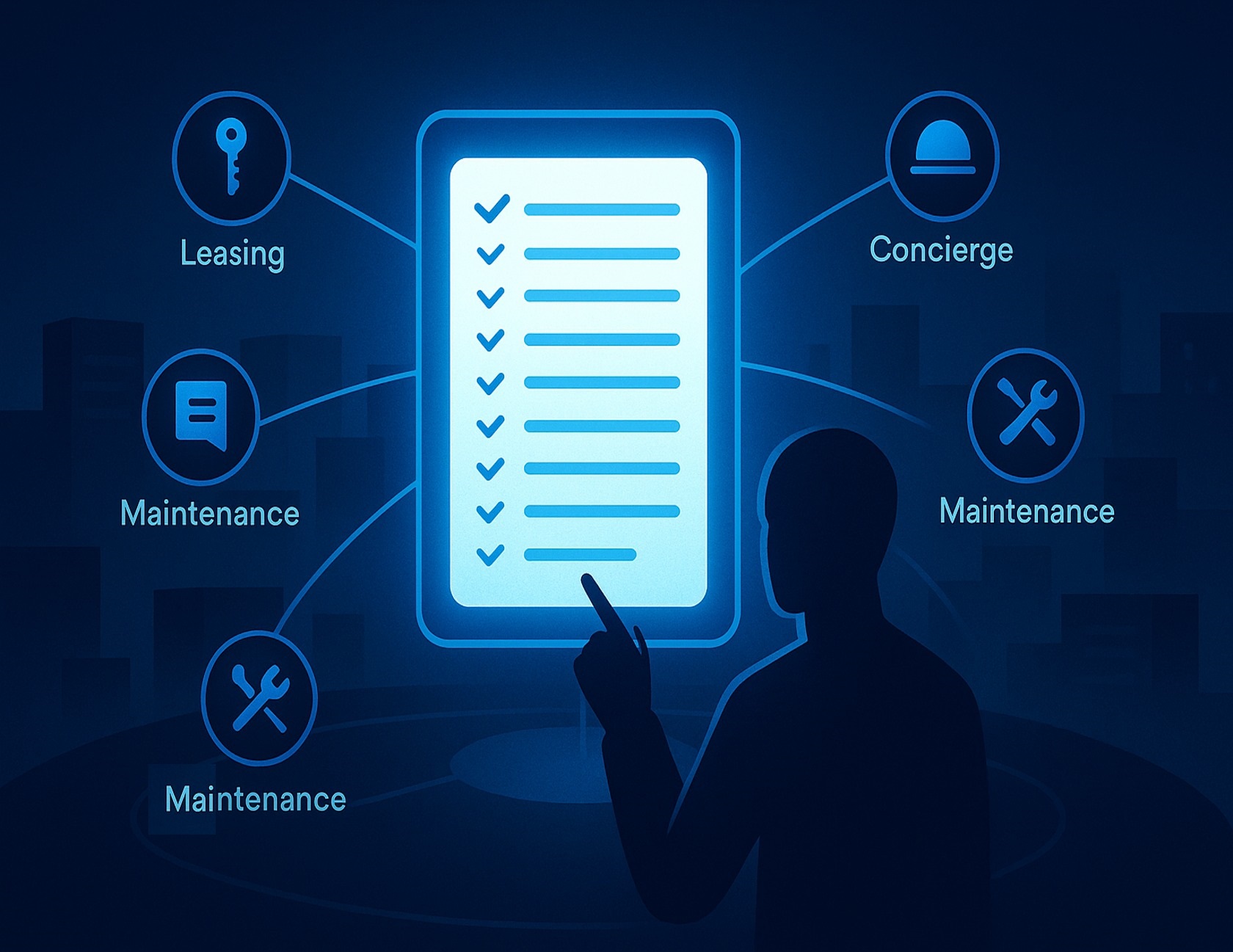
The conference room is quiet except for the staccato clicks of a spreadsheet scrolling. It’s month-end. Elevators are booked, two associates are out on PTO, keys are missing for 3B, and a resident just posted a one-star review about a confusing move-in. Leasing, concierge, and maintenance are all doing the right things—just not at the right time, in the same place, with the same information.
If that sounds familiar, this guide was built for you. The goal is simple: give operations leaders a repeatable, auditable way to run resident onboarding and move-out without more apps, guesswork, or dropped balls.
Picture a different week: one platform shows every move-in and move-out in a single view; owners and due-bys are clear; residents receive one consolidated message the day before arrival confirming keys, elevator, parking, and Wi-Fi setup. That’s what a Unified Living Ecosystem feels like—steady Experience Flow instead of scramble.
When Experience Fragmentation Breaks Move-In and Move-Out
Property management software is a component hub for onboarding and move-in/move-out workflows. Said another way, the platform should coordinate people (roles and permissions), process (step sequencing and SLAs), and technology (integrations and audit trails). Property management software enables operational efficiency and time recovery by removing duplicate entry and manual handoffs. Property management software reduces app fatigue and error risk by centralizing tasks and communications. These relationships are foundational for Class A operations.
In fragmented environments, small misses compound into visible service failures: duplicate data entry creates contradictory messages; unclear handoffs delay deposits or keys; untracked exceptions lead to refunds and reputation damage. Industry guidance consistently favors standard operating procedures, checklists, and auditability to maintain service quality—especially during turnover and peak periods. (recognition.boma.org, IREM)

The “Before” State: Manual Handoffs and App Fatigue Create Errors
Disjointed Tools Multiply Tasks and Hide Ownership
Multiple apps for messaging, reservations, access, and inspections mean nothing lives in one place. Owners become unclear, and time is lost asking “who has it?” rather than “what’s next?”
Unclear Handoffs Create Missed Steps and Refund Risk
When steps are tracked in spreadsheets or email threads, shifts change and items stall. Without permissions, alerts, and a formal audit trail, even diligent teams can miss a prerequisite that later snowballs into claims or concessions. (This is why mature programs formalize SOPs with sign-offs and documentation.) (recognition.boma.org)
The “After” State: A Unified Property Management Model Restores Experience Flow
One Platform Centralizes Tasks, Owners, and Timelines
A unified platform such as a modern property management software becomes the single source of truth for every onboarding/move-out task, owner, and due-by. The result is predictable execution across buildings and seasons.
Automated Notifications and Role Permissions Reduce Errors
Automations—reminders, approvals, permissions—cut handoff risk and staff time, and they create consistent service even during surges. General research on operations automation shows time reductions and error elimination when workflows are redesigned with controls and auditability. (McKinsey & Company)
Why this works: automation handles the routine; role-based permissions keep ownership explicit; audit trails allow managers to review exceptions rather than hunt for them later. In practice, that’s less rework, faster handoffs, and calmer residents.
The Bridge: Your 12-Step Digital Onboarding & Move-Out Checklist
Unify onboarding to restore Experience Flow.
This is a 12-step, owner-assigned checklist designed for Class A communities. Each step includes: Owner, Due-By (relative to move-in/out), and a Checkpoint (pass/fail). Implement inside your core platform with PMS integration so tasks sync to the resident record.
- Application & Screening Finalization
Owner: Leasing | Due-By: T-14 | Checkpoint: All screening approvals recorded; compliance docs attached. - Lease Countersignature & Deposits
Owner: Leasing | Due-By: T-10 | Checkpoint: Executed lease + deposit/fees posted to PMS; e-receipt sent. - Insurance & Utilities Pre-Verification
Owner: Leasing | Due-By: T-7 | Checkpoint: Proof of renters’ insurance on file; utilities/Internet pre-activation verified. - Elevator & Loading Zone Reservation
Owner: Concierge | Due-By: T-5 | Checkpoint: Reservation confirmed in system; move window shared with resident. - Access Credentials Provisioning (Keys, Fobs, App Access)
Owner: Concierge/IT | Due-By: T-3 | Checkpoint: Credentials staged; mobile access tested. - Parking/Locker Assignment & Registration
Owner: Concierge | Due-By: T-3 | Checkpoint: Stall/locker assigned; license/plate registered. - Unit Readiness & Photos (Pre-Move-In)
Owner: Maintenance | Due-By: T-2 | Checkpoint: Work orders closed; timestamped condition photos uploaded. - Pre-Arrival Resident Message (Unified)
Owner: Concierge | Due-By: T-1 | Checkpoint: Single consolidated message sent (keys/elevator/parking/Wi-Fi/app instructions). - Day-0 Handoff at Desk/Loading Dock
Owner: Concierge | Due-By: Day-0 | Checkpoint: ID match; credentials issued; elevator escort as needed. - Welcome & App Onboarding
Owner: Community Team | Due-By: Day-0 | Checkpoint: Resident joins resident experience platform; amenity rules acknowledged. - First-Week Follow-Up & Ticket Sweep
Owner: Maintenance | Due-By: Day+7 | Checkpoint: Initial tickets resolved; satisfaction check sent from the same platform. - Move-Out Walk-Through & Key Return (When Applicable)
Owner: Maintenance/Concierge | Due-By: Move-out Day | Checkpoint: Keys/fobs returned; condition photos; charges documented; forwarding info logged.
Why these steps matter: standardization, role clarity, and audit trails make service levels repeatable and defensible across periods and personnel changes. Industry bodies consistently codify checklists and SOPs for this reason. (IREM, recognition.boma.org)
Outcome hook: Less rework, faster handoffs, and a more consistent resident experience.
Exception Playbook: What to Do When Plans Meet Reality
Peak Turnover Weeks (Month-End, University Calendars)
- Activate a “surge” checklist template with tighter SLA thresholds.
- Pre-batch communications inside the platform; send one consolidated message per resident.
- Expand loading dock windows and stagger bookings; publish availability in-app.
Staff PTO Overlaps and Temporary Coverage
- Pre-assign secondary owners on critical steps; enable auto-reassignment when primary is unavailable.
- Use role-based permissions so float staff can execute without credential gaps.
- Schedule a daily 10-minute “exceptions stand-up” to clear blockers.
Elevator/Access Disruptions and Alternative Procedures
- Flip to a contingency access flow (stairs pathing, added staff escorts).
- Offer flexible windows and clear signage; update the resident’s in-app instructions.
- Log the exception reason on the checklist for audit and make-good review.
Day-to-Day Application: Role Clarity and SLA Guardrails
Who Owns What—and When—Across Leasing, Concierge, and Maintenance
Ownership follows the lifecycle. Leasing owns readiness through countersignature and deposits; concierge owns logistics and communications from elevator booking through credentialing; maintenance owns condition, photos, and first-week ticket sweeps. Cross-team overlap is expected—but responsibility is not shared. Each line item has a single owner, even when multiple teams contribute.
SLA Thresholds, Checkpoint Sign-Offs, and Audit Trails
Set due-bys relative to move dates (T-10, T-5, T-1, Day-0, Day+7) and enforce them with platform alerts and checkpoint sign-offs. The aim is not “more process” but fewer surprises. Look, this is the part where most teams get tripped up: if a step can complete without a recorded sign-off, it will eventually be skipped under pressure. Require sign-offs and keep the audit trail intact for reviews and claims defense. (General operations literature supports SOPs and checklists to ensure consistent outcomes.) (recognition.boma.org)
Myth & Fact
Myth: Onboarding can’t be standardized across buildings with different amenities.
Fact: Standardize the sequence and sign-offs; handle amenity-specific variation with templates and conditional tasks inside the platform.
Common Pitfalls to Avoid When Standardizing Onboarding & Move-Out
Spreadsheet Checklists Without Owners
Spreadsheets don’t enforce permissions, alerts, or audit trails; tasks stall the moment shifts rotate or a teammate is out.
Ignoring Exception Scenarios
Month-end surges, PTO overlaps, and access outages are predictable. Prebuild the playbooks and assign secondary owners so coverage is automatic.
Fragmented Messaging
Email here, SMS there, app somewhere else—contradictions are inevitable. Consolidate to a single messaging layer in your resident engagement platform.
What If… Peak Turnover Overlaps With Staff PTO?
- Pre-schedule float coverage two weeks ahead based on projected move counts.
- Pre-assign secondary owners for all SLA-critical steps in the checklist.
- Activate a “surge” template with tightened SLAs, then review audit logs weekly to tune capacity.
Core Concept Deep Dive: Role-Based, Time-Bound Checklists
Critical importance. Checklists with explicit owners and due-bys prevent dropped balls and drive consistent service.
Common misconception. “A generic spreadsheet is enough.” It isn’t—spreadsheets lack permissions, alerts, and audit trails, which are the controls that sustain service standards. (IREM)
Real-world implications. Permissioned, time-bound checklists promote repeatability across seasons and teams; in practice, they are the backbone of SOPs recognized in building programs. (recognition.boma.org)
- Definition: A unified property management platform = the centralized system coordinating onboarding/move-out tasks, owners, and communications.
- Analogy: Think of it like an airline pre-flight checklist—nothing leaves the gate until each role signs off.
- Experiential scenario: The day before move-in, the resident receives one app message confirming keys, elevator, parking, and Wi-Fi setup—each item triggered by the same checklist state.
- Action: Adopt the checklist above inside your platform today and assign owners/due-bys to make execution automatic.
How Consolidation Eliminates App Fatigue During Onboarding
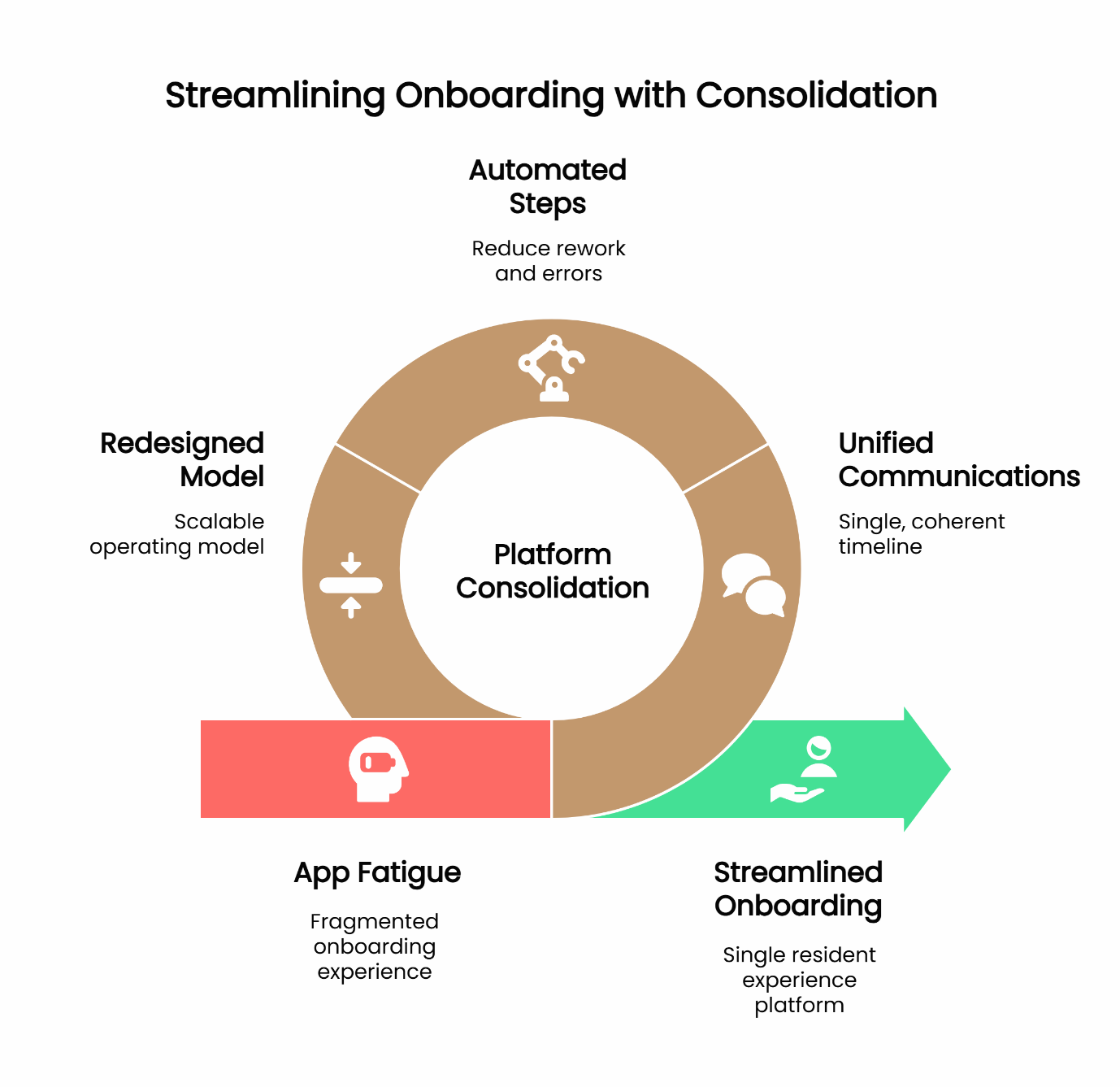
Consolidation replaces fragmented micro-tools with a single resident experience platform that handles communications, reservations, access, and follow-ups in one place. From a business perspective, this reduces context switching, duplicate data entry, and “who owns this?” confusion. From a resident’s perspective, it reduces messages to a single, coherent timeline. Independent research in services operations suggests that automating routine steps with embedded controls reduces rework and human error—especially when the operating model is redesigned to scale. (McKinsey & Company)
Frequently Unasked Question
The question to start asking: How will we measure onboarding success across buildings and seasons?
Why it matters: Without a small set of shared metrics, teams drift back to ad hoc practices.
Expert answer (standard measures to track):
- Time to key handoffs (percentage of residents receiving credentials on time)
- First-week ticket volume (trend and resolution time)
- On-time completion rate for checklist tasks
- Review sentiment during move-in/move-out windows
From Fragmented Handoffs to a Unified Living Ecosystem
According to the ElevateOS framework, the path forward is to standardize today so you can fund tomorrow: one platform for people, process, and technology; one 12-step checklist that enforces owners, due-bys, and sign-offs; one messaging layer for consistent resident touchpoints. The “before” state was scramble and second-guessing; the “after” state is clarity and cadence. Clear. Consistent. Auditable.
Looking ahead. As this checklist scales, data from onboarding and move-out will inform staffing models, guide predictive maintenance, and power proactive resident retention across the portfolio. That’s the practical arc from steady daily execution to strategic leadership.
Ready to Standardize Onboarding With Confidence?
Start with a low-commitment step, then choose a deeper engagement when your team is ready.
- Subscribe to Our Newsletter—get practical playbooks for Class A operations.
- When it’s time to evaluate platforms: Schedule a Demo or Get Your Custom Quote.
Smart Next Clicks for Operators
- Explore unified property management software options that centralize onboarding and move-out.
- Strengthen your amenity workflows with amenity management and connect it to the onboarding checklist.
- Build a consistent resident communications layer with the resident experience platform for announcements, reservations, and support.
Sources and Further Reading
- SOPs and auditability in building programs: BOMA 360 Criteria require documented SOPs and proof of program execution. (recognition.boma.org)
- Checklists in property management practice: IREM’s catalog of operational forms includes move-in checklists and stepwise controls commonly used by multifamily teams. (IREM)
- Automation reduces time and error risk: Research on digital operating models shows process automation can meaningfully reduce time and eliminate human error when paired with redesigned controls and audit trails. (McKinsey & Company)
Our Editorial Process
Our expert team uses AI tools to help organize and structure our initial drafts. Every piece is then extensively rewritten, fact-checked, and enriched with first-hand insights and experiences by expert humans on our Insights Team to ensure accuracy and clarity.
About the ElevateOS Insights Team
The ElevateOS Insights Team is our dedicated engine for synthesizing complex topics into clear, helpful guides. While our content is thoroughly reviewed for clarity and accuracy, it is for informational purposes and should not replace professional advice.