.avif)

📌 Key Takeaways
A 90-day pilot with shared KPIs eliminates the misalignment that causes Operations, IT, and Finance to measure success differently and delay decisions indefinitely.
- Shared Metrics End Stakeholder Conflicts: When Operations, IT, and Finance track identical KPIs on a single scorecard reviewed weekly, accountability becomes clear and the go/no-go decision shifts from political negotiation to data-driven outcome.
- Leading Indicators Drive Early Momentum: Time-to-first-value, activation rates, and SLA adherence reveal adoption health within weeks, while lagging indicators like renewal intent and support backlog trends validate sustained operational impact by week 12.
- Pre-Day 0 Governance Prevents Mid-Pilot Chaos: A RACI matrix with explicit decision rights, a completed security checklist covering SSO and PII handling, and documented escalation paths stop the costly pauses that happen when stakeholders discover gaps after resident onboarding begins.
- The Risk Playbook Keeps Pilots on Track: Predetermined responses to integration delays, bandwidth gaps, and data quality issues—narrowing scope, re-baselining KPIs, and securing executive cover—transform obstacles into managed adjustments rather than pilot-killing blockers.
- Fixed Timeline Forces Disciplined Evaluation: The 30/60/90 blueprint with phase-specific owners, artifacts, and exit criteria prevents scope creep and pilot fatigue by giving every stakeholder a clear endpoint and success definition from day one.
Structure turns evaluation into operational discipline—either the platform meets documented criteria at day 90 and earns portfolio rollout, or it provides clear evidence of gaps requiring resolution.
Multifamily property management executives and regional operators leading technology evaluations will find a complete execution framework here, preparing them for the detailed governance structures, KPI definitions, and phase-specific workstreams that follow.
This 90-day pilot plan shows how Operations, IT, and Finance align on a unified resident experience platform. Use the pre-Day 0 governance checklist, the 30/60/90 execution blueprint, and the KPI scorecard to reach time-to-first-value, de-risk integrations, and make a clear go/no-go decision with documented owners, artifacts, and exits.
Running a pilot without stakeholder alignment creates three separate agendas. Operations wants faster resident onboarding. IT needs security sign-offs and integration testing. Finance demands a clear ROI case before portfolio rollout. A 90-day structured pilot resolves this by giving each function shared KPIs, weekly visibility, and predefined exit criteria. When all three groups review the same scorecard at week 12, the go/no-go decision becomes straightforward.
Why a 90-Day pilot reduces cross-functional risk and accelerates time-to-value
It solves the Ops/IT/Finance alignment problem with shared KPIs and exits
Technology evaluations often extend indefinitely when stakeholders measure success differently. Operations tracks resident adoption rates. IT monitors integration stability and security incidents. Finance watches cost per unit and payback periods. Without shared metrics, pilot "success" means different things to different teams, delaying the purchase decision and creating scope creep.
A 90-day window forces discipline. Each stakeholder commits to specific leading indicators—activation rates, SLA adherence, time-to-first-value—and lagging indicators like renewal intent and support ticket trends. Document these KPIs in a RACI matrix before Day 0. Assign a single owner per metric, clarify who gets consulted, and define escalation paths when thresholds aren't met.
The control-tower model: one platform, one scorecard, shared outcomes
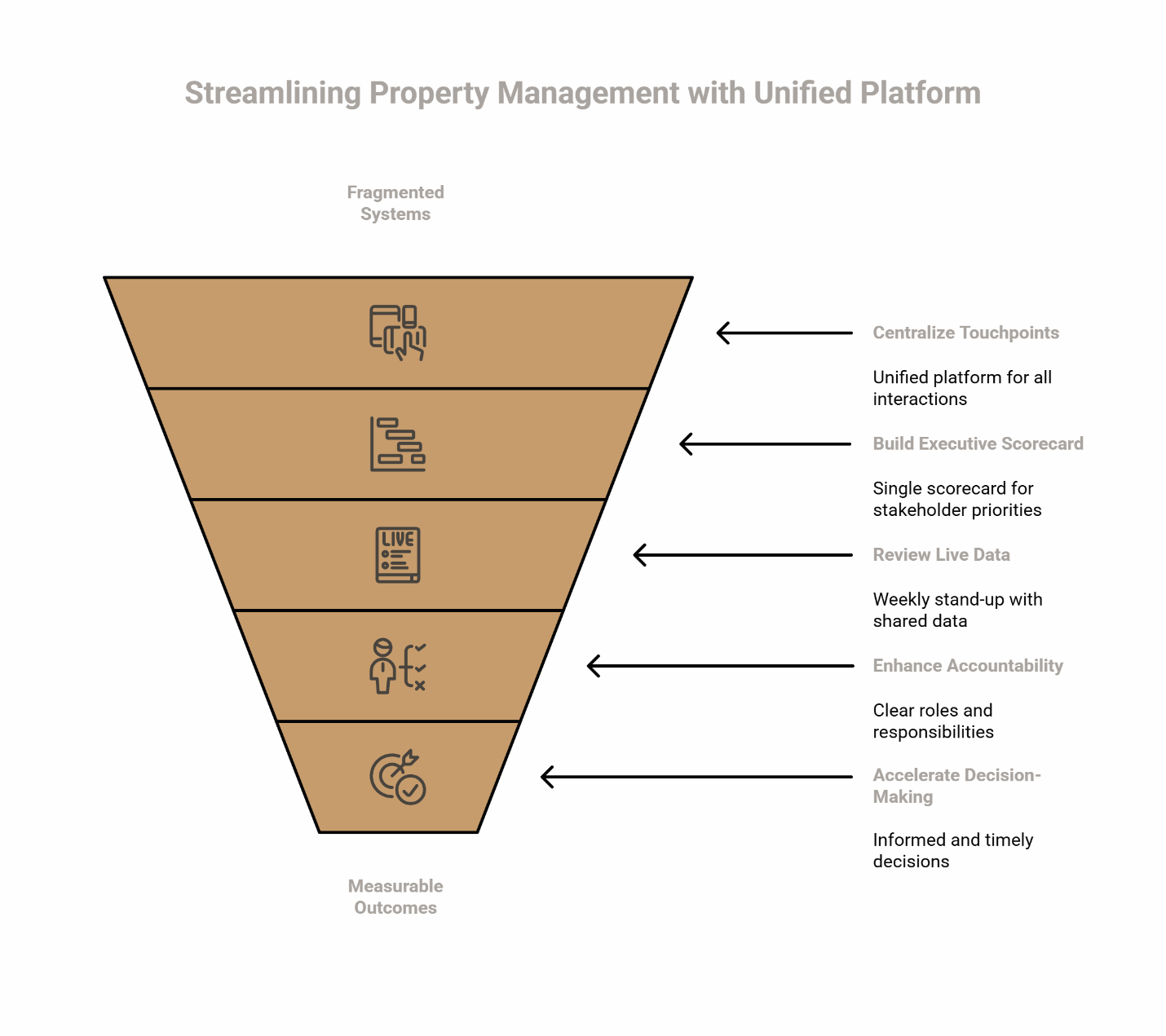
Fragmented systems create invisible costs. Residents juggle separate portals for rent payments, amenity bookings, and maintenance requests. On-site teams toggle between vendor dashboards. Property managers reconcile reports that don't align. A Resident Experience Platform centralizes these touchpoints, but the pilot must demonstrate this consolidation advantage quantitatively.
Build a single executive scorecard that updates weekly. Include columns for each stakeholder's priority: activation velocity for Ops, integration health for IT, cost per transaction for Finance. Populate it with live data from the pilot properties. When all three functions review identical numbers at the weekly stand-up, accountability becomes clear and decision-making accelerates.
The control-tower approach also prevents pilot fatigue. Teams know exactly when the evaluation ends, what success looks like, and who decides. This structure transforms a vague "let's try it" into a bounded experiment with measurable outcomes. For detailed guidance on how the platform orchestrates amenities, communications, and service workflows while capturing engagement data, see Amenity Management.
The pilot governance you need before Day 0
RACI & decision rights (template + sign-offs)
Start with a RACI swimlane that maps every critical decision to a single Responsible party, identifies who must Approve, lists who gets Consulted, and notes who should be Informed. For a Unified Resident Experience Platform pilot, typical decision rights include:
Operations: Responsible for user cohort selection, onboarding workflow design, and resident communication cadence. Approves training schedules and onsite champion assignments.
IT: Responsible for SSO configuration, API integration testing, and security audit completion. Approves production environment setup and vendor access controls.
Finance: Responsible for budget allocation, cost tracking, and ROI model validation. Approves contract terms and any scope changes that affect pricing.
Document these roles in a shared template. Require sign-off from all three functional leaders before kickoff. This prevents mid-pilot conflicts over who authorized a scope expansion or why a security step was skipped. When integration delays occur—and they will—the RACI tells you exactly who owns the escalation and who must approve the new timeline.
Security & data checklist (SSO, PII handling, audit logging)
IT and compliance teams need specific confirmations before resident data flows into a new platform. Create a pre-Day 1 security checklist that includes:
Single sign-on (SSO) setup: Confirm identity provider integration and test multi-factor authentication flows. Align practices with NIST Digital Identity Guidelines for authentication assurance levels appropriate to multifamily environments.
PII handling review: Document what resident data the platform will store, where it resides, and who can access it. Verify encryption standards for data at rest and in transit.
Audit logging enablement: Ensure the platform tracks user actions, system changes, and access attempts. Logs support post-incident investigation and compliance audits.
Vendor access controls: Define which vendor personnel can access production data and under what conditions. Require approval workflows for any elevated permissions. Follow CISA guidance on secure SaaS integrations for principle-of-least-privilege and vendor access controls.
Completing this checklist before the pilot goes live prevents the costly pause that happens when IT discovers a security gap mid-deployment.
Define success criteria (leading vs. lagging KPIs)
Not all KPIs move at the same speed. Leading indicators appear within days or weeks. Lagging indicators take months. A balanced scorecard tracks both.
Leading KPIs (weeks 1-8):
- Time-to-first-value: Days from account creation to first platform interaction
- Activation rate: Percentage of invited residents who complete onboarding
- SLA adherence: Percentage of service requests resolved within target timeframes
Lagging KPIs (weeks 9-12):
- Renewal intent signals: Net Promoter Score movement or lease renewal conversations
- Support backlog trend: Week-over-week change in open tickets or escalations
- Operational efficiency: Reduction in manual tasks or vendor touchpoints
Supplement quantitative metrics with qualitative feedback. Schedule brief check-ins with onsite teams to surface what's working, what's confusing, and where they're improvising workarounds. This qualitative layer catches issues that numbers miss—like a confusing menu structure that drives residents to call the leasing office instead of using the app.
The 30/60/90 execution blueprint
Table 1: 30/60/90 pilot blueprint with owners, artifacts, and exit criteria
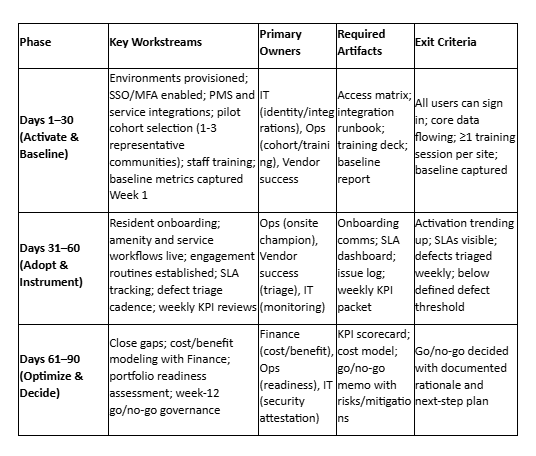
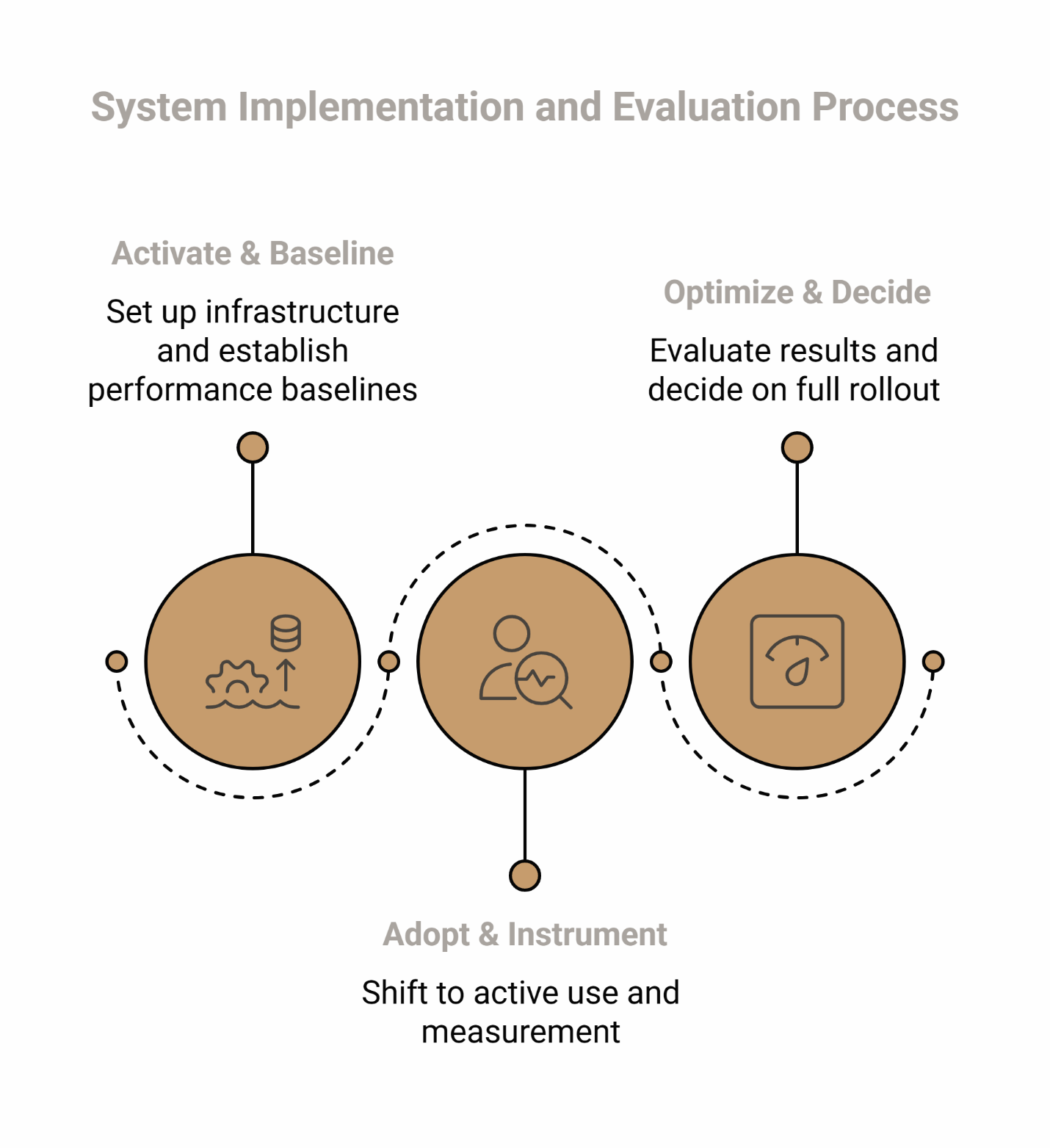
Days 1–30 (Activate & Baseline): environments, integrations, user cohorts, training
The first month establishes infrastructure and captures baseline performance. IT provisions the production environment and completes SSO integration. Ops selects pilot properties—ideally 1-3 communities that represent the portfolio's diversity in size, age, and resident demographics. Avoid choosing only your newest, highest-performing asset; the pilot needs to reveal how the platform performs under typical conditions.
Define a clear user cohort. Start with new move-ins if onboarding workflows are a priority, or current residents if you're testing amenity management features.
Train onsite champions before resident onboarding begins. These champions—typically leasing consultants or community managers—become the first line of support. They need hands-on experience with every resident-facing workflow before they start answering questions.
Record baseline metrics during the first weeks. How long does resident onboarding currently take? What's the average response time for maintenance requests? How many separate logins do residents juggle today? These baselines become the reference points for measuring improvement. Expand the pilot to additional cohorts after week 6 if KPIs trend positive.
Days 31–60 (Adopt & Instrument): engagement routines, SLA tracking, defect triage
Month two shifts from setup to usage. Establish a weekly cadence for reviewing KPIs with all stakeholders. Operations presents activation rates and engagement trends. IT reports integration stability and defect counts. Finance tracks cost per transaction and compares it to legacy vendor invoices.
Instrument SLA tracking from day one. If the platform promises 24-hour response times for maintenance requests, measure actual performance weekly. When SLAs slip, the weekly review surfaces it immediately, and the RACI clarifies who owns the fix.
Defect triage becomes critical during this phase. Not every issue warrants a code fix. Categorize defects by severity and focus vendor engineering time on items that block core workflows. Document lower-priority items for post-pilot consideration.
If KPIs trend positive after week 6—activation rates exceed targets, SLAs hold steady, resident feedback is constructive—expand to additional user cohorts. If numbers lag, hold cohort size constant and investigate root causes before scaling.
Days 61–90 (Optimize & Decide): KPI review, cost/benefit, go/no-go governance
The final month synthesizes findings into a decision. Finance completes the ROI model by comparing pilot costs (platform fees, implementation labor, training time) against measurable benefits (vendor consolidation savings, time saved on manual processes, ancillary revenue from new service offerings). Decoding engagement data from the pilot informs retention and satisfaction projections.
Operations documents qualitative insights. What did onsite teams learn? Which workflows proved intuitive and which need refinement? Where did residents struggle, and what support resources would smooth portfolio rollout?
IT assesses technical readiness. Are integrations stable enough for a 50-property deployment? What security or performance concerns emerged, and how were they resolved? What would need to change for a larger-scale rollout?
Convene a final governance session with executive sponsors. Present the complete scorecard—quantitative KPIs, qualitative feedback, ROI model, and technical assessment. The structured approach makes the go/no-go decision data-driven rather than political. If the pilot met success criteria, approve portfolio rollout with a documented implementation plan. If it didn't, the 90-day investment provided clear evidence of gaps to address before reconsidering.
Staffing & change-management that prevents pilot stalls
Onsite champions, escalation paths, and weekly cadence
Pilots fail when onsite teams lack clarity on their role. Designate one champion per pilot property—someone who knows the resident base, understands operational workflows, and can troubleshoot basic platform issues without escalating to IT. This champion becomes the local expert, the person who fields initial questions and identifies patterns in resident feedback.
Escalation paths must be explicit. When does an issue move from the onsite champion to the vendor's support team? When does IT get involved? When does Finance need visibility? Map these paths in the pre-Day 0 RACI and reinforce them in weekly stand-ups.
Reserve 30-45 minutes weekly for the entire pilot team—Ops, IT, Finance, vendor account manager, onsite champions. Use this time to review the shared scorecard, surface blockers, and commit to action items. Accountability increases when the same people report progress on last week's commitments before discussing new issues.
Early warnings for pilot fatigue—and mitigations
Pilot fatigue sets in when teams perceive the evaluation as never-ending or when early enthusiasm meets operational reality. Watch for these signals:
Slipping attendance in trainings: When scheduled sessions have empty seats or late arrivals, engagement is dropping.
Rising "how-to" tickets: If the same basic questions recur week after week, workflows aren't intuitive enough.
Flat activation early in the pilot: When onboarding numbers plateau, something is blocking adoption—unclear value proposition, technical friction, or competing priorities.
Counter these patterns with micro-refreshers—brief, focused sessions that address specific confusion points rather than repeating full training. Simplify workflows in the platform where friction appears. Deploy tailored resident nudges—targeted communications that highlight specific features based on resident needs or property type.
Mitigate fatigue by reinforcing the fixed timeline. Certainty about the endpoint keeps teams engaged through the finish line.
Your KPI coverage map for go/no-go
Table 2: KPI coverage (leading vs. lagging) with weekly cadence tracking
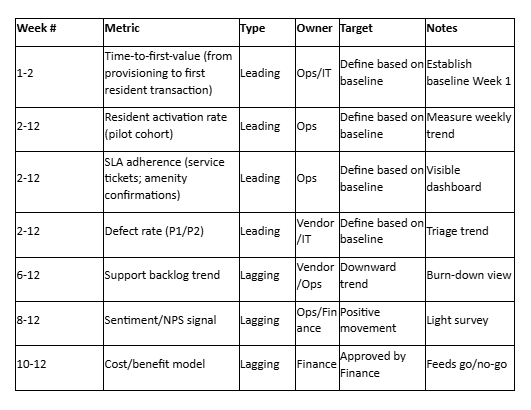
Leading KPIs: time-to-first value, activation, SLA adherence
Leading indicators measure momentum. They answer: Is adoption happening, and is the platform performing as promised?
Time-to-first-value tracks how quickly residents derive benefit after account creation. For a unified platform, this might mean days from move-in to first amenity reservation or first service request submission. Establish your target based on current onboarding timelines; some portfolios target under 3 days for engaged segments and under 7 days for the full cohort, while others adjust these windows based on move-in season and property demographics.
Activation rate measures the percentage of invited residents who complete onboarding and perform a core action—logging in, updating a profile, or booking an amenity. Set your target based on current baseline performance; portfolios typically see meaningful adoption when 60-75% of invited residents activate within the first 8 weeks, though this varies by property type and resident demographics.
SLA adherence tracks whether the platform delivers on service commitments. If maintenance requests should close within 24 hours, measure weekly compliance. Define your target threshold based on current performance—many operations teams aim for 85% or higher, though the appropriate level depends on your service model and staffing.
Lagging KPIs: renewal/NPS signals, support backlog trends
Lagging indicators measure sustained impact. They answer: Is the platform improving resident satisfaction and operational efficiency over time?
Renewal intent and NPS movement won't show dramatic shifts in 90 days, but directional signals matter. If Net Promoter Score improves during the pilot or renewal conversations become more positive, the platform is influencing resident perception. Capture these signals through brief check-ins with leasing teams.
Support backlog trend reveals whether the platform reduces operational burden or creates new work. Track the week-over-week change in open support tickets. If the backlog grows, either adoption is outpacing support capacity or the platform is introducing complexity. If it shrinks, the platform is delivering on the efficiency promise.
A complete KPI coverage map balances these leading and lagging indicators. Leading metrics confirm early traction. Lagging metrics validate whether that traction translates into operational and financial outcomes worth scaling across the portfolio.
Decision rule: If leading KPIs meet target by week 8 and lagging KPIs trend positive by week 12, proceed to scale. If targets aren't met, extend the pilot with narrowed scope or exit. Use Finance's thresholds to define "meets target" and "trends positive" based on your portfolio's specific economics.
What to do if X happens (risk playbook)
Integration delays
API integrations rarely go perfectly. Authentication handshakes fail. Data formats mismatch. Legacy systems lack documentation. When integration delays threaten the pilot timeline, trigger this response:
Narrow scope immediately. Prioritize read-only sync first and sequence writes later. Residents can view data even if updates don't flow back to the property management system. This partial integration keeps the pilot moving while engineering resolves write-back issues.
Re-baseline KPIs with a new exit date. If delays push the pilot timeline, extend the evaluation window or adjust success criteria to account for the shortened assessment period. Document this change in the governance call so all stakeholders operate with the same expectations. Maintain a separate go/no-go date for deferred scope items.
For security considerations during integration hardening, reference CISA SaaS guidance on vendor access controls and least-privilege principles.
Bandwidth gaps
Onsite teams get pulled into leasing priorities, emergency maintenance, or corporate initiatives. When champion availability drops, support quality suffers and pilot momentum stalls. Mitigate bandwidth gaps by:
Reducing cohort size temporarily. If champions are overwhelmed, pause new resident onboarding until they catch up on existing support volume. A smaller, well-supported cohort provides better data than a large, under-resourced one.
Escalating to vendor support faster. If onsite teams lack time for tier-one support, route more questions directly to the vendor. This keeps residents unblocked but may slow issue resolution if vendor support queues are long.
Securing executive cover. When bandwidth constraints stem from competing priorities, escalate to the executive sponsor. They can provide temporary relief by reassigning responsibilities or deferring lower-priority projects. Protect the weekly cadence window and shift noncritical tasks off pilot staff.
Data quality issues
Incomplete or inaccurate data undermines pilot insights. If resident records lack email addresses, activation invitations can't be sent. If unit numbers don't match between systems, amenity reservations fail. When data quality issues surface:
Audit the source system first. Often the problem originates in the property management system, not the pilot platform. Run a data cleanliness check on the legacy system and fix missing or malformed records at the source.
Manually correct critical records. For smaller pilot cohorts, manual data cleanup is feasible. Correct email addresses, phone numbers, and unit assignments in a spreadsheet and re-import. This brute-force approach buys time while you address systemic data hygiene issues.
Document data requirements for portfolio rollout. Use the pilot to create a data quality checklist for future deployments. Which fields are mandatory? What format validations prevent integration failures? Confirm audit logging and identity controls align with NIST digital identity practices. This documentation turns a pilot pain point into a portfolio playbook.
Composite case snapshot
Problem: A regional team managing three Class A properties struggled to coordinate amenity bookings, resident messaging, and service SLAs across fragmented tools. Adoption stalled because staff toggled between multiple vendor dashboards and residents faced inconsistent communication channels.
Solution: The team ran a 90-day pilot on a Unified Resident Experience Platform with SSO, a single engagement scorecard visible to Ops/IT/Finance, and weekly triage sessions. They selected one representative community per market segment and defined 8 shared KPIs with explicit owners.
Qualitative result: Faster time-to-first-value as residents onboarded through a single app instead of three separate portals. Clearer SLA visibility allowed Operations to identify bottlenecks in service request routing. The structured approach produced a documented go/no-go recommendation at week 12 with quantified benefits and a portfolio rollout plan.
This generalized example illustrates the method. Results vary by portfolio baseline, staff capacity, and resident demographics.
A 90-day pilot turns platform evaluation from an open-ended exploration into a bounded experiment with clear outcomes. Operations, IT, and Finance enter with aligned KPIs, review the same scorecard weekly, and reach a go/no-go decision based on documented evidence rather than opinion. The governance structure—RACI assignments, security checklists, weekly cadence—prevents the coordination failures that extend pilots without decision.
The three-phase execution blueprint gives each stakeholder predictable milestones. Month one establishes infrastructure and baselines. Month two tracks adoption and instruments SLAs. Month three synthesizes findings into a decision artifact. When the final governance session convenes, the data tells the story. Either the platform met success criteria and warrants portfolio rollout, or it didn't and the pilot provided clear evidence of gaps to address.
This structured approach doesn't eliminate risk—integrations will slip, bandwidth constraints will surface, data quality issues will emerge. But the risk playbook provides predetermined responses, keeping the pilot on track when obstacles appear. The combination of shared KPIs, weekly governance, and fixed timeline transforms pilot evaluation from a political negotiation into an operational discipline. That discipline is what allows you to reach time-to-first-value, de-risk integrations, and make a confident go/no-go decision at day 90.
Frequently Asked Questions
Is a 90-day pilot enough to see meaningful resident outcomes?
Yes—if you define leading KPIs, instrument SLAs from week one, and schedule a week-12 go/no-go with Finance and IT. The pilot measures momentum (activation rates, time-to-first-value) and early satisfaction signals (support ticket trends, qualitative feedback). Full renewal impact takes longer, but directional evidence emerges within 90 days.
What security checks should happen before day 1?
Complete SSO setup, PII handling review, audit logging enablement, and vendor access controls. Document owners in a RACI. IT should validate encryption standards, test authentication flows, and confirm that the platform logs user actions for compliance audits. Align practices with NIST identity guidance and CISA's SaaS integration recommendations.
How many properties or cohorts should we start with?
Start with 1-3 representative communities and a clear user cohort. Expand after week 6 if KPIs trend positive. Avoid selecting only your newest or highest-performing asset—the pilot needs to reveal how the platform performs under typical conditions.
What staffing do we need on-site?
Name a champion per site, define escalation paths, and reserve 30-45 minutes weekly for training and triage. Champions should be leasing consultants or community managers who know the resident base and can troubleshoot basic issues without escalating to IT. They become the local experts who field initial questions and identify feedback patterns.
How do we judge success beyond activation rates?
Use a balanced scorecard: time-to-first value, SLA adherence, defect rates, sentiment/NPS, backlog trend. Leading indicators confirm early traction. Lagging indicators validate whether traction translates into operational efficiency and resident satisfaction. Supplement quantitative metrics with qualitative feedback from onsite teams.
What if integrations slip?
Trigger the risk playbook: narrow scope, prioritize read-only sync, and re-baseline KPIs with a new exit date. If authentication or data format issues delay bidirectional integration, implement read-only sync first so residents can view data while engineering resolves write-back problems. Document timeline changes in the governance call so all stakeholders adjust expectations together.
Trust & Company Profiles
Our Editorial Process
The ElevateOS Insights Team produces operator-first content for multifamily professionals. Every article begins with a documented brief, sources only approved links, and is reviewed by a subject-matter expert for accuracy and clarity. We update articles when product capabilities or standards change and clearly mark any corrections.
About the ElevateOS Insights Team
We research, test, and document the operating playbooks modern multifamily teams use to streamline resident experience and property operations.