.avif)
Multifamily Operations
```Multifamily Resident Communication Audit: A 25-Point Checklist for Apartment Teams
Use this practical resident communication audit to identify missed messages, disconnected channels, repetitive staff work, slow responses, and opportunities to create a more consistent apartment living experience.
Multifamily resident communication can become fragmented without anyone intentionally designing it that way.
```Leasing teams send emails. Property managers post announcements. Maintenance teams provide service updates. Front desk employees answer questions in person. Residents receive package notifications, event reminders, amenity instructions, move-in details, emergency messages, and renewal communications through different systems.
Every message may be necessary, but the overall experience can still feel confusing.
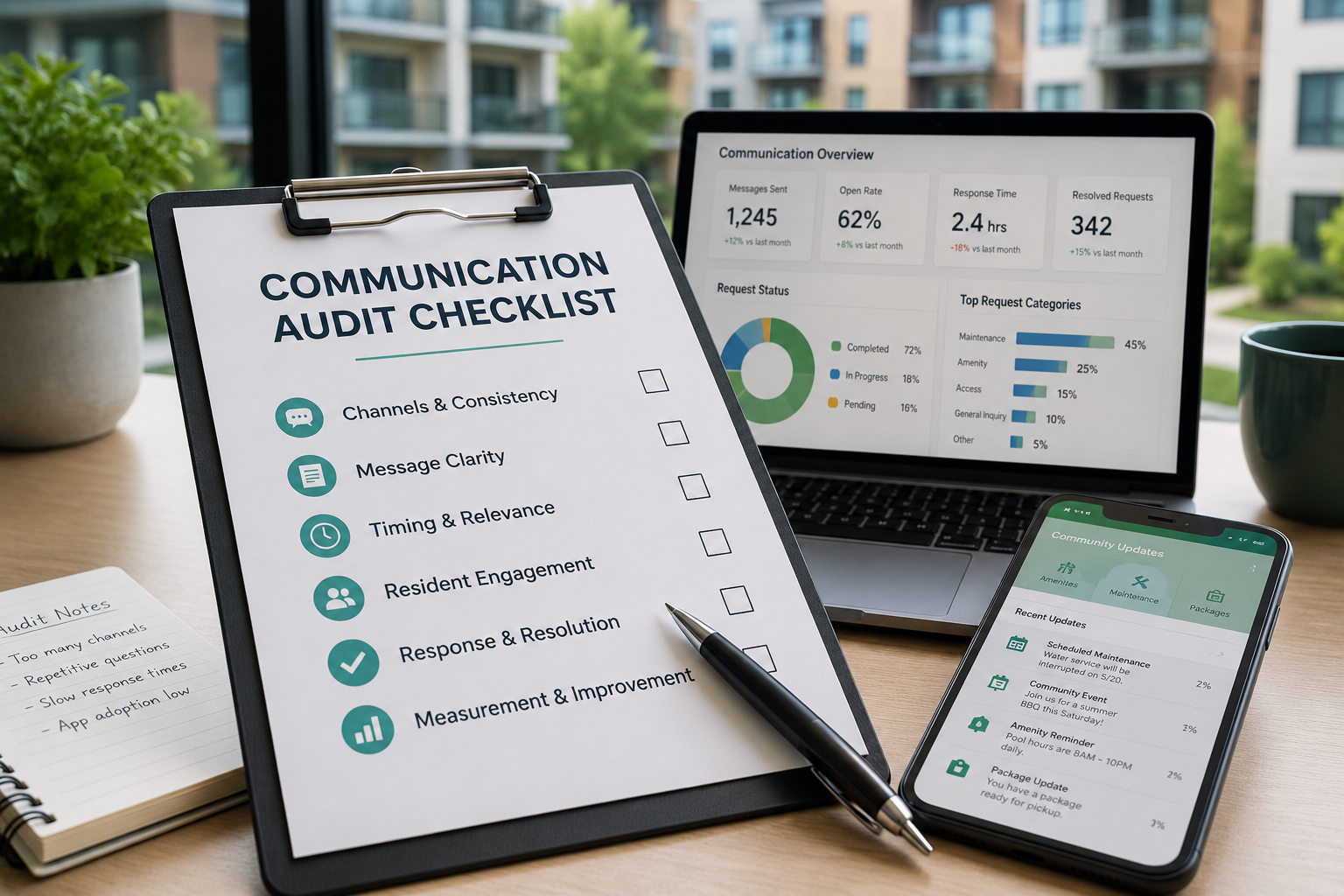
A multifamily resident communication audit helps property teams step back and evaluate how information moves across the community. It reveals where messages are duplicated, delayed, overlooked, difficult to understand, or dependent on manual staff follow-up.
This guide provides a 25-point audit that multifamily operators can use across individual properties or entire portfolios.
Key Takeaways
```- Resident communication should be evaluated as a connected system, not a collection of isolated messages.
- The strongest communication strategies give residents one clear place to find information and take action.
- Automation should eliminate repetitive work without making resident service feel impersonal.
- Communication performance should be measured through resident behavior, response times, resolution rates, and staff workload.
- A communication audit can reveal opportunities to consolidate disconnected tools into one resident experience platform.
What Is a Multifamily Resident Communication Audit?
```A multifamily resident communication audit is a structured review of how an apartment community creates, sends, receives, organizes, and measures resident-facing information.
The audit examines every stage of the communication process:
- Who creates each message
- Which residents should receive it
- Which channel is used
- When the message is delivered
- What action the resident should take
- How staff know whether the message was received
- What happens when a resident responds
- How unresolved issues are escalated
The goal is not simply to send more messages. The goal is to create communication that is timely, relevant, clear, actionable, and connected to the property’s operational workflows.
Why Apartment Communities Should Audit Resident Communication
```Communication problems rarely appear as one obvious failure. They usually surface as dozens of small operational issues.
For example:
- Residents repeatedly call about amenity hours.
- Move-in instructions are scattered across several emails.
- Maintenance updates depend on technicians remembering to send them.
- Important announcements compete with promotional messages.
- Staff members answer the same package questions every day.
- Residents do not know whether to use the app, portal, email, phone, or front desk.
- Corporate teams cannot see which properties are communicating consistently.
Each issue creates friction. Across hundreds or thousands of residents, that friction can lead to more office interruptions, slower response times, inconsistent service, lower app adoption, and greater staff workload.
A communication audit turns those scattered symptoms into a visible operating picture.
The 25-Point Multifamily Resident Communication Audit
```Score each item using the following scale:
1. Communication Channel Audit
1. Residents have one clear place to start.
Residents know where to find property information, submit requests, read announcements, and contact the appropriate team without guessing which system to use.
2. Every communication channel has a defined purpose.
Email, push notifications, text messages, app announcements, phone calls, printed notices, and in-person communication are used intentionally rather than interchangeably.
3. Staff do not rely on personal inboxes or informal messages.
Resident requests are captured in shared, trackable workflows instead of being buried in individual email accounts, text conversations, or handwritten notes.
4. Residents are not required to download multiple single-purpose apps.
Core resident needs such as communication, amenities, access, services, packages, events, and requests are consolidated wherever possible.
5. Communication preferences are respected.
Teams distinguish between urgent operational notices, required updates, routine reminders, community news, and optional promotional communication.
2. Message Clarity Audit
6. Each message has one clear purpose.
Residents can quickly understand why they received the message and what information matters most.
7. The requested resident action is obvious.
Messages clearly explain what residents need to do, where they need to go, and when action must be completed.
8. Messages use resident-friendly language.
Communication avoids unnecessary internal terminology, unexplained abbreviations, vague instructions, and overly technical language.
9. Important information is easy to scan.
Dates, times, locations, instructions, deadlines, contact information, and action buttons are visually prominent.
10. Communication templates are standardized.
Recurring messages use approved templates so residents receive consistent information regardless of which employee sends the update.
3. Timing and Relevance Audit
11. Messages reach the right resident segment.
Building notices, amenity updates, maintenance interruptions, events, and service messages are targeted instead of automatically being sent to the entire community.
12. Messages are delivered at useful times.
Residents receive information early enough to act, but not so early that the message is forgotten before it becomes relevant.
13. Reminder sequences are automated where appropriate.
Move-in tasks, event RSVPs, amenity reservations, inspections, package pickups, and other time-sensitive actions do not depend entirely on manual follow-up.
14. Residents are protected from message overload.
Teams coordinate message frequency and avoid sending multiple low-priority notifications that can cause residents to ignore more important updates.
15. Communication reflects the resident lifecycle.
Residents receive information appropriate to their current stage, including onboarding, move-in, daily living, service support, engagement, renewal, and move-out.
4. Request and Response Audit
16. Every resident request receives confirmation.
Residents know that their request was received and understand what will happen next.
17. Requests are routed to the correct team.
Communication workflows distinguish between leasing, maintenance, management, concierge, amenities, access, packages, and other service categories.
18. Residents receive meaningful status updates.
The resident is not left wondering whether a request is open, assigned, delayed, completed, or waiting for additional information.
19. Overdue requests trigger escalation.
Unanswered messages and unresolved requests are visible to managers before frustration turns into a complaint or negative experience.
20. Closed requests include a clear resolution.
Residents are informed when work is complete, what action was taken, and how to follow up if the issue remains unresolved.
5. Measurement and Portfolio Consistency Audit
21. Communication performance is measured.
Teams review indicators such as delivery, read activity, response times, request volume, resolution time, app engagement, and recurring resident questions.
22. The team tracks why residents contact the office.
Frequent questions are categorized so teams can improve information, automate answers, or redesign confusing workflows.
23. Staff workload is included in the analysis.
The audit considers how much time employees spend sending updates, answering repeated questions, transferring requests, and finding resident information.
24. Communication standards are consistent across properties.
Portfolio leaders define common message templates, response expectations, escalation rules, and reporting standards while allowing appropriate property-level customization.
25. Audit findings lead to assigned improvements.
Every identified communication gap has an owner, next action, target date, and measurable definition of success.
How to Interpret Your Communication Audit Score
```| Score | Communication Maturity | Recommended Priority |
|---|---|---|
| 0–20 | Highly fragmented | Define channels, ownership, routing, and basic message standards. |
| 21–40 | Partially standardized | Consolidate recurring workflows and reduce manual follow-up. |
| 41–60 | Connected but inconsistent | Improve targeting, measurement, escalation, and portfolio standards. |
| 61–75 | Mature and measurable | Optimize resident behavior, personalization, app adoption, and continuous improvement. |
What Metrics Should Multifamily Teams Track?
```An audit should lead to measurable improvements. The most useful metrics connect communication activity to resident outcomes and staff efficiency.
Resident engagement metrics
- Resident app activation rate
- Active app usage
- Announcement views
- Push-notification engagement
- Event RSVP activity
- Amenity reservation activity
- Self-service completion rate
Operational metrics
- Average first-response time
- Average resolution time
- Percentage of overdue requests
- Number of request transfers
- Messages requiring manual follow-up
- Repeated questions by category
- Calls, emails, and front desk visits per occupied unit
Experience metrics
- Resident satisfaction after service interactions
- Communication-related complaints
- Move-in feedback
- Maintenance communication feedback
- Resident renewal sentiment
No single metric tells the full story. A decrease in office calls may be positive when residents are successfully using self-service tools. It may be negative if residents have stopped expecting a response. Metrics should therefore be reviewed together and supported by resident feedback.
How to Turn Audit Findings Into an Improvement Plan
```1. Fix the highest-volume communication problems first
Start with the questions, messages, and requests that consume the most staff time. Common examples include package questions, amenity rules, maintenance updates, move-in instructions, parking details, guest procedures, and building announcements.
2. Choose one primary resident destination
Residents should not need to remember a different tool for every interaction. Establish one mobile-first destination where they can access information, complete common tasks, and begin a request.
3. Standardize recurring messages
Create reusable templates for move-ins, maintenance updates, package procedures, amenity closures, event reminders, service interruptions, inspections, renewals, and other common workflows.
4. Connect communication to action
A message should not send residents on a scavenger hunt. When asking residents to reserve an amenity, complete a checklist, RSVP to an event, submit a request, or review an update, link directly to the relevant action.
5. Automate predictable follow-up
Use automated confirmations, reminders, status updates, and escalation triggers for repeatable workflows. Staff should focus their attention on exceptions and higher-value resident interactions.
6. Review communication performance monthly
Track common resident questions, unresolved requests, message engagement, response times, and staff feedback. A communication system should continue evolving as resident needs and property operations change.
How ElevateOS Supports Connected Resident Communication
```ElevateOS is an all-in-one community operating system built to help multifamily teams connect resident engagement and property operations.
Instead of treating communication as a standalone feature, ElevateOS connects messages to the resident activities they support. Apartment communities can create a branded resident experience spanning:
- Resident announcements and updates
- Move-in and onboarding workflows
- Maintenance and service requests
- Amenity reservations
- Package-related communication
- Community events and RSVPs
- Guest and access workflows
- Concierge and personal services
- Resident engagement
- Daily building operations
This connected approach helps residents know where to go while giving onsite and portfolio teams better visibility into the communication surrounding each resident interaction.
The result is fewer disconnected experiences, less technology clutter, more consistent service, and a resident app that supports everyday living rather than functioning as another isolated communication channel.
Frequently Asked Questions
```What is a multifamily resident communication audit?
A multifamily resident communication audit is a structured review of how an apartment community sends messages, receives requests, provides updates, routes responses, and measures resident communication across channels and teams.
How often should apartment communities audit resident communication?
A complete audit should generally be completed at least once per year. Multifamily teams should also review key communication metrics monthly and conduct additional audits after major staffing, technology, ownership, or operational changes.
What should be included in a resident communication strategy?
A resident communication strategy should define message types, target audiences, approved channels, timing, ownership, templates, response expectations, escalation procedures, resident preferences, and performance metrics.
How can multifamily properties reduce repetitive resident questions?
Properties can reduce repetitive questions by centralizing information, creating clear resident-facing resources, automating common updates, improving message clarity, connecting communication to self-service actions, and giving residents one reliable place to start.
What communication channels should apartment communities use?
Apartment communities may use resident apps, push notifications, email, text messaging, phone calls, printed notices, portals, and in-person communication. Each channel should have a defined purpose based on urgency, audience, complexity, and the action residents need to take.
Can a resident app improve apartment communication?
Yes. A resident app can provide one mobile destination for announcements, requests, amenities, events, services, packages, access information, and community resources. Its value increases when these functions are connected rather than spread across separate apps.
How does communication software help apartment staff?
Communication software can help staff standardize messages, target the right residents, automate reminders, track requests, provide status updates, escalate delays, reduce repetitive questions, and improve coordination across departments.
What resident communication metrics should property managers track?
Useful metrics include message engagement, app usage, first-response time, resolution time, overdue requests, repeated questions, self-service completion, communication-related complaints, resident satisfaction, and staff time spent on manual follow-up.
How can portfolios standardize communication across multiple properties?
Portfolio teams can establish shared templates, message categories, response standards, escalation rules, reporting definitions, and approved workflows while allowing each property to customize relevant local details.
Does communication automation make resident service less personal?
Not when it is implemented thoughtfully. Automation can handle routine confirmations, reminders, and status updates so onsite teams have more time for complex questions, service recovery, hospitality, and meaningful resident relationships.
```Final Takeaway
```Resident communication is not just the message an apartment community sends. It is the entire experience surrounding that message: where residents receive it, whether it is relevant, what action they can take, how staff respond, and whether the issue is resolved.
A multifamily resident communication audit helps teams identify gaps that may otherwise remain hidden inside inboxes, phone calls, front desk conversations, disconnected apps, and manual follow-up.
The strongest communication strategies create one clear resident experience. They connect messages with services, requests, amenities, events, access, packages, onboarding, and building operations.
For residents, that means less confusion and faster access to what they need. For staff, it means fewer repetitive interruptions and more organized workflows. For operators, it creates a more consistent experience that can scale across the portfolio.