.avif)
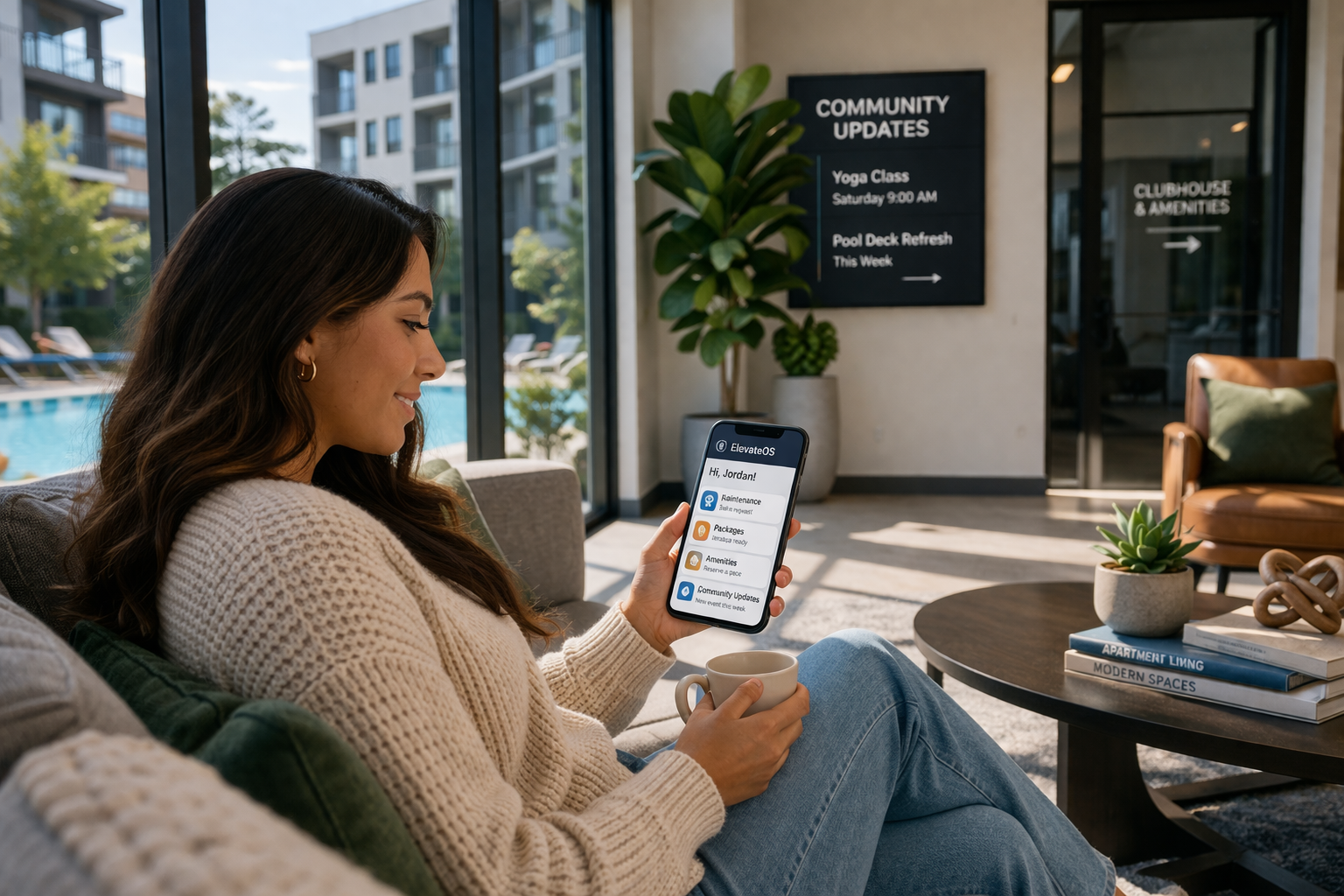
Every multifamily team knows the pattern.
The phone rings while a leasing agent is helping a prospect. A resident walks into the office to ask whether their package arrived. Another wants to reserve the grill for Saturday. Someone else needs an update on a maintenance request they already submitted. Meanwhile, the team is still trying to answer emails, follow up on renewals, and keep daily operations moving.
None of these resident needs are unreasonable. In fact, they are normal. The problem is that when too many simple requests depend on office staff, small interruptions become a constant drain on productivity.
That is why more operators are rethinking how daily service gets delivered. The goal is not to remove the human element. It is to make routine interactions easier for residents and lighter for on-site teams.
That is the value of self-service multifamily operations.
When residents can handle common tasks on their own schedule through one connected experience, staff spend less time fielding repetitive requests and more time on leasing, service, retention, and community operations.
See how ElevateOS helps simplify daily property operations
Give residents one place to handle everyday tasks while your team gains back time for higher-value work.
Table of Contents
- What self-service operations mean in multifamily
- Why office interruptions cost more than they seem
- Which resident tasks are best suited for self-service
- How self-service improves the resident experience
- How self-service helps leasing and operations teams
- Common mistakes to avoid
- What to look for in a self-service multifamily platform
- Final takeaway
- FAQs
What self-service operations mean in multifamily
Self-service multifamily operations means giving residents the ability to complete common tasks without needing to call, email, or visit the leasing office every time they need something.
That can include:
- Submitting maintenance requests
- Checking maintenance status updates
- Booking amenities
- Managing package notifications
- Viewing community updates
- Accessing move-in information
- Registering for events or services
- Handling routine communication from one place
This does not mean residents never interact with staff. It means staff no longer have to manually facilitate every small task that could be handled digitally.
The result is a more scalable operating model. Residents get faster access to what they need, and property teams are not trapped in a cycle of constant reactive support.
Why office interruptions cost more than they seem
Interruptions are easy to underestimate because each one seems minor on its own.
A resident asking whether a package is ready may only take two minutes. A call about gym access may take three. A follow-up question about a work order may take five. But when these requests pile up all day, they fracture focus and slow everything else down.
That affects far more than the front desk.
It affects:
- Leasing follow-up speed
- Tour quality
- Response times to more urgent resident needs
- Administrative accuracy
- Staff stress levels
- Overall service consistency
In many communities, the hidden cost is not just time. It is the loss of momentum across the entire team.
When staff are constantly switching from one small request to another, it becomes harder to stay proactive. Leasing slips into reaction mode. Resident services become fragmented. Operational priorities get pushed back by tasks that should have been simple in the first place.
Which resident tasks are best suited for self-service
Not every interaction should be automated. But many of the most common daily requests are perfect candidates for self-service.
1. Maintenance request submission
Residents should be able to submit requests quickly, add details, upload photos, and receive updates without calling the office for every step.
2. Amenity reservations
Shared spaces such as lounges, guest suites, fitness classes, conference rooms, grills, and event areas are much easier to manage when residents can view availability and reserve them directly.
3. Package notifications
Package-related questions create a steady stream of office interruptions. A digital workflow reduces confusion, speeds pickup, and limits unnecessary back-and-forth.
4. Community communication
Residents should not have to search through email threads, paper notices, and text messages to find basic information. A centralized communication experience makes updates easier to find and easier to trust.
5. Move-in and onboarding tasks
New residents often have a lot of questions in a short period of time. A structured self-service onboarding flow reduces confusion and improves first impressions.
6. Lifestyle and convenience services
When communities offer resident services, classes, or concierge-style experiences, self-service access makes them easier to discover and easier to use.
Want fewer repetitive office interruptions?
ElevateOS helps communities centralize maintenance, packages, amenities, communications, and resident services into one connected experience.
How self-service improves the resident experience
Some operators worry that self-service will make the property feel less personal.
In practice, the opposite is usually true.
Residents do not generally want more friction in order to feel cared for. They want clarity, convenience, and responsiveness. If they can book a service, check a status, or complete a request in seconds, that feels more modern and more respectful of their time.
Self-service supports the resident experience by making everyday living easier.
It reduces uncertainty
Residents want to know what is happening and what to expect next. A good self-service experience gives them visibility without forcing them to chase updates.
It works on the resident’s schedule
Many common requests happen outside office hours. Self-service gives residents flexibility without delaying action until the office opens.
It creates consistency
When common workflows follow the same digital path every time, residents are less likely to receive mixed messages or incomplete information.
It removes unnecessary effort
Convenience matters. The less effort it takes to handle ordinary tasks, the more positively residents tend to view the property as a whole.
How self-service helps leasing and operations teams
Self-service is not just a resident feature. It is an operational strategy.
When routine requests move into a better system, site teams gain more than just time savings.
They gain cleaner workflows
Requests are easier to track, assign, update, and complete when they come through one connected system instead of scattered channels.
They gain better focus
Leasing agents can spend more time on tours and prospect follow-up. Community managers can stay focused on priorities that drive performance.
They gain more predictable service delivery
Standard workflows help reduce missed steps, duplicated effort, and status confusion.
They gain stronger resident interactions
When staff are not overwhelmed by repetitive tasks, they have more capacity for the moments where human service matters most.
That is an important distinction. Self-service should not replace hospitality. It should protect it by removing friction from the interactions that do not need to be manual.
Common mistakes to avoid
1. Treating self-service as a collection of separate tools
If residents need one place for packages, another for maintenance, and another for amenities, the experience becomes fragmented. Adoption drops when digital convenience turns into digital confusion.
2. Launching without clear resident education
Even a strong platform needs a clear rollout. Residents should understand what they can do, where to do it, and why it makes life easier.
3. Failing to keep human support available
Some issues still need personal attention. Self-service should handle routine interactions while staff remain available for exceptions, escalations, and relationship-building moments.
4. Prioritizing features over usability
A long feature list means very little if residents and staff do not actually use the platform. Simplicity and adoption matter more than complexity.
5. Ignoring the staff experience
Resident-facing tools only work well when site teams can manage them efficiently. A good self-service system should reduce operational burden, not add another dashboard to monitor.
What to look for in a self-service multifamily platform
If your goal is to reduce office interruptions while improving the resident experience, the platform should support both sides of the equation.
Look for a solution that helps residents:
- Access common services from one place
- Complete routine tasks quickly
- Get updates without chasing staff
- Engage with the property on their own schedule
And make sure it helps site teams:
- Centralize communication
- Streamline maintenance and amenity workflows
- Reduce repetitive manual coordination
- Improve visibility across daily operations
- Deliver a more consistent resident experience
The best systems do not just digitize one task. They reduce friction across the full resident journey.
Unify the resident experience with ElevateOS
From maintenance and amenities to packages, onboarding, and resident communications, ElevateOS helps properties create a smoother experience for residents and staff alike.
Final takeaway
Multifamily teams do not need fewer resident interactions. They need fewer unnecessary interruptions.
That is a big difference.
When residents have to rely on the office for every small task, staff get buried in routine requests that break focus and slow down operations. But when communities create a smarter self-service experience, everyone benefits.
Residents get speed, convenience, and better visibility. Staff get time back, cleaner workflows, and more room to focus on the work that matters most.
In other words, self-service multifamily operations is not about doing less for residents.
It is about delivering better service with less friction.
And for communities focused on efficiency, satisfaction, and long-term performance, that is exactly the kind of operational shift worth making.
Frequently Asked Questions
What are self-service multifamily operations?
Self-service multifamily operations allow residents to handle common tasks like maintenance requests, amenity bookings, package updates, and communications without always needing staff assistance.
How does self-service reduce office interruptions?
It moves routine resident requests into a digital workflow, reducing calls, walk-ins, and emails for simple tasks that can be completed faster through one connected platform.
Does self-service reduce resident satisfaction?
No. When done well, it often improves resident satisfaction by making everyday tasks easier, faster, and more transparent.
What tasks should residents be able to handle through self-service?
Common examples include maintenance submissions, amenity reservations, package notifications, onboarding steps, community updates, and access to resident services.
Why does this matter for multifamily operators?
Because repeated office interruptions slow down leasing, service delivery, and daily operations. A better system helps teams work more efficiently without lowering the level of service.
What should property managers look for in a self-service platform?
Look for a platform that centralizes resident tasks, reduces fragmentation, improves visibility for staff, and makes everyday workflows easier for both residents and on-site teams.
Ready to streamline resident service without adding more operational complexity?
See how ElevateOS helps multifamily communities deliver a better resident experience through one connected platform.