.avif)
📌 Key Takeaways
Beautiful amenities don't create value—activated amenities do, and activation requires systems that remove friction between resident interest and actual usage.
- Friction Kills Usage: When booking requires phone calls, office visits, or unclear policies, residents default to not using amenities at all, regardless of quality.
- Passive Keeps Doors Open, Active Creates Usage: Passive management ensures spaces are available and maintained; active management programs recurring events, automates reservations, and proactively communicates opportunities to residents.
- Automation Reduces Work, Not Hospitality: Self-serve booking, automated reminders, and policy enforcement handle repeatable logistics, freeing property teams to focus on relationship-building and high-impact resident interactions.
- Monetization Requires Structure First: Fee-based amenity bookings generate ancillary income only when payment processing, deposit logic, and clear policies are built into the reservation workflow.
- Integration Prevents Adoption Failure: Residents won't download another app—amenity booking must live inside the platform they already use for rent payments and maintenance requests.
Active management transforms expensive spaces into measurable, revenue-generating community hubs without adding headcount.
Property managers and asset management teams overseeing Class A communities will find immediate operational relief here, preparing them for the 30-day implementation plan that follows.
The rooftop deck sits empty on a perfect Saturday afternoon.
You walk past the fitness center at 6 PM—prime time—and count exactly two people on the treadmills. The party room calendar shows three bookings this quarter. The golf simulator that cost $85,000? It's gathering dust behind a locked door because no one knows how to reserve it.
You built world-class amenities. You marketed them during lease-up. But now, eight months post-stabilization, the spaces that were supposed to differentiate your Class A community feel like expensive storage rooms. Residents complain about availability when they do try to book something, your site team fields the same "how do I reserve this?" questions daily, and your latest resident survey shows amenity satisfaction scores dropping below your portfolio average.
This isn't a design failure. It's an operating model failure. Beautiful spaces don't manage themselves, and the old playbook—build it, unlock it, hope for the best—doesn't survive contact with real operations.
Recognizing the Warning Signs
The early indicators of passive management are easy to spot:
- Shared spaces require paper sign-ups or ad hoc approvals
- Rules are inconsistent ("It depends who's on shift" becomes the unofficial policy)
- Residents are unclear on what exists, what it costs (if anything), and how to access it
- Staff time gets consumed by repetitive questions, exceptions, and enforcement disputes
- Booking conflicts arise because there's no central tracking system
- Premium amenities sit unused while residents assume they're unavailable or too complicated to reserve
These frictions compound. Even residents who want to use amenities stop trying after a few failed attempts. The result is an expensive set of spaces that look impressive on a tour but deliver limited ongoing value.
The Myth: 'Build It and They Will Come' Does Not Survive Real Operations
Most communities operate on what feels like common sense: invest in premium amenities, keep them maintained, and residents will naturally take advantage of them. This is passive amenity management—ensuring spaces are available, clean, and safe.
The operational reality looks different. Paper sign-up sheets sit blank in the clubhouse. Residents double-book the conference room because there's no central system. The bocce court rules are unclear, leading to neighbor conflicts that escalate to management. Your site team spends hours each week fielding basic questions about availability, policies, and how to actually access these spaces.
Passive management creates three predictable problems. First, friction kills usage—if booking requires a phone call, an office visit, or deciphering a binder of rules, most residents simply won't bother. Second, invisible amenities stay invisible—without proactive communication, new residents never discover half of what's available. Third, manual processes don't scale—as occupancy grows, the administrative burden on your team compounds, turning amenity management into a time sink rather than a value driver.
The result? Underutilized assets, missed revenue opportunities, and a resident experience that falls short of the premium brand you're trying to build.
Passive Amenity Management Keeps Doors Open; Active Amenity Management Creates Usage
Passive amenity management focuses on availability. The fitness center is unlocked from 5 AM to midnight. The pool is maintained and accessible all summer. The sky lounge exists, and residents technically have access to it.
Active amenity management focuses on activation. It means programming recurring fitness classes in that gym, hosting monthly rooftop socials by the pool, and creating a frictionless digital booking system for the sky lounge that includes automated reminders, clear policies, and payment collection for private events. Active management transforms spaces from static assets into dynamic community hubs through intentional programming, consistent communication, and systems that remove every barrier between "I'd like to use that" and "I just booked it."
The distinction isn't philosophical—it's operational and measurable. Passive management keeps amenities available. Active management makes them used, monetized, and central to the resident experience.
Active Amenity Management Increases Utilization by Removing Friction
The primary barrier to amenity usage isn't resident interest. It's operational friction. When booking requires navigating unclear processes, residents choose the path of least resistance: they don't book at all.
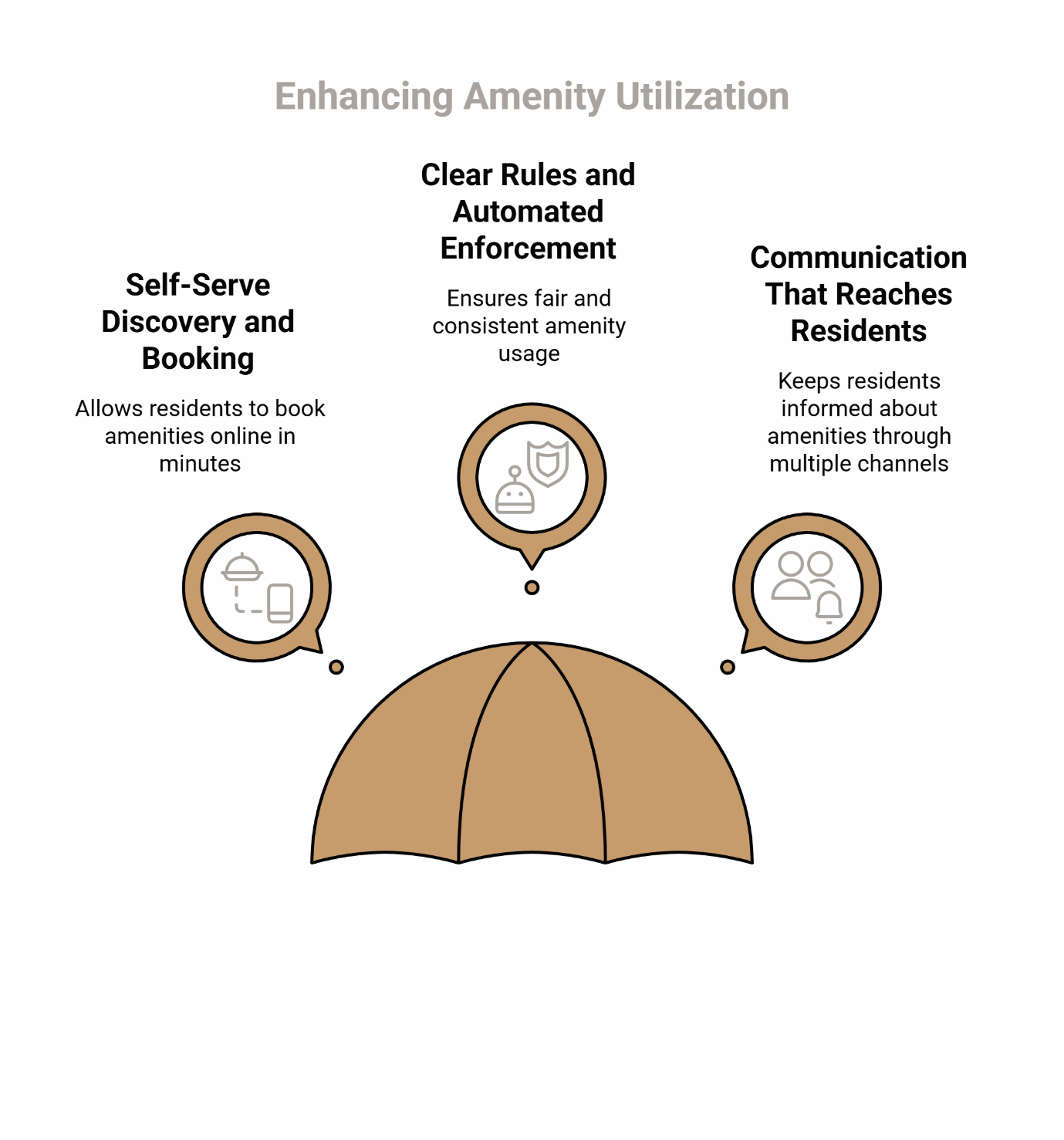
Self-Serve Discovery and Booking
Residents shouldn't need to call the office or send an email to reserve the clubhouse. A modern amenity reservation tool allows them to check real-time availability, understand the rules, and complete the booking in under two minutes—from their phone, at 9 PM on a Tuesday, without involving your team.
This approach aligns with what industry research consistently shows: reducing the steps between interest and reservation drives measurable increases in usage. According to the National Multifamily Housing Council, streamlined amenity access ranks among the top factors influencing resident satisfaction in Class A properties.
This shift delivers immediate operational relief. Your leasing agents stop fielding repetitive booking questions. Your site manager isn't manually updating spreadsheets or resolving double-booking conflicts. As one resident noted, booking amenities becomes "a breeze—no more paper sign-ups or guessing availability."
Clear Rules and Automated Enforcement
Ambiguity creates conflict. If the pool cabana policy is "first come, first served" but there's no system tracking reservations, disputes are inevitable. Active management means establishing clear rules—maximum occupancy, advance booking windows, cancellation policies, deposit requirements—and encoding them into the booking system so enforcement is automatic, not discretionary.
This protects both residents and your team. Residents gain predictability and fairness. Your team is liberated from being the referee for every amenity conflict. The National Apartment Association emphasizes that standardized policies, consistently applied, reduce both resident complaints and staff burden.
Communication That Reaches Residents Where They Are
Even the best amenities are worthless if residents don't know they exist or how to access them. Active management includes proactive, multi-channel communication: push notifications about upcoming fitness classes, email reminders about pool season opening, in-app announcements about new programming.
The communication happens where residents already are—in the resident app they use for maintenance requests and rent payments—not in a separate portal they have to remember to check.
Active Amenity Management Drives Revenue by Making Bookings Measurable and Billable
Underutilized amenities represent not just a missed experience opportunity but a missed revenue opportunity. Communities that shift to active management often discover their amenity spaces can generate significant ancillary income.
Monetization Prerequisites: Payments, Deposits, Policies
Turning amenity bookings into a revenue stream requires three operational foundations. First, integrated payment processing so residents can pay booking fees or deposits at the moment of reservation. Second, automated deposit return logic so your team isn't manually processing refunds after each event. Third, clearly documented policies defining what's complimentary versus fee-based, cancellation windows, and damage accountability.
Without these systems, monetization remains theoretical. With them in place, the guest suite that used to sit empty can generate $250 per booking. The party room can be priced at $150 for private events. The conference room becomes a resource for residents running home businesses.
Turning 'Nice Spaces' Into a Measurable Asset
Active management makes amenity performance visible. You can track which spaces are booked most frequently, which time slots have highest demand, and which programming drives the most engagement. This data informs capital allocation decisions—whether to add a second yoga studio, retire the underused craft room, or adjust pricing on premium spaces.
For ownership and asset management teams, this shift transforms amenities from qualitative talking points into quantifiable performance indicators. You gain operational signals—demand patterns, peak usage times, recurring friction points—that support strategic decisions about programming, staffing schedules, and fee structures. The Urban Land Institute has documented how activation systems differentiate high-performing mixed-use properties from those where "hardware" exists but "software" is missing.
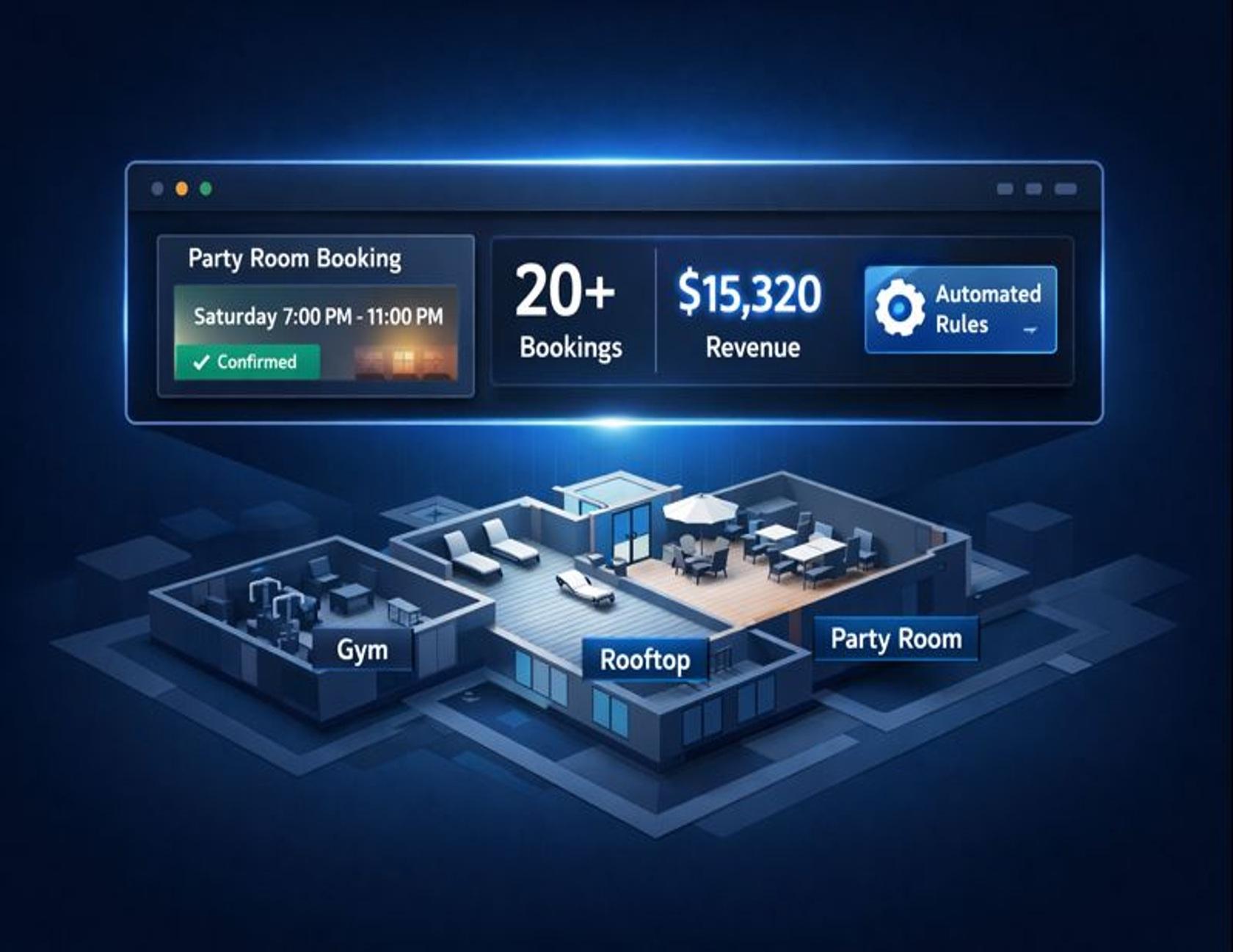
One ElevateOS community increased monthly amenity income from $1,500 to over $15,000 by implementing active management systems—booking automation, clear pricing, and consistent programming—without adding a single staff member.
Active Amenity Management Scales When Technology and Hospitality Work Together
The common objection to active management is simple: "Our team is already stretched thin. We can't add more work." The answer isn't more people. It's better systems.
What to Automate vs. Keep Human
Certain tasks should be fully automated: booking confirmations, payment processing, availability updates, cancellation handling, reminder notifications, and policy enforcement. These are rules-based processes that technology handles more consistently and efficiently than humans.
Other elements benefit from the human touch: event planning and facilitation, responding to custom requests, resolving unusual conflicts, curating programming based on resident feedback, and building relationships that turn amenity users into community advocates.
The goal isn't to eliminate hospitality—it's to free your team from administrative burden so they can focus on the high-value interactions that actually build community. Setup requires front-loaded effort to document workflows and establish rules, but ongoing manual coordination drops dramatically when systems absorb repeatable tasks.
How to Avoid 'New Tool' Failure at the Site Level
Technology adoption fails when it creates complexity instead of reducing it. The most common failure mode: introducing a standalone amenity app that residents have to download separately from the tools they already use for rent payment and maintenance requests.
Active management succeeds when the booking system lives inside the platform residents already know. When reserving the clubhouse happens in the same app where they submit work orders, adoption is immediate because the learning curve is zero. As property teams have found, making it "easy to manage event sign-ups, fitness classes, and amenity reservations" in one unified system is what drives actual behavior change.
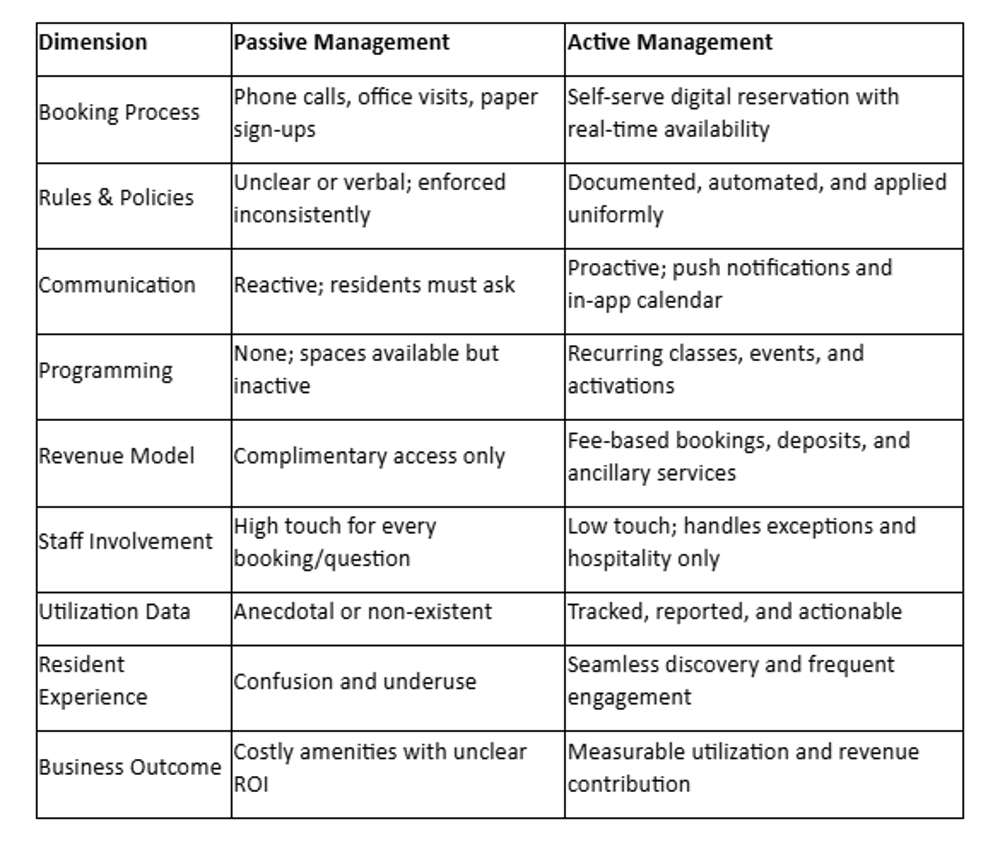
The 'Active vs. Passive' Comparison Chart
Quick-Start: A Practical 30-Day Shift Plan
You don't need to overhaul your entire amenity program overnight. Start with one high-value space and prove the model works.
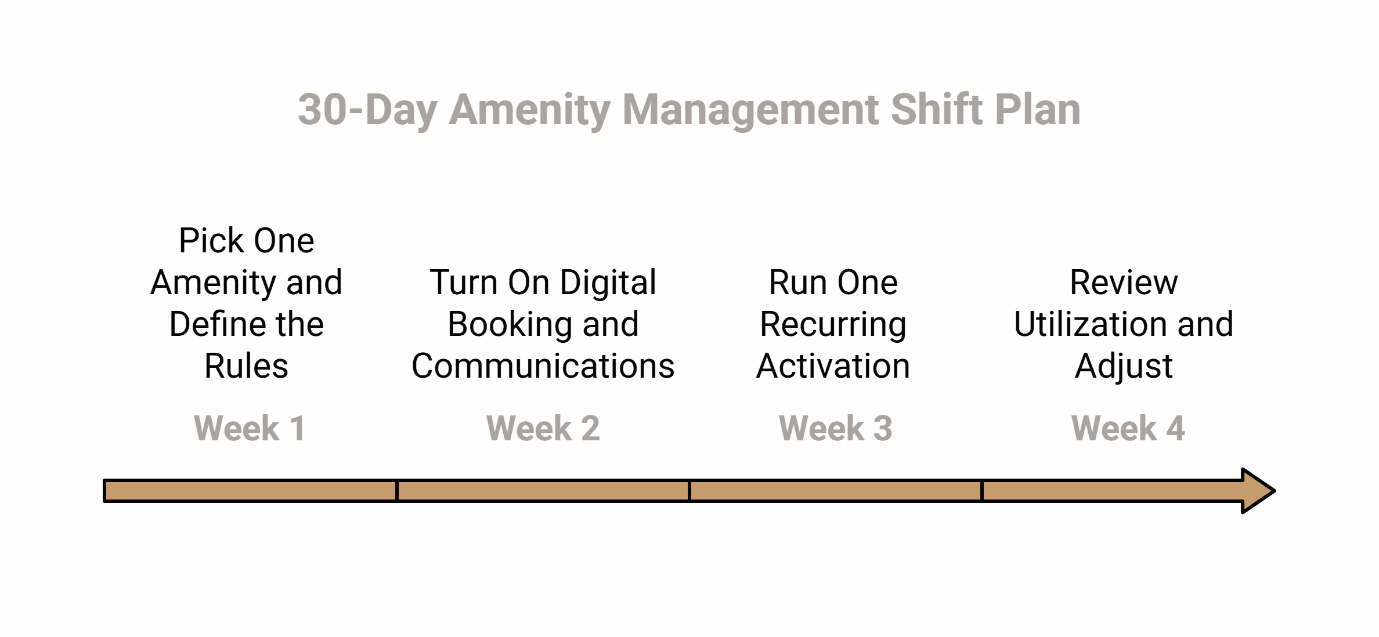
Week 1: Pick One Amenity and Define the Rules
Choose a single amenity with clear monetization or engagement potential—the party room, guest suite, or conference room. Document the complete policy: booking windows, maximum capacity, fees or deposits, cancellation terms, prohibited uses, and damage accountability. Make the rules clear enough that a resident could understand them in 60 seconds.
Week 2: Turn On Digital Booking and Communications
Implement a digital reservation system for your chosen amenity. Ensure it integrates with your existing resident app or property management portal so residents don't need to learn a new platform. Set up automated confirmation emails, reminder notifications 24 hours before the booking, and post-event follow-up requests for feedback.
Test the full booking flow yourself—from discovery to confirmation to cancellation—to identify any friction points before residents encounter them.
Week 3: Run One Recurring Activation
Launch one simple, recurring program in or around your target amenity. If you chose the fitness center, schedule a weekly yoga class. If you chose the clubhouse, host a monthly resident coffee hour. If you chose the pool deck, organize Sunday afternoon family swim sessions.
The goal isn't perfection. The goal is proof that consistent programming drives predictable usage and creates the foundation for community building.
Week 4: Review Utilization and Adjust
Pull the booking data. How many reservations happened? What time slots saw highest demand? What feedback did residents provide? Use this information to refine your policies, adjust pricing if applicable, and identify which aspects of the activation worked versus which need modification.
Then expand the model to your next amenity.
Common Objections and Grounded Answers
"We Already Built Great Amenities—Why Aren't They Used?"
Quality isn't the issue. Accessibility is. If the booking process is opaque, the rules are unclear, or residents simply forget the amenity exists because they never receive reminders, even the most impressive spaces will sit empty.
The solution isn't rebuilding the amenity. It's rebuilding the system around it—making discovery effortless, booking frictionless, and usage a consistent part of residents' weekly routines through programming and communication.
"Our Team Is Too Busy to Add More Work"
Active management done poorly does create more work. Active management done correctly eliminates work. When booking, payments, reminders, and policy enforcement are automated, your team stops being the bottleneck for every amenity interaction.
The hours saved answering "how do I book the gym?" and manually tracking spreadsheets can be redirected toward higher-value activities: planning resident events, building community relationships, and focusing on retention strategies that actually move NOI.
"Will Residents Actually Adopt Another App?"
This is the wrong question—and it reveals the core problem with most amenity strategies. Residents won't adopt another app. They're already exhausted by app overload.
The right approach consolidates amenity booking into the platform residents already use daily. When the clubhouse reservation lives in the same app where they pay rent and submit maintenance requests, there's no adoption barrier. The interface is familiar. The login is remembered. The behavior is natural.
Integration isn't a feature. It's the prerequisite for success.
Fair Housing and Equitable Access
Any amenity services, tools, events, and features must be accessible consistently to all residents. Policies and workflows should be designed to support equitable access and consistent application across the community, in full compliance with the Fair Housing Act. Active management systems should reduce bias and inconsistency, not introduce new barriers.
Ready to shift from passive to active? Explore how amenity management technology and services can increase utilization and revenue without adding headcount—or calculate your community's potential revenue using our free assessment tool.
For additional implementation guidance, see our detailed framework on active vs. passive amenity management.
Disclaimer: This article provides educational insights into amenity management strategies for multifamily properties. Specific outcomes depend on property type, market conditions, and implementation approach. All residents must have equal access to amenities and services in compliance with fair housing requirements.
Our Editorial Process: Articles are developed using industry research, proprietary operational data, and insights from communities using modern property management systems. Content is reviewed for accuracy and practical applicability.
About the ElevateOS Insights Team
The ElevateOS Insights Team is our dedicated engine for synthesizing complex topics into clear, helpful guides. While our content is thoroughly reviewed for clarity and accuracy, it is for informational purposes and should not replace professional advice.