.avif)
📌 Key Takeaways
A digital resident concierge centralizes all resident interactions into one branded platform, eliminating fragmented systems that erode trust and operational efficiency.
- Centralization Eliminates Operational Chaos: Routing all requests through one platform reduces missed handoffs and redirects staff time toward leasing and retention activities.
- Financial Impact Hits Two P&L Lines: Fee-based amenity reservations generate direct revenue while automation of routine inquiries reduces cost-per-lease.
- Phased Rollout Ensures Adoption Success: Starting with high-frequency workflows like amenity booking, then expanding after stability, minimizes resident and staff resistance.
- System Integration Is Not Optional: Seamless connections to existing PMS, access control, and package systems determine timeline and long-term viability.
- Fair Housing Compliance Requires Equal Access: All residents must access identical features and services regardless of characteristics—it's both legal mandate and trust foundation.
Automation scales hospitality without scaling headcount.
Property managers and operations leaders at Class A communities will gain implementation clarity here, preparing them for the platform evaluation process that follows.
The resident expects white-glove service. The budget expects skeleton-crew efficiency.
This is the defining tension in luxury multifamily today. Class A communities promise hotel-level experiences—24/7 responsiveness, seamless amenity access, frictionless service—but few have the staffing model to deliver it consistently. The leasing office closes at six. The maintenance team works standard hours. Yet residents expect answers at eleven at night and bookings confirmed by morning.
A digital resident concierge solves this by creating a centralized, automated service layer that operates around the clock without requiring additional headcount. It's not a replacement for your team—it's the infrastructure that allows your team to focus on high-value interactions while routine requests, bookings, and updates happen automatically through a branded app experience.
What Is a Digital Resident Concierge?
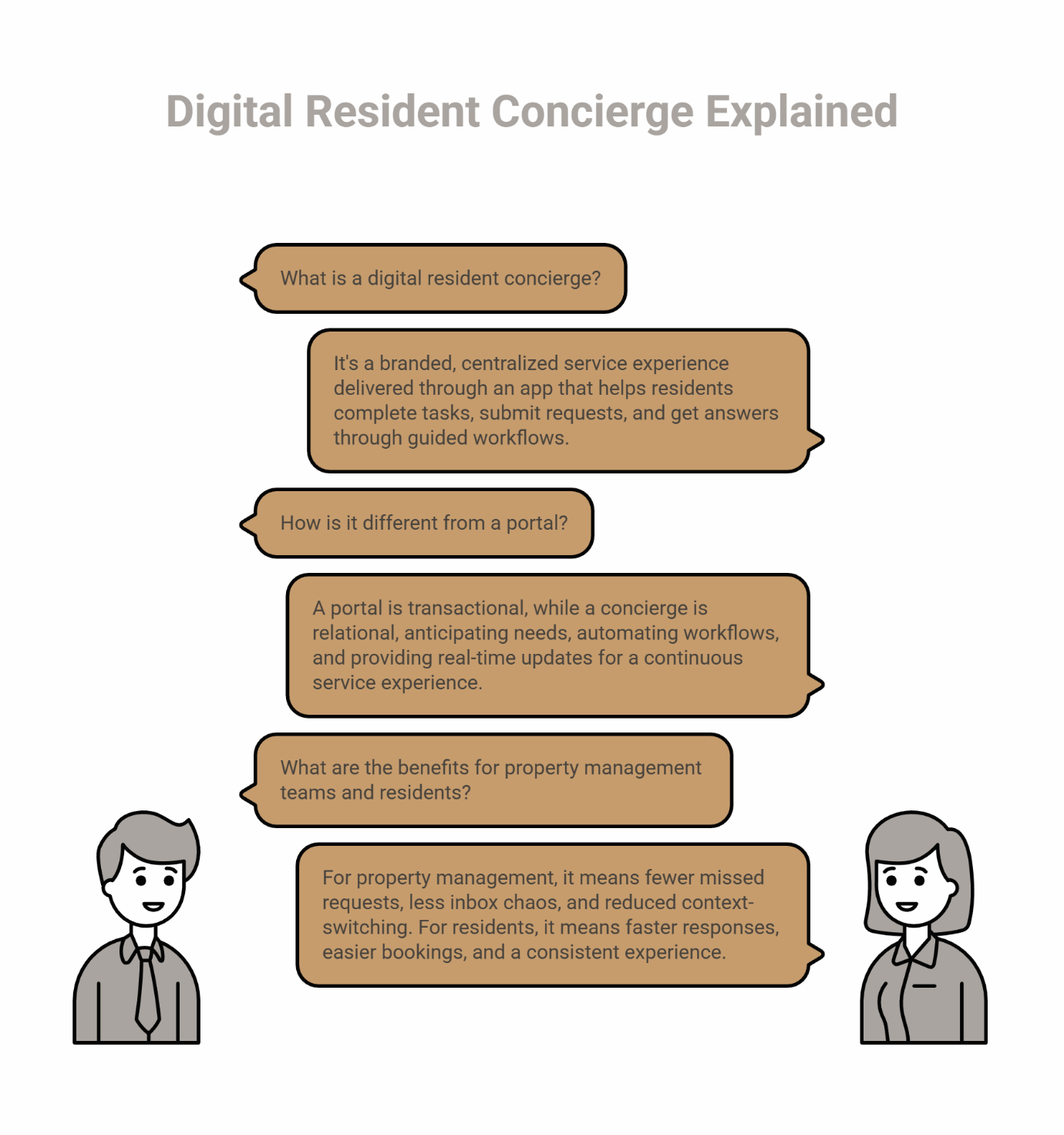
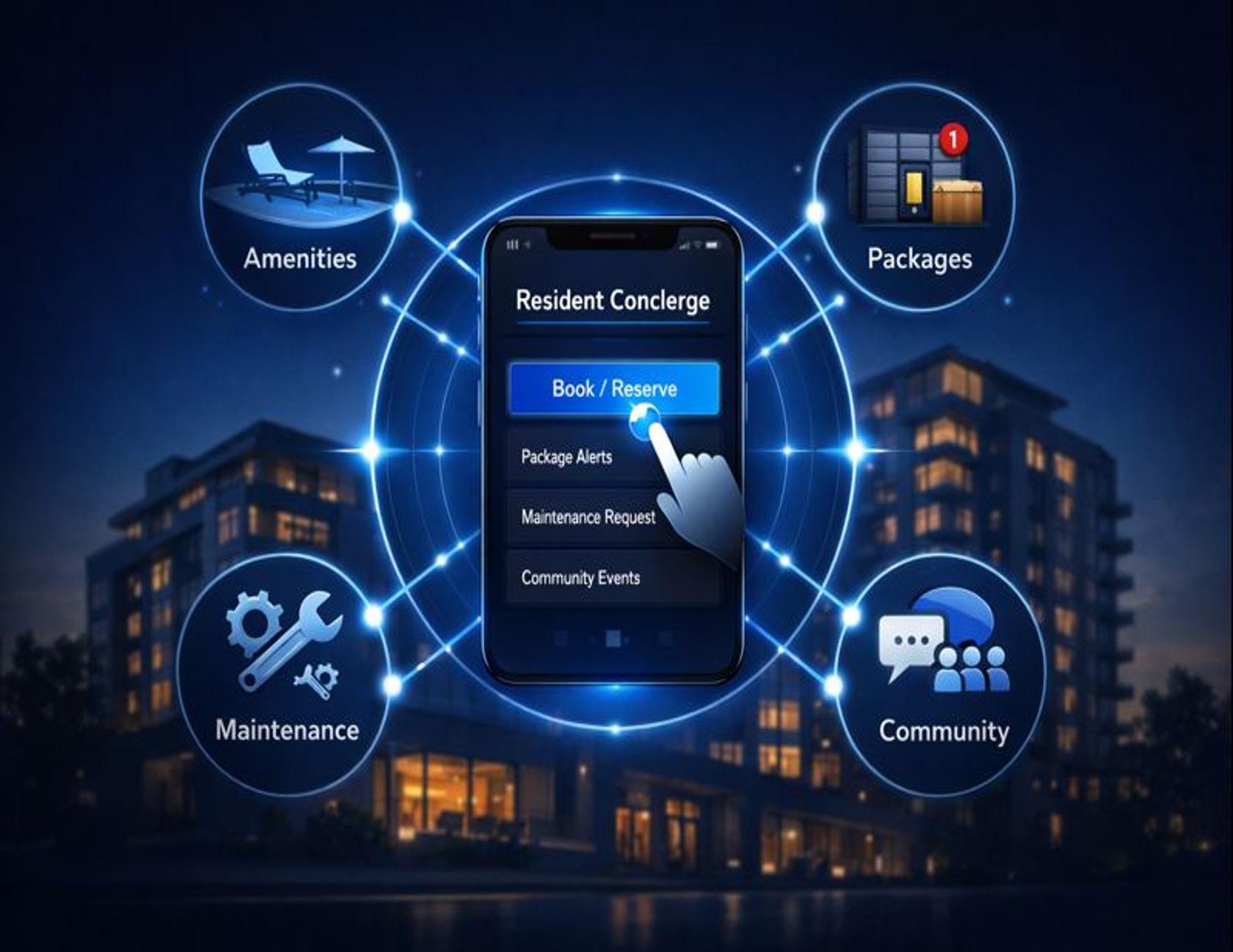
A digital resident concierge is a branded, centralized service experience—typically delivered through a branded resident app—that helps residents complete common tasks, submit requests, and get fast answers through guided workflows. It centralizes and automates resident interactions: service requests, amenity reservations, package notifications, maintenance updates, and community communications in one unified interface.
The key distinction: this is not a generic portal. A portal is transactional—pay rent, submit a ticket, check a balance. A concierge is relational. It anticipates needs, automates workflows, provides real-time updates, and creates a continuous service experience that mirrors the attention residents receive at a luxury hotel.
For property management teams, this means fewer missed requests, less inbox chaos, and reduced context-switching. For residents, it means faster responses, easier bookings, and a consistent experience that reinforces your brand promise.
Portal vs. Concierge: Why "Pay and Submit" Is Not Luxury
A basic portal typically focuses on a narrow set of transactions. A concierge experience focuses on the full service journey: clarity, responsiveness, and consistency.
Here's the practical difference:
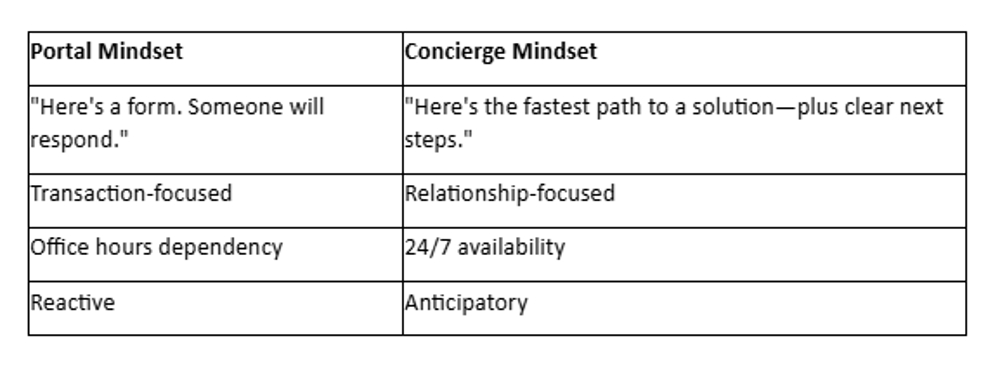
In a Class A context, that difference is not cosmetic. It shapes brand perception, reduces friction, and signals whether the building is run like a modern hospitality experience or a back-office system.
For teams comparing this distinction in more detail, this related perspective is useful: Why your building needs a digital concierge, not just a portal.
Why Luxury Buildings Can't Afford to Skip This
Luxury is defined by expectations, not features. When residents pay premium rents, they're paying for more than square footage and finishes—they're paying for the experience of effortless living. A fragmented tech stack undermines that promise.
Consider the typical resident journey in a building without a digital concierge. They download one app to pay rent. They email the leasing office to book the party room. They call maintenance about a leak. They check a third-party system for package tracking. Each disjointed interaction introduces friction and increases the 'time-to-resolution' metric—a key driver of resident churn. When systems do not speak to one another, the resident is forced to bridge the gap, degrading the perceived value of the lease.
Now multiply that across hundreds of units and dozens of daily requests. The operational cost isn't just time—it's the erosion of trust that happens when residents feel like they're chasing answers instead of receiving service.
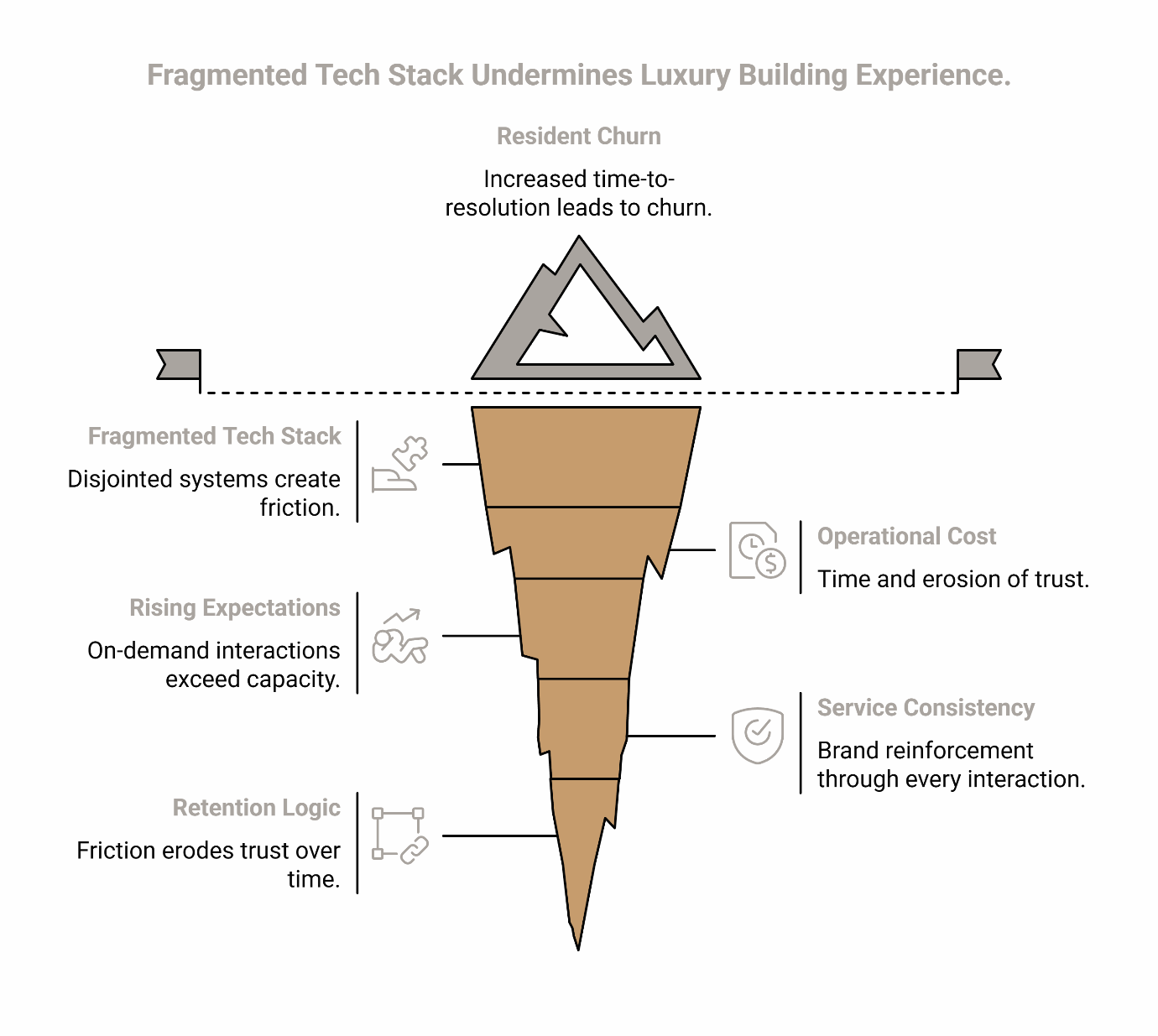
Three dynamics make this especially relevant for Class A communities:
1. Expectations rise faster than staffing capacity
Residents increasingly expect on-demand interactions. When capacity doesn't match expectation, the experience becomes inconsistent—often in the places residents remember most.
2. Service consistency becomes part of the brand
A luxury building is a living ecosystem. Every interaction is brand reinforcement—or brand erosion. Consistency matters as much as friendliness.
3. Retention logic is influenced by friction
Retention is multi-factor and varies by building, but friction is reliably corrosive. Missed handoffs, unclear processes, and slow follow-up compound over time.
A digital concierge eliminates this fragmentation. One interface. One login. One branded experience. Residents get the responsiveness they expect. Your team gets the operational clarity they need to deliver it.
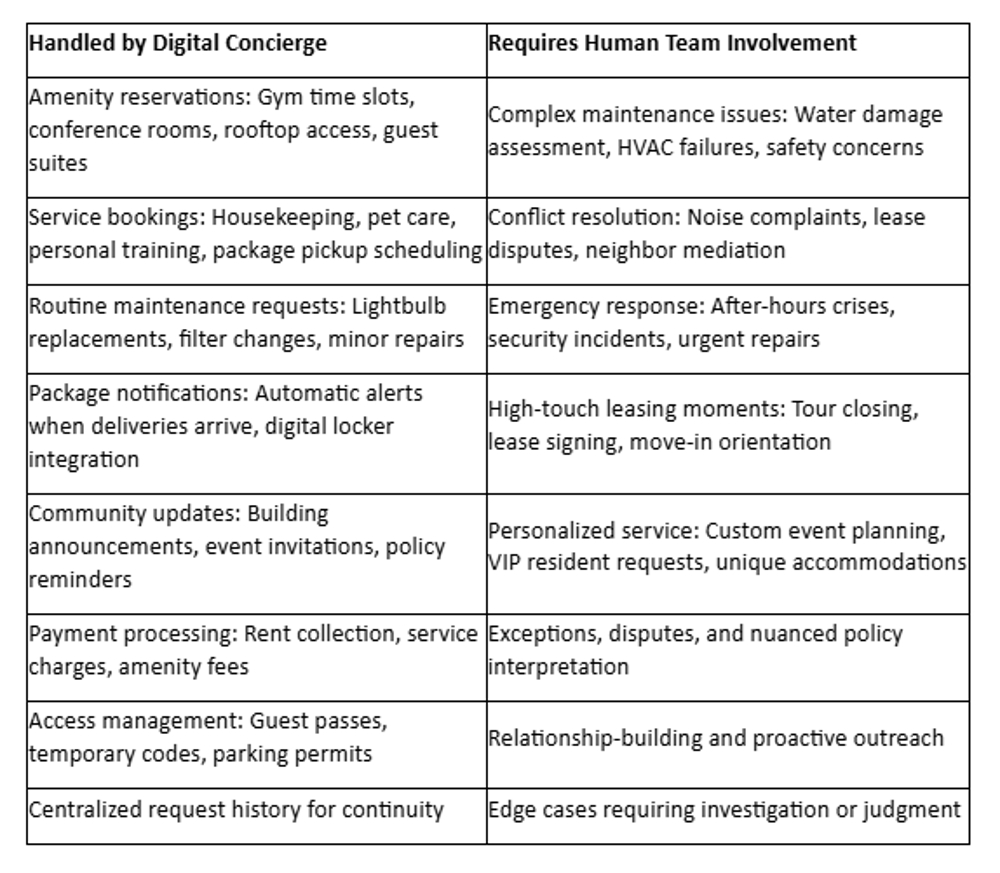
What a Digital Concierge Handles vs. What Still Requires a Human
Not every task should be automated. The goal isn't to eliminate human interaction—it's to ensure your team's time is spent where it creates the most value. Here's how the division typically works:
"The app is incredibly intuitive and puts everything I need right at my fingertips. Booking amenities like the gym or rooftop deck is a breeze." — Chris M (Google Reviews)
The digital concierge doesn't replace empathy or judgment. It removes the repetitive, time-consuming tasks that prevent your team from applying those qualities where they matter most.
The Operational Upside: Fewer Missed Handoffs, Less Inbox Chaos
Property management teams often operate in a state of constant triage. Requests arrive via email, text, voicemail, paper notes left at the front desk, and residents stopping by during tours. Tracking who's responsible for what—and ensuring nothing gets lost—becomes a full-time job in itself.
Centralization Reduces Fragmented Communication
A digital concierge creates a single source of truth. Every request is logged, assigned, and tracked automatically. Status updates go directly to residents without requiring manual follow-up. The maintenance team knows exactly what's pending without checking three inboxes and a spreadsheet.
When requests arrive through multiple channels, staff time is lost reconstructing context: what was requested, by whom, when it was acknowledged, and what the status is now. A concierge layer centralizes the thread so handoffs are cleaner and follow-up is more reliable.
Routine Workflows Stop Interrupting High-Value Work
This centralization has a measurable impact. Site teams often lose time to micro-interruptions: "How do I reserve the space?" "Where do packages go?" "What's the process for a maintenance request?" A concierge approach routes routine questions into guided workflows so attention can be reserved for complex issues that need judgment.
Teams report spending less time on administrative coordination and more time on strategic priorities—pre-leasing preparation, resident engagement initiatives, property improvements that drive renewals.
Data Visibility Enables Better Resource Allocation
The system also generates data that manual workflows can't. Which amenities are most in demand? What time of day do most requests come in? Where are the recurring bottlenecks? These insights allow you to allocate resources more effectively and identify service gaps before they become resident complaints.
"The training and attention offered by their team is exceptional, which made our onboarding process with our staff a breeze." — CHRISTI M (Google Reviews)
The Resident Upside: Faster Answers, Frictionless Booking, Consistent Experience
From the resident's perspective, a digital concierge transforms everyday frustrations into seamless interactions.
Booking the gym no longer requires calling the office during business hours and hoping someone picks up. Checking if a package arrived doesn't mean walking to the mailroom or waiting for an email confirmation. Reporting a maintenance issue doesn't involve leaving a voicemail and wondering if anyone heard it.
Instead, residents open a single app. They see real-time availability for amenities and book instantly. They receive push notifications the moment their package is logged. They submit maintenance requests with photos, track progress, and get updates without needing to follow up.
Residents rarely grade technology on features. They grade it on outcomes: speed, clarity, and confidence that requests won't vanish. A concierge layer improves the experience in practical ways:
- Fewer friction moments: Residents know where to go for service and what to expect next.
- Faster resolution paths: Routine tasks can be completed without waiting for office hours.
- A branded experience: The building's hospitality posture becomes visible through the interface, not dependent on who happens to be on shift.
The experience feels hotel-like—not because it's extravagant, but because it's predictable and reliable. Residents know where to go for help, and they trust that help will arrive. That trust is what drives renewals in luxury communities.
"I've lived in a lot of apartment communities over the years, but my experience at this one, thanks to ElevateOS, has honestly been the best. A few weeks after I moved in, I had family visiting and needed to reserve the clubhouse last minute. Normally that kind of thing would be a headache, but with ElevateOS I was able to book it through the app in under two minutes." — Christian S (Google Reviews)
Implementation Considerations: Integration, Adoption, and Starting Small
Rolling out a digital concierge doesn't require a complete operational overhaul. The most successful implementations follow a phased approach that prioritizes quick wins and minimizes disruption.
Does It Integrate with Existing Systems?
Integrations are often a gating factor, but the specifics vary by vendor and stack. A digital concierge should connect seamlessly with your property management system (Yardi, Entrata, RealPage) to sync resident data, lease information, and payment processing. It should also integrate with any smart building infrastructure—access control systems, package lockers, smart thermostats—so residents can manage everything from one place.
A due diligence approach that generally works:
- List the systems already in use (PMS, access control, package solutions, maintenance workflows).
- Ask for the vendor's current integration pathways and what requires configuration vs. custom work.
- Confirm what is included at launch vs. what is staged later.
This is not a "nice to have." It influences timeline, staff workflow continuity, and long-term adoption.
How Does Staff Adoption Happen?
Staff adoption is equally critical. The technology only works if your team actually uses it. Adoption becomes more feasible when the tool is intuitive—clear workflows, predictable steps, and minimal training burden speed up day-to-day usage.
Look for platforms with intuitive management portals that reduce training time. As one property manager noted: "The training and attention offered by their team is exceptional, which made our onboarding process with our staff a breeze."
How Do You Drive Resident Adoption?
Resident adoption happens through clear communication and immediate value delivery. Position the rollout as a service enhancement rather than a technical migration. Effective adoption strategies include 'concierge days' in the lobby for hands-on demos, and utilizing SMS rather than email for the initial invite to bypass inbox fatigue.
Highlight the specific pain points it solves—faster bookings, instant notifications, 24/7 access. Offer incentives for early adoption. Expand features only after the first workflows are stable and residents understand where to go.
"We use the Elevate OS white label app at all of our communities, and it has been a game changer!" — Kevin L (Google Reviews)
Start Small and Expand Strategically
Starting small allows you to build momentum. Roll out one feature set first—amenity booking or package management—and expand as residents become comfortable with the platform. Launch a narrow set of high-frequency workflows first (amenity booking, service requests, packages). Train staff on the operational routing, not just the interface. Expand features only after the first workflows are stable and residents understand where to go.
This phased approach reduces resistance and gives your team time to refine workflows before adding complexity.
How Does It Actually Make Money?
Financial impact hits two distinct lines on the P&L: Ancillary Revenue and OpEx Reduction.
Ancillary Revenue (Direct Income): A seamless booking engine removes friction, which typically supports higher amenity utilization rates. This empowers management to effectively implement fee-based reservations for high-demand spaces (e.g., private lounges, guest suites) that previously sat empty due to friction-heavy booking processes.
OpEx Reduction (Indirect Income): By automating a significant volume of routine front-desk inquiries—such as package retrieval and guest passes—site staff hours are redirected toward leasing and retention activities, helping to optimize the cost-per-lease.
Fair Housing Compliance Is Non-Negotiable
All residents must be able to access the same services, tools, events, features, etc. Any concierge rollout should be designed with equal access in mind—especially for services that shape daily living.
Fair housing requires equal access to all digital services, amenity booking systems, and community features regardless of resident characteristics. This isn't optional—it's a legal requirement and a trust issue. Your digital concierge platform must ensure every resident can use every feature without barriers.
For a U.S. baseline reference on fair housing obligations, review HUD's Fair Housing Act overview.
Elevate Service Standards While Protecting NOI
The business case for a digital concierge isn't just about resident satisfaction—it's about sustainable operations. When routine tasks are automated, your existing team can manage more units without additional hires. When residents renew because the experience matches their expectations, you avoid the costly vacancy-to-lease cycle. When amenity management becomes streamlined, you can monetize spaces that previously sat empty because booking was too cumbersome.
A digital concierge is the infrastructure that allows luxury buildings to deliver on their brand promise without compromising profitability. It's the difference between scaling service and scaling costs. It's best understood as the service layer that makes hospitality consistent: centralize requests, reduce operational chaos, and deliver a branded experience residents can trust—without forcing staffing models to become "always on."
For Next Steps:
- Explore how a branded experience layer supports a modern resident journey: resident app
- Review operational tools: amenity reservation tool
- See retention and engagement outcomes: solutions for engagement and retention
- Check our company profile: BBB profile
- Subscribe to our newsletter for practical insights on resident experience technology and operational efficiency strategies
- Schedule a demo or request a custom quote: contact page
External Resources
For deeper research on multifamily operations and resident experience:
- NMHC Research & Insight — Industry data and operational benchmarks
- National Apartment Association resources — Best practices for customer experience
- Urban Land Institute — Real estate research and development insights
Disclaimer: This content is for informational purposes and should not replace professional advice tailored to your specific property or operational context.
Our Editorial Process
Our expert team uses AI tools to help organize and structure our initial drafts. Every piece is then extensively rewritten, fact-checked, and enriched with first-hand insights and experiences by expert humans on our Insights Team to ensure accuracy and clarity.
About the ElevateOS Insights Team
The ElevateOS Insights Team is our dedicated engine for synthesizing complex topics into clear, helpful guides. While our content is thoroughly reviewed for clarity and accuracy, it is for informational purposes and should not replace professional advice.