.avif)
📌 Key Takeaways
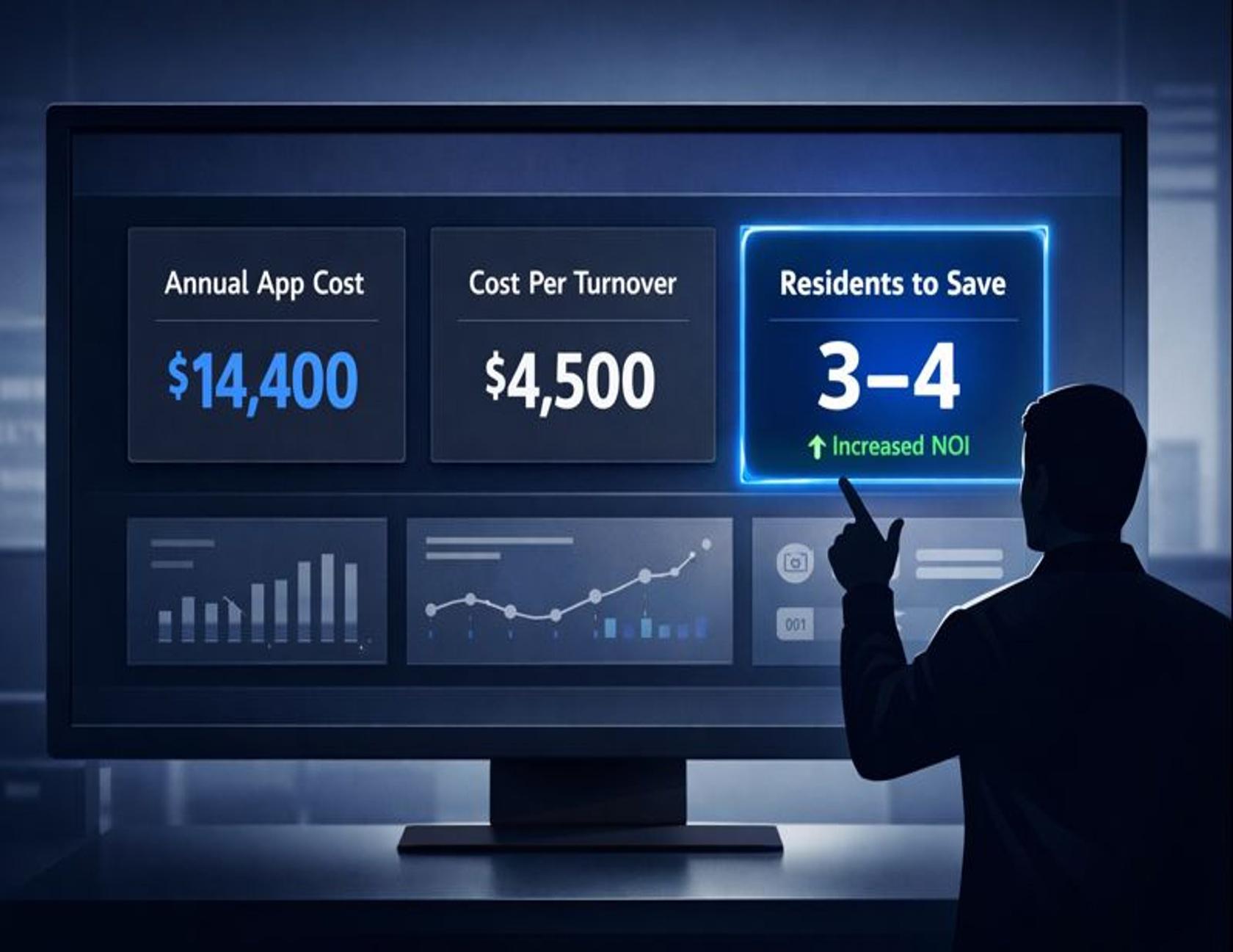
Retaining just 3–4 more residents per year can fully cover the cost of a unified property app when turnover expenses average $4,500 per move-out.
- Turnover Costs Add Up Fast: Financial vacancy, marketing spend, make-ready labor, concessions, and reputation drag combine to cost $3,000–$7,000 per move-out in Class A communities.
- Daily Friction Triggers Move-Outs: Package delays, amenity booking conflicts, and maintenance visibility gaps accumulate into renewal-breaking frustrations that unified apps eliminate.
- Community Connection Drives Retention: Residents who attend events, join interest groups, or recognize neighbors through shared activities demonstrate measurably lower move-out rates.
- Break-Even Happens at 5% Churn Reduction: A 200-unit property spending $14,400 annually on a premium app ($6/unit/month) recovers costs by preventing just 3.2 move-outs.
- Launch Core Workflows in 30 Days: Properties can implement package management, amenity reservations, and maintenance requests within one month using focused rollout plans.
Small retention gains generate exponential NOI impact when vacancy costs are fully quantified.
Multifamily property managers evaluating resident experience platforms will find decision-grade ROI frameworks here, preparing them for the implementation roadmap that follows.
Unified property apps improve resident retention by reducing everyday friction—maintenance status, amenity booking, packages, communications—and increasing community connection through events, groups, and participation opportunities. When turnover costs thousands per move-out, even a small reduction in annual move-outs can cover the app's cost, especially when daily "experience moments" are unified into one consistent, building-branded workflow.
The review drops to 3.9 stars. A resident complaint about a lost package that sat in the office for three days. The leasing team is fielding calls. Marketing is watching the damage spread across review sites. And you're left wondering: How much is this one friction point actually costing us?
The answer is more than you think—and the solution is simpler than most property teams realize.
Yes, unified property apps improve resident retention by reducing everyday friction and increasing community connection. Even a 1–2% reduction in annual move-outs can cover the cost of the platform when you quantify what turnover actually costs: vacancy loss, marketing spend, make-ready labor, concessions, staff time recovering from service misses, and the compounding drag of negative reviews that reduce conversion efficiency.
The equation is straightforward. The implementation is faster than a traditional lease-up campaign. And the break-even threshold is lower than most owners expect.
The Retention Equation: What Turnover Really Costs
Most property teams track occupancy. Far fewer track the full economic impact of a single move-out. When a resident leaves, the visible costs—vacancy and re-leasing fees—are only part of the story.
With rising supply in many multifamily markets, retention economics matter more than they did three years ago. The competitive landscape makes every retained resident more valuable.

The Hidden Cost Buckets
Turnover creates a cascade of expenses that most P&L statements don't fully capture:
- Vacancy loss – The economic gap between a move-out and a new revenue-generating lease start date. While physical turn times may be short, financial vacancy often averages 15–30 days, accounting for marketing time, lease administration, and applicant screening—even in stabilized markets.
- Marketing and leasing effort – Digital ads, tour coordination, application processing, and leasing team time to convert one new resident
- Make-ready and maintenance labor – Paint, carpet, appliance repair, and the coordination overhead to turn a unit
- Concessions and discounting – First month free, reduced deposits, or other incentives to close deals faster in competitive supply environments
- Staff time and error recovery – The hours spent managing resident complaints, fixing missed handoffs (lost packages, scheduling conflicts), and addressing negative reviews after service failures
- Reputation drag – Each negative review reduces your conversion rate on future prospects, requiring more marketing spend to achieve the same lease velocity
According to industry benchmarks, the total cost of turnover in Class A communities typically ranges from $3,000 to $7,000 per unit, depending on market dynamics and building age.
The Simple Formula
You can estimate your baseline turnover cost using this structure:
Cost of Turnover = Vacancy Loss + Marketing + Make-Ready + Concessions + Staff Time
For a property with 200 units and 30% annual turnover, that's 60 move-outs per year. At $4,500 per turnover (a conservative midpoint), you're spending $270,000 annually just to replace residents who leave.
Now ask: What if you could retain just three more residents per year?
Why 'Experience' Drives Renewals (Two Levers)
Renewal isn't a decision made 60 days before the lease ends. It's a decision made every time a resident picks up a package or books the gym.
The cumulative effect of daily moments—positive or negative—shapes whether someone renews or starts browsing competitor listings. A unified property management software influences renewal propensity through two distinct mechanisms.
Lever 1: Friction Reduction in Daily Moments
Residents interact with building systems dozens of times per month: tracking packages, submitting maintenance requests, booking amenities, checking announcements, paying rent. When each task requires a different login, a phone call to the office, or a trip to the front desk, the system toggle tax accumulates.
Each toggle creates opportunity for failure. The package notification that never arrives. The amenity reservation that gets double-booked because the spreadsheet wasn't updated. The maintenance request that falls through the cracks because it was submitted via email instead of the work order system.
"Renewal isn't a decision made 60 days before the lease ends. It's a decision made every time they pick up a package or book the gym."
These aren't catastrophic failures. They're small frustrations. But research on resident priorities shows that operational friction—particularly around packages, maintenance response time, and amenity access—consistently appears among the top reasons residents cite dissatisfaction.
When everything works through one app, with one login, and synchronized workflows on the back end, the probability of a missed handoff drops significantly. Fewer missed handoffs mean fewer complaints. Fewer complaints mean fewer triggers that start the move-out thought process.
RESIDENT EXPERIENCE:
"The app is incredibly intuitive and puts everything I need right at my fingertips. Booking amenities like the gym or rooftop deck is a breeze – no more paper sign-ups or guessing availability. Getting building updates, package notifications, and submitting maintenance requests takes seconds."
— Chris M (Google Reviews)
Lever 2: Community Connection and Belonging at Scale
The second lever is emotional, not operational. Residents who feel connected to their community—who attend events, participate in interest groups, or recognize neighbors through shared activities—are demonstrably less likely to move.
The challenge is that creating community at scale requires infrastructure. Event RSVPs, group messaging, neighborhood announcements, and fitness class scheduling all need coordination. When these tools are accessible through one platform rather than scattered across multiple channels, participation becomes more equitable and engagement rates improve for all residents.
A unified resident app lowers the barrier to participation. Residents already open the app to pay rent or check on a package. When they see an event invitation or a neighbor's post in the community feed while they're there, engagement becomes frictionless.
Belonging reduces move-out temptation. When someone has connections in the building—whether that's a weekly yoga class they attend or a book club they've joined—the inertia to stay increases. The competitive multifamily landscape makes this connection more valuable: with rising supply in many markets, retention economics matter more than they did three years ago.
What a Unified Property App Must Include to Move Retention
Not all resident apps are created equal. A portal that only handles rent payments isn't a retention tool—it's a billing system. Research on customer experience technology shows how fragmented resident-facing systems increase operational complexity and reduce satisfaction. To activate both friction reduction and community connection, the platform needs specific capabilities designed to serve all residents equitably.
One Login and a Resident-First Home Screen
The experience must start with simplicity. Residents shouldn't need to remember which app handles packages versus amenities versus maintenance. One login. One home screen that shows what matters today: package arrivals, upcoming reservations, open maintenance requests, and community announcements.
Core Workflows: Amenities, Packages, Maintenance, and Communications
The app must consolidate the tasks that happen most frequently, ensuring all residents have equal access to building services:
- Amenity booking – Reserve the gym, pool, conference room, or guest suite without calling the office
- Package workflows – Receive notifications when deliveries arrive and track pickup status
- Maintenance requests – Submit issues with photos, track progress, and receive completion updates
- Building communications – Get push notifications for time-sensitive updates (elevator maintenance, weather alerts, community events)
These aren't optional features. They're the minimum set required to reduce the system toggle tax while ensuring equitable service access.
Push Notifications, Not Email-Only
Email is where information goes to be forgotten. Push notifications bring urgent updates—package arrivals, maintenance schedules, event reminders—into the resident's immediate attention without requiring them to open an inbox and sift through promotional messages.
Operational Analytics for Property Teams
The platform must provide visibility into what's working. Adoption rates by workflow. Engagement metrics for events and groups. Service response times for maintenance requests. These data points allow property management teams to identify bottlenecks before they escalate into complaints.
Branding Consistency
The app should feel like an extension of the building, not a generic third-party portal. White-label customization—brand colors, logo, welcome messaging—reinforces that the technology is part of the property's service commitment, not a separate vendor relationship.
The ROI Walkthrough: Retention Savings vs. App Cost
The math becomes concrete when you compare the cost of turnover to the cost of the platform.
Worked Example with Conservative Assumptions
Let's use a 200-unit Class A community with the following profile:
- Annual turnover rate: 30% (60 move-outs per year)
- Average turnover cost per unit: $4,500 (vacancy + marketing + make-ready + concessions + staff time)
- Total annual turnover cost: $270,000
Now assume the property implements a unified resident experience platform. For a comprehensive premium platform, we estimate a cost of $1,200 per month, or $14,400 annually ($6.00/unit/mo).
The break-even question: How much does turnover need to decrease to cover the app cost?
The Break-Even Calculator
Residents to Save = Annual App Cost ÷ Cost per Turnover
Using our example:
$14,400 ÷ $4,500 = 3.2 residents
In absolute terms, you only need to prevent 3 to 4 move-outs per year to cover the entire cost of the software. For a building losing 60 residents annually, this represents a modest 5.3% reduction in churn to reach profitability.
If the app reduces turnover by just 10% (6 retained residents), the property covers the cost and generates $12,600 in net savings. At a 15% reduction (9 renewals), the net gain jumps to $26,100 directly to the bottom line.
These aren't speculative figures. Properties that implement resident engagement platforms with both operational tools and community features report measurable improvements in renewal rates within the first year, particularly when the rollout includes staff training and adoption support.
RETENTION PARTNER EXPERIENCE:
"Elevated OS has been a valued partner to Willow Bridge for the past four years. Their professionalism and innovative platform have transformed our resident retention strategy and tightened our 'back doors.' Their app has been a game changer, making it easy to manage event sign-ups, fitness classes, and amenity reservations. It's helped us create stronger resident experiences while supporting asset performance and the percentage back on services is a win win."
— Jennifer B (Google Reviews)
Advanced: Sensitivity Analysis for Decision-Grade Confidence
A break-even point is a start, not the finish. A decision-grade model benefits from testing ranges:
- Turnover cost: low / base / high (based on actual make-ready scope and vacancy duration)
- App cost: base + optional modules or services (implementation-dependent)
- Expected retention lift: conservative / moderate (avoid overpromising; validate via adoption and complaint reduction)
Sensitivity analysis doesn't require complex finance tooling. It requires disciplined assumptions and a plan to measure adoption and operational friction reduction over the first 30–90 days.
30-Day Rollout Plan for Small Teams
Implementation doesn't require a six-month IT project. While complex portfolio-wide integrations (PMS two-way sync, access control) may require 60–90 days, most individual properties can launch core resident-facing workflows in approximately 30 days using a focused implementation roadmap.
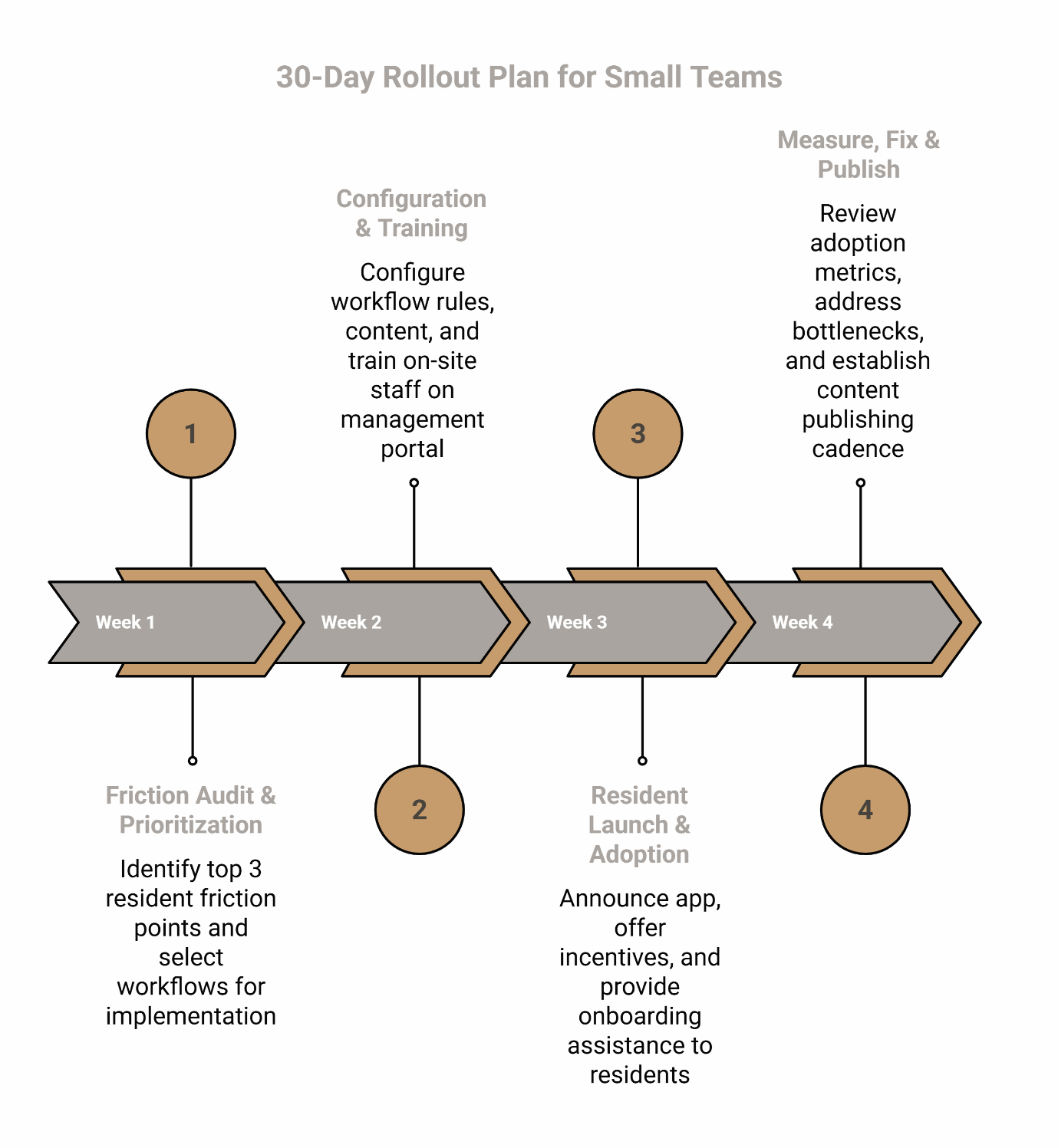
Week 1: Friction Audit and Workflow Prioritization
Identify the top three friction points from recent resident complaints. Review the past quarter's move-out surveys and online reviews. What operational issues appear most frequently?
Common patterns include:
- Package notification delays or lost deliveries
- Amenity booking conflicts (double-bookings, unclear availability)
- Slow maintenance response or lack of visibility into request status
Select the three workflows that will deliver the highest immediate value. For most properties, this means starting with package management, amenity reservations, and maintenance requests.
Week 2: Configure Rules, Content, and Staff Training
Work with the platform provider to configure workflow automation rules. Set up amenity booking policies (advance notice requirements, cancellation windows, capacity limits). Load building-specific content (community guidelines, neighborhood resources, welcome messaging).
Train your on-site team on the management portal. Ensure they understand how to process reservations, respond to maintenance tickets, and publish announcements. The app only works if the back-end operations are ready.
Week 3: Resident Launch and Adoption Nudges
Announce the app through multiple channels: email, flyers in common areas, and in-unit door hangers. Offer a simple incentive for early adoption—a raffle entry or small gift card for residents who complete their profile in the first week.
Consider hosting a brief demonstration where staff can help residents download the app and answer questions. Whether through scheduled sessions or concierge desk support, make the first interaction easy and ensure all residents have equal access to onboarding assistance.
Week 4: Measure, Fix Bottlenecks, Publish Cadence
Review adoption metrics. Which workflows are getting traction? Where are residents dropping off? If amenity bookings are low, check whether the reservation process is too complicated. If maintenance request submissions are weak, verify that residents know the feature exists.
Establish a publishing cadence for announcements and community posts. Residents need to see activity in the app to build the habit of opening it regularly.
FAQ
How Much Does Turnover Cost?
Turnover costs vary by market and building age, but industry benchmarks place the range between $3,000 and $7,000 per unit for Class A communities. This includes vacancy loss (typically 15–30 days), marketing and leasing expenses, make-ready labor and materials, concessions offered to new residents, and staff time spent managing the transition. In competitive markets with higher concession levels, costs can exceed $7,000 per unit.
How Do I Calculate Retention ROI?
Start with your baseline turnover cost: multiply the number of annual move-outs by your average cost per turnover. Then calculate the break-even churn reduction needed to cover the app investment using this formula: Annual App Cost ÷ Cost per Turnover. The result tells you how many residents you need to retain to fully offset the platform expense. Any retention improvement beyond that threshold generates net savings.
Which Features Matter Most for Renewals?
The features that directly reduce friction in high-frequency tasks deliver the strongest retention impact. Package management, amenity booking, and maintenance request tracking address the operational pain points that most commonly appear in resident complaints. Community engagement tools—event RSVPs, interest groups, and neighborhood announcements—support the emotional connection that makes residents less likely to consider moving. Both operational and social features are necessary; neither is sufficient alone.
How Fast Can We Launch?
While complex portfolio-wide integrations (PMS two-way sync, access control) may require 60–90 days, most individual properties can launch core resident-facing workflows in approximately 30 days using a focused implementation roadmap. The key accelerator is internal alignment: when the property team commits to the adoption process and actively promotes the app to residents during launch week, usage ramps faster.
Next Steps
Ready to calculate how retention savings compare to platform investment at your property? Use the break-even formula above and download the retention ROI worksheet for budget review conversations.
Want retention and NOI playbooks delivered monthly? Subscribe to the ElevateOS newsletter for practical frameworks from property operations specialists.
Prefer to see the platform in action? Schedule a demo or request a custom quote tailored to your portfolio.
For more on how unified platforms support multifamily amenity management and the ROI of human-powered hospitality, explore our resources on creating retention-focused resident experiences.
Disclaimer: This article provides general educational information about resident retention strategies and technology platforms. Specific implementation timelines, cost assumptions, and ROI projections will vary based on property characteristics, market conditions, and operational workflows. Property owners should evaluate platform options based on their unique requirements and consult with finance and operations teams when building business cases for technology investments.
Our Editorial Process
Our team follows a strict editorial process to ensure content is accurate, helpful, and aligned with real-world property operations. Each article is written by industry specialists, reviewed for clarity and practical value, and fact-checked when citing data, benchmarks, or industry reports.
About the ElevateOS Insights Team
The ElevateOS Insights Team is a group of property operations and resident experience specialists focused on helping multifamily communities improve retention, increase NOI, and deliver hospitality-level living through technology and services. Learn more about ElevateOS.