.avif)
📌 Key Takeaways
Gamification transforms routine property workflows into scalable engagement by making everyday actions—paying rent, booking amenities, participating in polls—feel rewarding through simple trigger-action-reward loops.
- Consolidation Eliminates Friction: Scattered login portals kill participation; one unified app reduces cognitive load and makes repeated engagement effortless.
- Start Small and Measure Smart: Focus on 1-2 behaviors with simple rules, then track participation rates and workflow completion instead of vanity metrics.
- Fair Housing Requires Action-Based Access: Rewards must tie to resident actions like bookings or RSVPs, never to protected characteristics or factors outside resident control.
- Groups Decentralize Community Management: Resident-formed interest clubs deploy challenges organically, reducing site team workload while increasing ownership and participation.
- Legal Compliance Protects Implementation: Structure payment incentives as sweepstakes with no-purchase-necessary options to avoid illegal lottery classification in most U.S. jurisdictions.
Simple mechanics, broad accessibility, consistent platform—engagement becomes operational habit, not event heroics.
Property managers and community teams at Class A multifamily communities will gain immediately deployable tactics here, preparing them for the implementation playbook and platform evaluation details that follow.
You planned the rooftop happy hour. Sent three reminders. Five people showed up.
The rest of your community? Silent. Scrolling. Somewhere else. Your building markets itself as a lifestyle destination, but the reality feels more like a hotel where everyone checks in and disconnects.
Now layer in the Monday morning reality: packages stacking up in the lobby, residents asking the front desk the same questions, the site team bracing for the next wave of friction. Or picture 5:30 PM: a resident taps their phone to book the grill for dinner, but the old portal is down again. These moments are not about resident apathy. They are design problems—usually caused by fragmented tools and unclear participation paths.
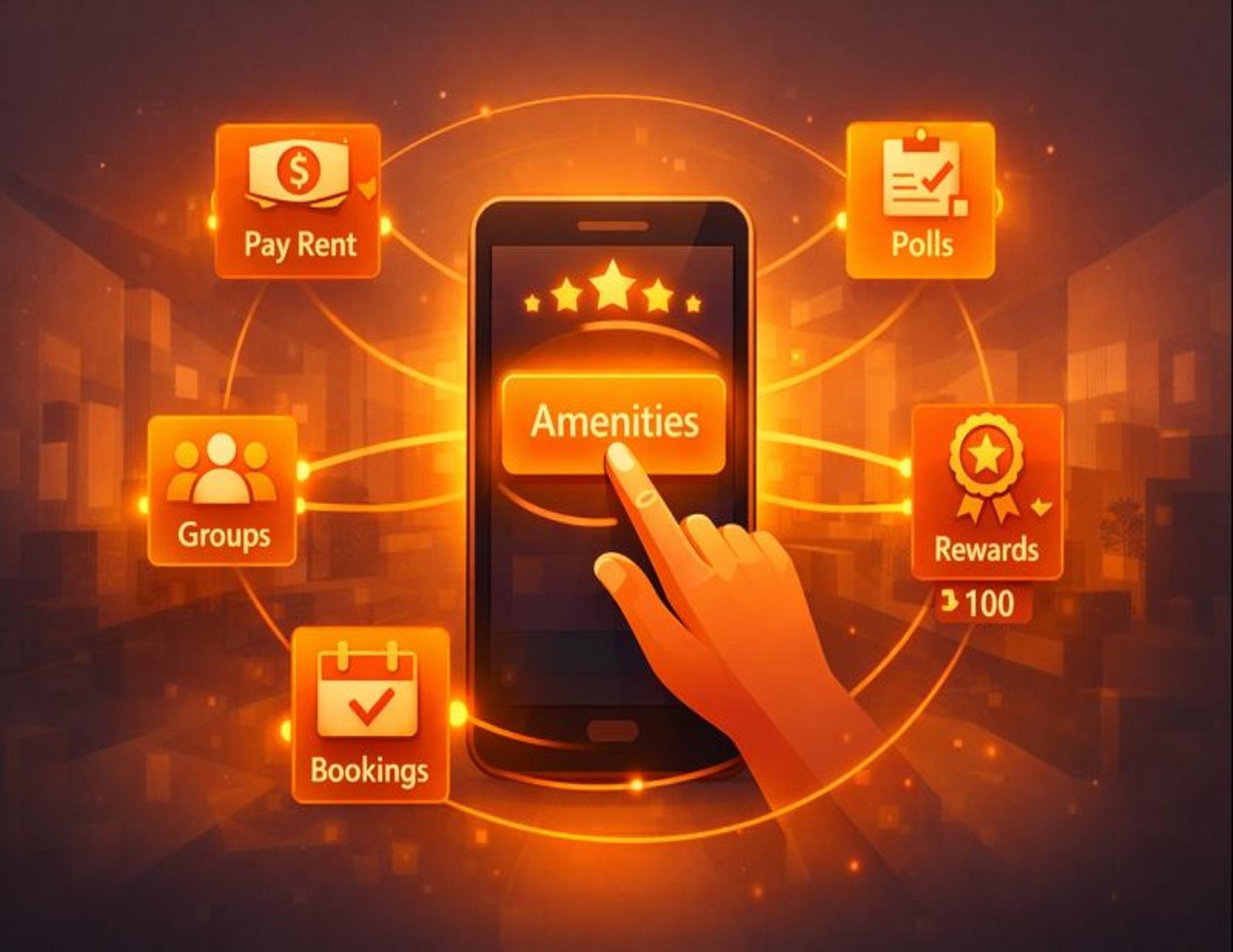
A gamified resident experience transforms this pattern. It converts routine property workflows—paying rent, booking amenities, participating in community life—into moments of recognition, progress, and belonging. When designed thoughtfully and deployed through a unified Resident App, gamification becomes a scalable engagement engine that works whether residents show up to events or not.
The Problem: Why Resident Engagement Stalls After Move-In
The 'Community Event Flop' Moment
The gap between marketing promises and lived experience becomes visible quickly. Communities invest in premium amenities and curated events, but participation remains inconsistent. The culprit is rarely apathy. More often, it's friction—residents face too many portals, unclear participation paths, and no visible reward for showing up.
The Hidden Cost of Disconnected Tools
When engagement lives across scattered systems—one app for payments, another for amenities, a third-party platform for events—each interaction requires a new login, a new learning curve, and a new decision to participate. This fragmentation doesn't just frustrate residents. It creates invisible operational drag for property teams who must promote, manage, and reconcile data across multiple platforms.
Two patterns typically drive the stall: Energy is spent on coordination instead of connection. When workflows are scattered across multiple tools, residents disengage and teams spend time redirecting people rather than creating momentum. Participation requires too much effort. If residents must remember separate logins, hunt for information, or navigate unreliable portals, even small actions—RSVPs, booking amenities, joining groups—stop happening.
The cost compounds during renewals. Communities with low engagement see higher turnover. Residents who feel disconnected from their building view it as a transaction, not a home. The impact extends beyond the event calendar—it affects renewals, reputation, and the day-to-day strain on the property management team, especially in Class A communities where expectations are higher.
What a Gamified Resident Experience Actually Is
A gamified resident experience uses lightweight game mechanics—clear prompts, small wins, and social reinforcement—to make positive behaviors easier to start and more satisfying to repeat. The goal is not turning life into a game. The goal is consistent participation in the actions that make a community feel premium and well-run.
Gamification vs. Gimmicks
Gamification applies the principles of game design—clear goals, visible progress, meaningful rewards—to non-game contexts. In property management, this means taking actions residents already perform and adding layers of recognition, achievement, or social proof.
A gimmick offers superficial novelty without changing behavior. True gamification creates a feedback loop that makes desirable actions feel rewarding and worth repeating. Effective gamification is simple and operationally realistic: one or two behaviors, easy rules, and rewards that are fair and broadly accessible.
The Behavior Loop: Trigger → Action → Reward
Effective gamification follows a simple sequence. A trigger prompts the resident to act—a push notification, a calendar reminder, or a visual cue in the app. The action is straightforward: pay rent on time, reserve an amenity, join a community poll. The reward provides immediate feedback: points earned, a badge unlocked, or public recognition in the community feed.
This loop works because it mirrors how humans naturally seek progress and acknowledgment. When the cycle is clear and the rewards feel genuine, participation increases without requiring constant manual intervention from your team. This loop works best when it lives inside one consistent, branded experience—so residents don't have to "go find" engagement.
5 Gamification Tactics You Can Deploy with a Branded Resident App
The tactics below are intentionally framed as options and examples. Specific feature availability varies by platform and implementation. Where "points" or "badges" are mentioned, they can be run as simple recognition mechanics even without a built-in points engine.
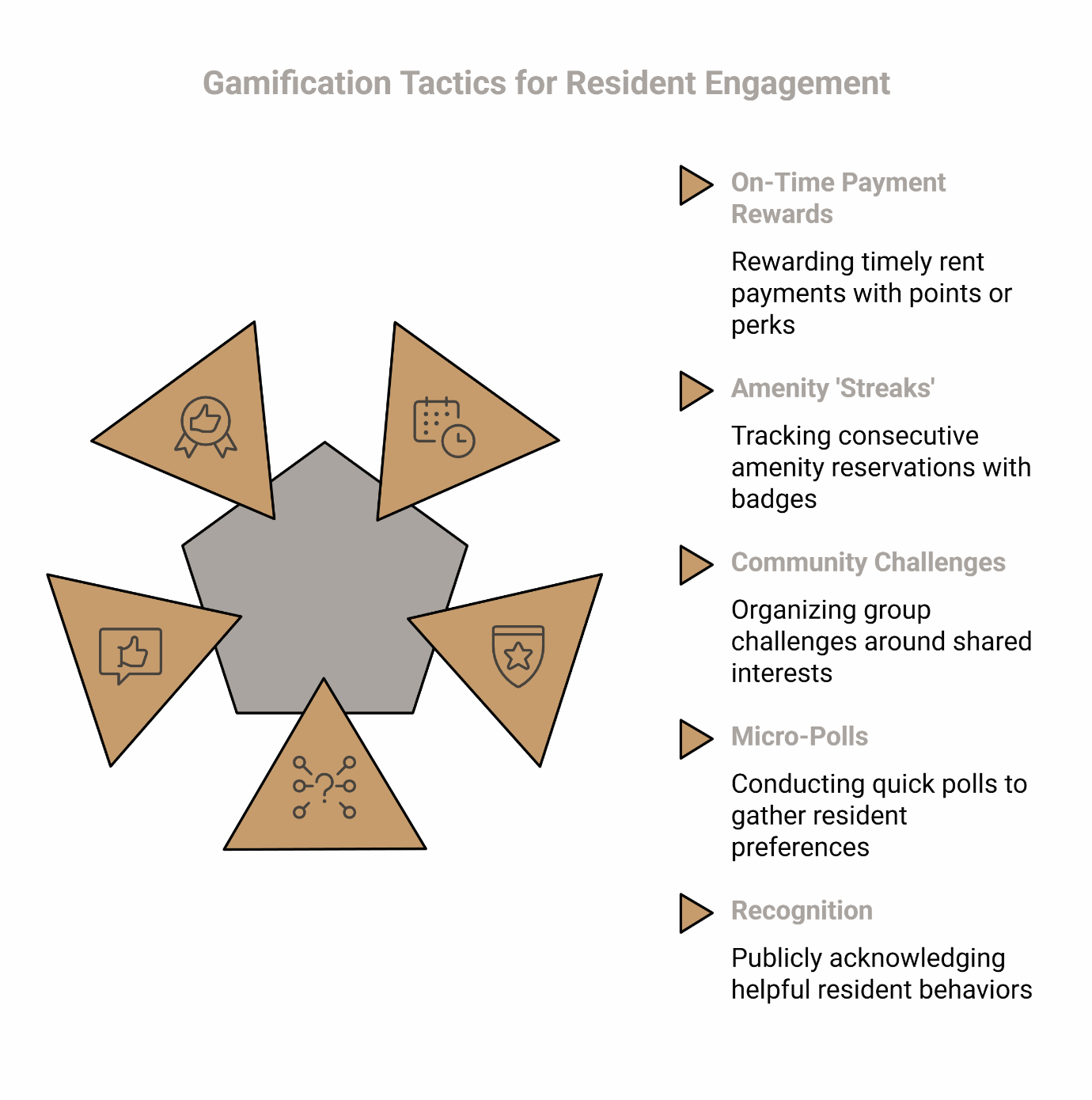
1. On-Time Payment Rewards (Points or Perks)
Rewarding timely rent payments with rewards programs (where permitted by state legislation) transforms a routine obligation into a positive milestone. On-time payment is a routine workflow that benefits from positive reinforcement. Recognition can be as simple as a monthly "thank you" perk or a community-wide acknowledgment. The key is making the reward visible and valuable enough to reinforce the behavior without creating an expectation that payment itself is optional, and to avoid anything punitive or exclusionary.
For instance, residents who consistently pay on time might earn credits toward amenity bookings, priority event access, or partner discounts. Another approach: a monthly sweepstakes for residents who pay by a published date. Note: Ensure this is structured to comply with local sweepstakes laws to avoid classification as an illegal lottery (often requiring a "no purchase necessary" alternative entry method).
2. Amenity 'Streaks' and Reservation Badges
Tracking consecutive amenity reservations—gym bookings, pool cabana use, or coworking space check-ins—creates a sense of momentum. Amenities are where "hotel-like" experience is felt—when booking is frictionless and participation is encouraged. Residents who maintain a streak earn badges that appear on their profile. This tactic works particularly well for underutilized amenities. When residents see their progress toward a milestone, they're more likely to continue engaging with those spaces.
Consider recognition for residents who use a fitness center reservation feature three times in a month, paired with a friendly shout-out rather than gated privileges.
3. Community Challenges Inside Groups
The Groups feature within a Resident App allows organic community formation around shared interests—fitness enthusiasts, pet owners, book clubs. Challenges like "30 Days of Wellness" or "Neighborhood Cleanup Week" leverage these existing connections to drive participation. Residents compete or collaborate toward a shared goal, earning recognition or rewards that reinforce their sense of belonging. Group-based challenges create belonging without requiring constant in-person events.
A weekly "small wins" challenge where residents post one positive moment, or a pet-photo theme week that drives light participation, can generate momentum with minimal site team involvement.
4. Micro-Polls and Contests That Create Belonging
Quick polls about community preferences—Which food truck should we book? What movie should we screen?—give residents a voice in shaping their environment. Micro-polls are one of the lowest-lift engagement tools available. They create momentum because participation takes seconds, and residents see the collective outcome. Contests for best pet photo, balcony garden, or holiday decoration create moments of lighthearted competition and connection. These tactics require minimal operational lift but generate significant engagement because they make residents feel heard and seen.
A one-question poll to select next month's lobby playlist theme, followed by a short message—"You voted, here's what's happening"—closes the feedback loop and reinforces participation.
5. Recognition That Reinforces Helpful Behaviors
Publicly acknowledging residents who participate in community life—picking up packages for neighbors, attending events, or referring new residents—creates a culture of contribution. Recognition can take the form of leaderboards, monthly shoutouts in the community feed, or tangible perks. The goal is to make positive behaviors visible and socially rewarding. Recognition loops work because they make community norms visible. Highlighting positive behaviors improves experience without adding operational overhead.
A monthly "Community Kudos" post that thanks residents for helpful participation, with nominations open to everyone, reinforces the behaviors that make a community feel welcoming.
A real-world signal that boring processes can feel better comes directly from an ElevateOS review: "Fantastic resident experience software provider! Their app offers a seamless and modern resident service, making bored property processes easy and fun for both residents and property owners." — Vadik G (Google Reviews)
📋 Gamification Ideas Swipe File
Copy and adapt these five tactics for your community:
- On-Time Payment Rewards – Award rewards programs for consistent rent payments (where permitted by state legislation); offer exclusive perks or amenity credits. Or run a monthly sweepstakes for residents who pay by a published date (ensure compliance with local sweepstakes laws).
- Amenity Streaks – Track consecutive reservations; unlock badges for sustained engagement with underutilized spaces. Celebrate consistent usage with a monthly shout-out.
- Community Challenges – Launch fitness, sustainability, or social challenges within Groups; recognize top participants. Run a weekly theme inside Groups to spark light participation.
- Micro-Polls & Contests – Run quick polls on community decisions; host photo contests or creative competitions. Ask one question, publish results fast, and act on one result monthly.
- Helpful Neighbor Recognition – Highlight residents who contribute to community life; feature them in feeds or offer small perks. Spotlight helpful behaviors that improve shared experience.
Fair Housing and Accessibility: How to Gamify Without Creating Risk
Fair housing and accessibility are not add-ons. They are requirements. Any gamified program must be designed so all residents can access the same services, tools, events, and features, with no unequal participation paths.
Equal Access to Rewards and Events
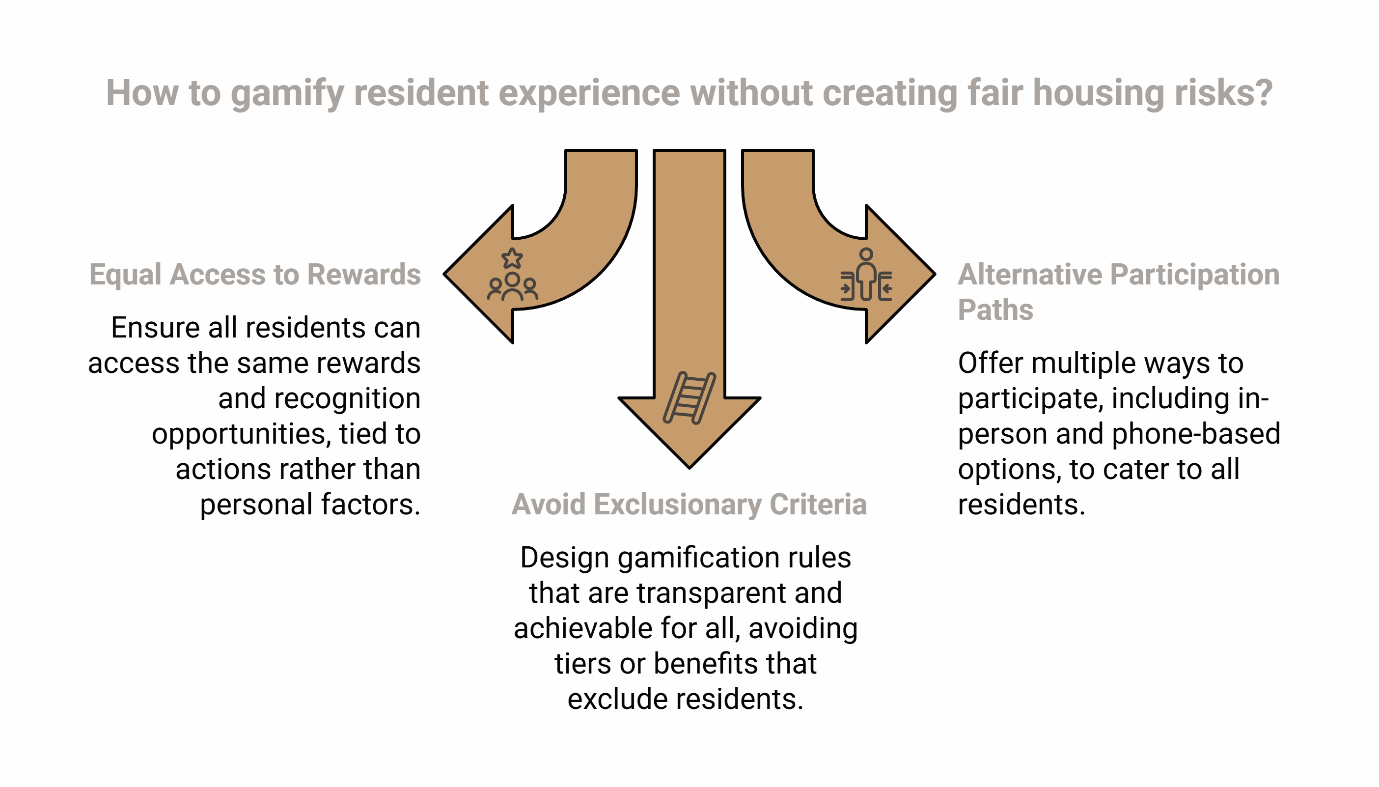
All residents must be able to access the same gamification features, rewards, and recognition opportunities. Designing a system where participation is tied to income level, unit type, or lease terms creates potential fair housing violations. Rewards should be tied to actions—booking amenities, attending events, engaging in polls—not to factors outside a resident's control. Do not gate core services behind participation or scoring.
Alternative Participation Paths
Not every resident will engage through digital channels. Offering alternative ways to participate—in-person RSVPs, phone-based sign-ups, or physical recognition boards—ensures that gamification remains inclusive. The goal is to create multiple entry points so that technology enhances the experience without becoming a barrier. Avoid smartphone-only exclusivity; if something is offered in-app, provide an equivalent way to participate or receive information.
Avoiding Exclusionary Eligibility Criteria
Gamification rules must be transparent and universally achievable. Avoid creating tiers or benefits that exclude residents based on protected characteristics or arbitrary thresholds. For example, a leaderboard that only recognizes residents who attend a certain number of events could inadvertently disadvantage residents with mobility challenges or non-traditional work schedules. Design systems that celebrate diverse forms of participation. Do not tie participation to factors that could create disparate impact—income-linked thresholds, ability-linked requirements, or subjective "approval" mechanics.
Gamification should feel like hospitality—welcoming, simple, and consistent.
Disclaimer: Fair housing laws prohibit discrimination in the provision of services, tools, events, and features based on protected characteristics. When implementing gamification, consult with legal counsel to ensure compliance with federal, state, and local regulations.
Implementation Playbook: Launch, Measure, Iterate
This approach keeps the program small-business realistic and low-lift.
Pick 1–2 Behaviors to Change
Start small. Identify the specific resident behaviors you want to encourage—on-time payments, amenity usage, event attendance—and focus your initial gamification efforts there. Choose behaviors that are both measurable and meaningful: event RSVP participation, amenity booking adoption, group participation, or response rates to polls. Trying to gamify everything at once creates complexity and dilutes impact. A narrow focus allows you to refine the experience before scaling. Avoid launching five new mechanics at once.
Define Simple Rules and Guardrails
Keep the mechanics straightforward. Residents should understand how to earn rewards, what the rewards are, and how to redeem them within seconds of opening the app. Avoid complex point systems or multi-tiered eligibility. Complex scoring systems create confusion. Keep rules readable in one screen and use plain language. If a perk exists, define it clearly and apply it consistently. The simpler the rules, the higher the participation.
Measure Engagement and Adoption Trends
Track the metrics that matter: participation rates, repeat usage, time to first action. Metrics vary by platform and reporting, but the direction is consistent—adoption (active users), participation (poll responses, group activity, RSVPs), and workflow completion (amenity reservations, request updates). If residents earn points but never redeem them, the reward structure needs adjustment. If a challenge launches but few residents join, the trigger or communication strategy may need refinement. Use your platform's analytics to identify what's working and what's creating friction. Measurement is not about vanity numbers. It's about identifying where friction still exists.
Avoid App Fatigue by Consolidating Workflows
Gamification succeeds when it lives inside the same platform residents already use for rent payment, maintenance requests, and amenity bookings. Asking residents to download a separate app for engagement features guarantees low adoption. When residents juggle multiple tools, engagement drops. Consolidation reduces cognitive load and makes it easier for residents to participate repeatedly—because the "place to go" is consistent. A unified Resident App eliminates this barrier and ensures gamification becomes a natural extension of daily workflows rather than an isolated add-on.
How ElevateOS Supports Engagement Without Adding Site Workload
Self-Organized Interest Nodes
By allowing residents to form their own clubs—fitness, pets, hobbies—the platform decentralizes community management. Gamification challenges can be deployed directly within these spaces to drive participation. This organic structure reduces the operational burden on site teams while giving residents ownership over their social experience.
Event Support and Concierge-Style Services
Professional event planning and concierge services offered through the platform handle the logistics—marketing, setup, coordination—so property teams don't have to add event management to their already full workload. Events become easier to execute, and when paired with gamification (RSVPs earn points, attendance earns badges), participation naturally increases.
Unified App Experience to Reduce Tool-Switching
A single platform that consolidates payments, Amenity Management Software, maintenance requests, and engagement features eliminates the friction that kills adoption. Residents don't need to remember multiple logins or switch between apps. Property teams manage everything from one dashboard. This consolidation is what makes gamification practical rather than aspirational.
Moving from Bored to Engaged
A gamified resident experience is not about adding complexity. It's about making the actions residents already take feel rewarding, visible, and connected to something larger. When designed with fair housing compliance in mind and deployed through a unified platform, gamification becomes a scalable way to increase engagement, improve retention, and differentiate your community—all without overwhelming your site teams.
The choice is not between events and technology. It's about creating a system where participation happens continuously, not just when your team can rally attendance for a single night.
Ready to explore how gamification can work in your community? Contact ElevateOS to see how a unified resident engagement platform can support your goals.
Resources
- From App Chaos to Command Center: The All-In-One Resident App Framework
- The Hidden Cost of 'App Fatigue': Why Residents Ignore Your Tools
- Why Multiple Resident Apps Are Undermining Your Community's Experience Flow
- Decoding Engagement Data: Unlocking Deeper Insights from Your Resident Experience Platform
- Seasonal Engagement Strategies: Adapting Your Platform Usage Through Peak and Off-Peak Periods
External References
- National Multifamily Housing Council (NMHC)
- National Apartment Association (NAA)
- Better Business Bureau profile
Our Editorial Process
Our expert team uses AI tools to help organize and structure our initial drafts. Every piece is then extensively rewritten, fact-checked, and enriched with first-hand insights and experiences by expert humans on our Insights Team to ensure accuracy and clarity.
By: The ElevateOS Insights Team
The ElevateOS Insights Team is our dedicated engine for synthesizing complex topics into clear, helpful guides. While our content is thoroughly reviewed for clarity and accuracy, it is for informational purposes and should not replace professional advice.