.avif)
📌 Key Takeaways
Underutilized common areas become controlled revenue channels when you fix the operating system—not the space itself.
- Operating System Failure, Not Design Flaw: Dead space bleeds money because access is complicated, rules are unclear, and booking requires staff coordination—automation solves all three.
- Three Hidden Costs Compound Fast: Maintenance drain ($400–$1,000 monthly for a 2,000-square-foot clubhouse), conflict friction that turns leasing teams into referees, and missed ancillary revenue that could boost NOI.
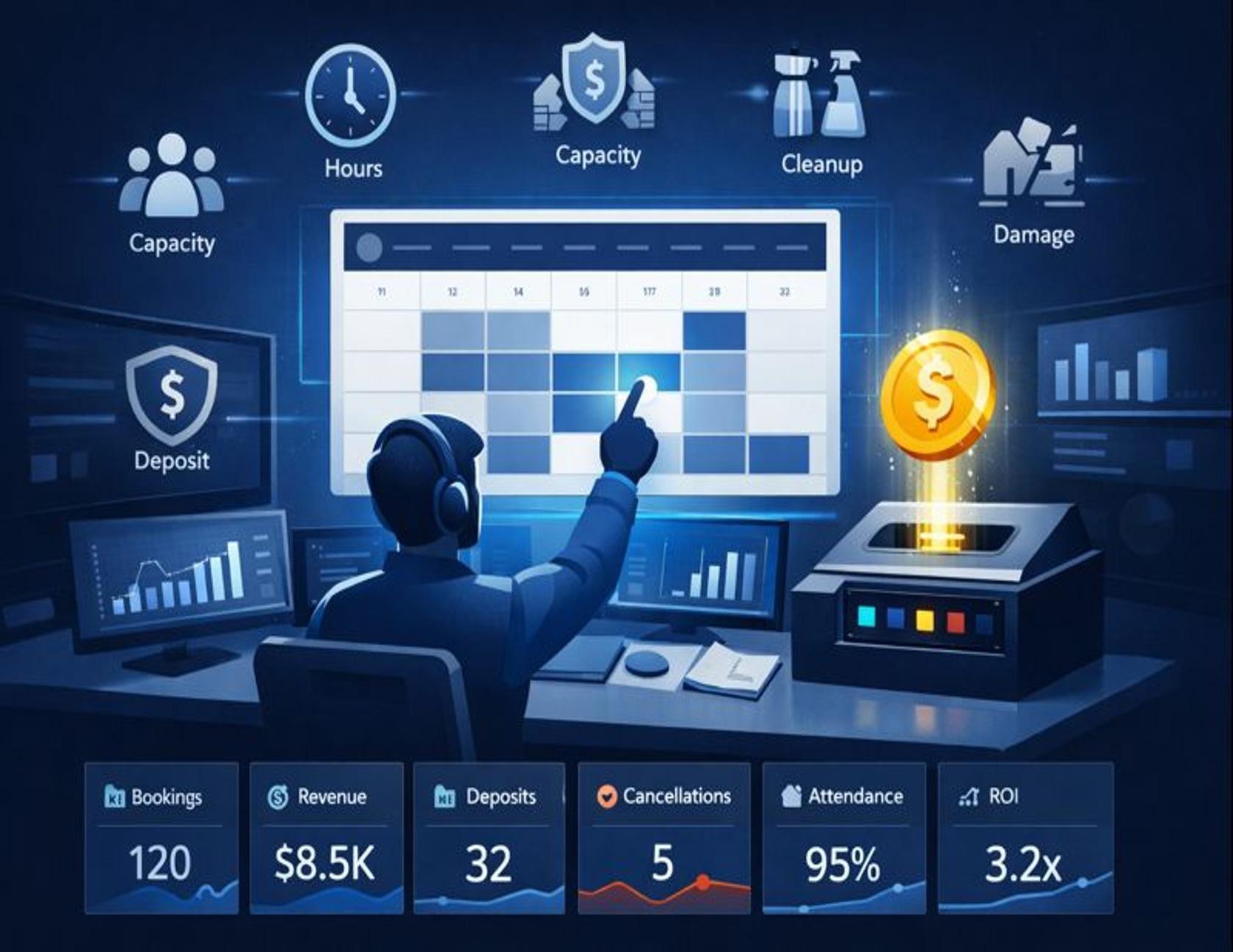
- Rules Written Once Eliminate Daily Refereeing: Document six categories (hours, capacity, deposits, cleanup, cancellations, damage) and automate enforcement through digital booking to stop manual coordination.
- Start Small, Prove ROI in 30 Days: Pick one high-scoring space from the audit, write the rules, launch the booking calendar, and track metrics before scaling to additional areas.
- Six Metrics Drive Activation Decisions: Utilization rate, revenue per hour, cancellations, incident rate, staff time spent, and resident sentiment reveal which spaces justify continued investment.
Revenue stagnation isn't a square-footage issue; it's a process failure.
Property management teams navigating NOI pressure and budget scrutiny will gain an immediately deployable activation framework here, preparing them for the step-by-step implementation guide that follows.
9:00 AM on a Monday. The site team is dreading the package pile-up in the lobby. The clubhouse sits dark. The rooftop deck—built for sunset gatherings—has hosted exactly two events this year. Meanwhile, the budget review is in two weeks, and the maintenance line item for those underutilized assets is becoming a red flag in the budget review.
You already know the problem. Common areas are bleeding money. But here's what most property teams miss: the issue isn't the space itself. It's the operating system around it.
Underutilized common areas are not a design problem; they are an operating problem. When you make access easy, set rules once, and automate booking and payments, "dead space" becomes a controlled revenue channel.
Define "Dead Space" in a Class A Community
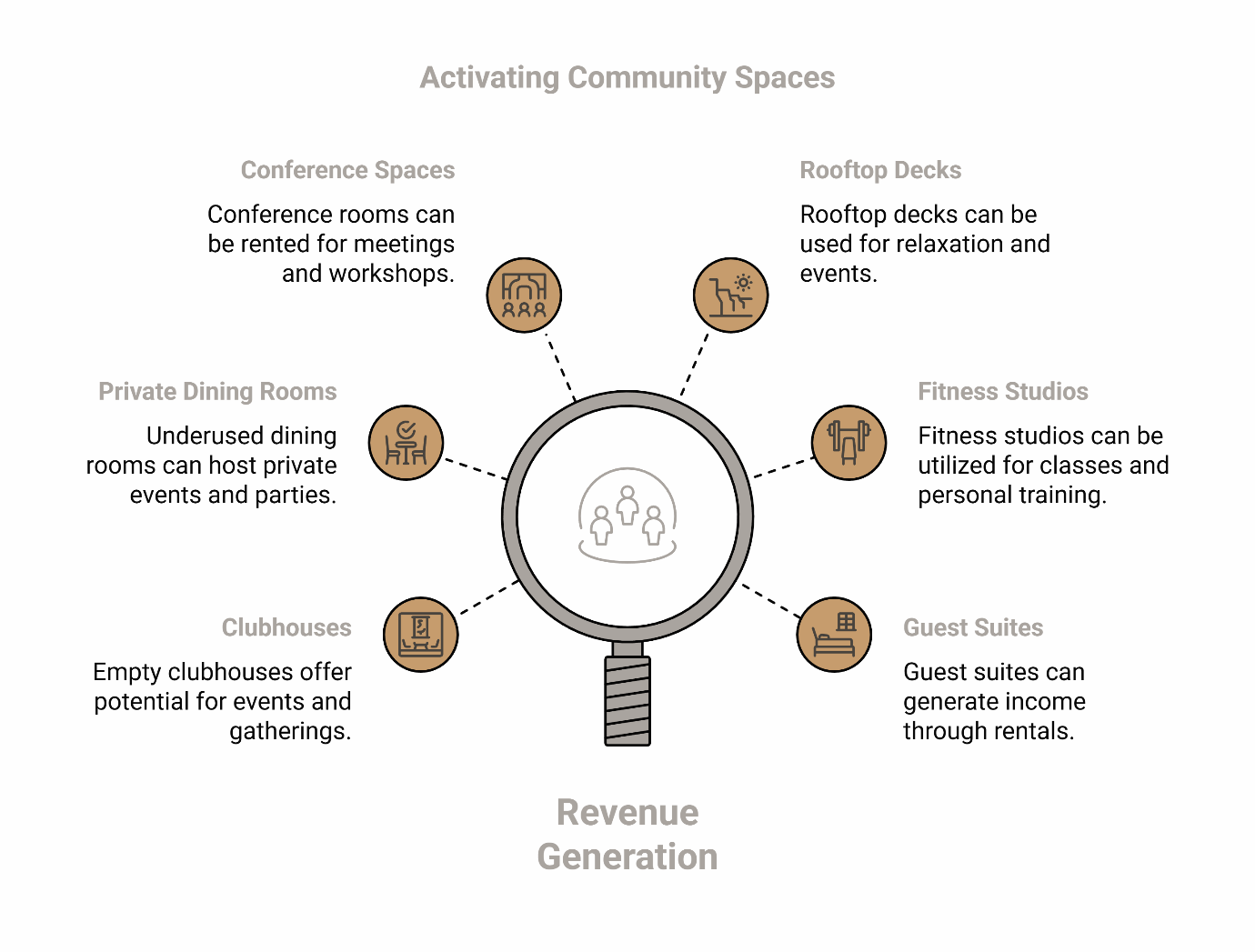
Dead space is typically characterized as any common area that sits empty for a significant majority of operational hours despite having clear functional potential.[1] In Class A communities, this typically includes clubhouses, private dining rooms, conference spaces, rooftop decks, fitness studios, and guest suites.
One resident's experience illustrates what activation looks like when the operating system works: the booking process puts everything needed right at fingertips, making amenity reservations completely frictionless. That kind of seamless access is the foundation for turning underutilized space into revenue-generating assets.
The Hidden Cost: Maintenance, Conflict, and Missed Ancillary Revenue
Every underutilized space carries three hidden costs:
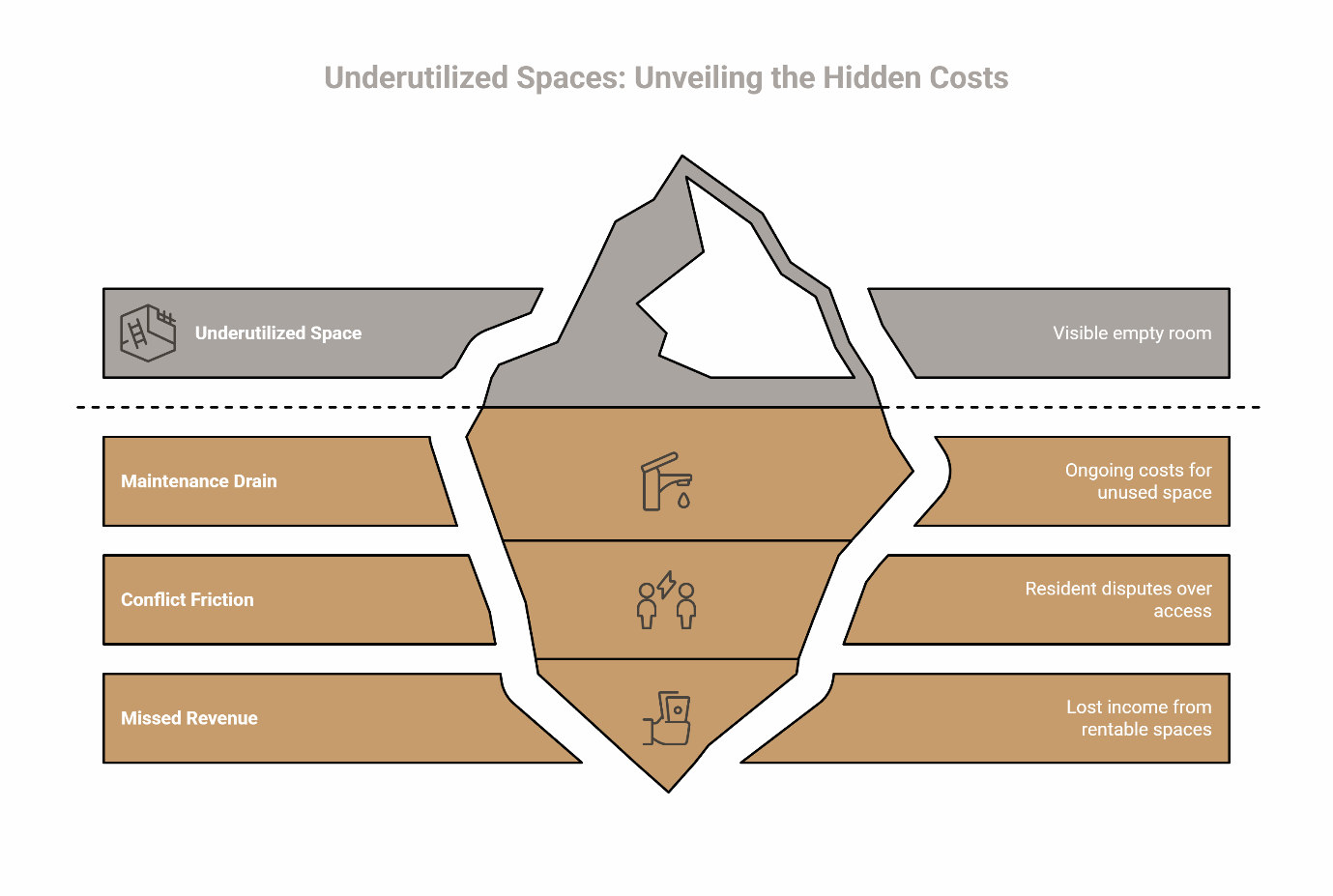
Maintenance drain. You're cleaning, climate-controlling, and insuring rooms that generate zero return. For a 2,000-square-foot clubhouse, that can mean an estimated $400–$1,000 monthly in utilities and upkeep alone, depending on regional energy costs and cleaning frequency.[2]
Conflict friction. Without clear rules, residents argue over access. The leasing office becomes a referee instead of a sales team.
Missed ancillary revenue. According to industry data, properties that actively monetize shared spaces see measurable NOI improvement. Industry data suggests that strategic amenity activation acts as a Net Operating Income (NOI) booster, offsetting fixed utility costs while potentially enhancing asset value.[3] Empty clubhouses are wasted revenue potential; digital booking makes them rentable event spaces.
Run a 30-Minute Dead-Space Audit
Before you activate anything, rank your spaces by monetization potential. Use this five-question framework:
- Capacity: Can it host 8+ people comfortably without overcrowding or creating safety risks?
- Noise adjacency: Is it far enough from residential units to avoid complaints, and does it have adequate sound insulation for evening events?
- Cleanup complexity: Can it be reset in under 30 minutes with a simple checklist, or does it require deep cleaning and specialized equipment?
- Foot traffic: Is it visible enough that residents know it exists, and is access straightforward without staff escort?
- Supervision needs: Can it operate with minimal staff oversight using clear rules and self-serve systems?
Spaces that score 4 or 5 "yes" answers are your highest-ROI targets. Focus there first.
Choose Your Activation Model (Pick 1–2 Per Space)
There are four primary activation models. Most successful properties layer two models per space to maximize utilization.
Rentals (Private Reservations)
Allow residents to reserve spaces for private events—birthday parties, family dinners, corporate meetings. Charge a flat hourly or event fee.
What works: Clubhouses, rooftop decks, private dining rooms.
Operational requirement: Clear booking calendar + deposit system + automated payment collection.
Programming (Recurring Classes/Events)
Partner with instructors or vendors to run weekly classes: yoga, cooking demos, wine tastings, pet training. Residents pay per session or via package.
What works: Fitness studios, clubhouses, outdoor courtyards.
Operational requirement: Vendor agreements + liability waivers + registration system.
Partnering with local vendors activates spaces without adding staff work. Your role is coordination, not execution.
Partnerships (Vendor Pop-Ups)
Invite local businesses—massage therapists, mobile car detailers, meal prep services—to offer services on-site. Charge vendors a flat fee or revenue share.
What works: Parking garages (car wash), lobbies (farmer's market), courtyards (food trucks).
Operational requirement: Vendor vetting + scheduling + resident communication.
Services (Package Add-Ons, Concierge-Style Offerings)
Use common areas as staging grounds for premium resident services: in-home housekeeping staging, dog grooming stations, or package assembly for moving residents.
What works: Service rooms, package centers, pet wash stations.
Operational requirement: Service provider partnerships + booking integration.
Write the Rules Once (So the Team Stops Refereeing Conflicts)
The fastest way to kill activation momentum is inconsistent enforcement. Write the rules once, publish them clearly, and automate enforcement through your amenity management software.
Hours, Capacity, Deposits, Cleanup, Cancellations, and Damage
Every activated space needs six rules documented:
- Hours: When is the space available? (e.g., 8 AM–10 PM, no reservations on major holidays)
- Capacity: Maximum occupancy (fire code compliant)
- Deposits: Refundable security deposit amount (e.g., $100–$250)
- Cleanup: Who resets the space? (resident responsibility or staff-handled for fee)
- Cancellations: Notice period for full refund (e.g., 48 hours)
- Damage: Inspection protocol and deduction process
Consistent Access Principles (Fair Housing Constraint)
All residents must have equal access to the same services, tools, events, and features. This includes booking systems, pricing, and policies. Use transparent, first-come-first-served digital calendars. Avoid discretionary approval processes that create compliance risk.
Simple digital payments are the prerequisite for monetization. Without automated payment collection, your team becomes a collections agency.
Build the "Activation System"
Activation isn't a one-time announcement. It's a repeatable operating loop with four components.
Promotion (Resident Announcements)
Launch with a dedicated email campaign and in-app push notification. Highlight the specific use case: "Host your next family dinner in the private dining room—book in 60 seconds."
Frequency: Monthly feature spotlight on underutilized spaces.
Booking (Calendar + Approvals as Needed)
Use a digital calendar that syncs with your resident app. Residents should see real-time availability and book instantly.
For higher-risk spaces (rooftop deck with alcohol), require manager approval within 24 hours. For low-risk spaces (conference room), allow instant booking.
Payments (Digital-First)
Integrate payment processing directly into the booking flow. Residents pay deposits and fees at the time of reservation—not in person, not via check.
Operations Loop (Checklists + Accountability)
Create a two-step operations checklist:
Pre-event: Staff confirms space is clean, equipment works, and access codes are active.
Post-event: Staff inspects for damage within 24 hours and processes deposit return.
Assign one team member as the "activation coordinator" to own the loop.
Track the Only 6 Metrics That Matter
You can't improve what you don't measure. Track these six metrics monthly:
- Utilization rate: Percentage of available hours booked
- Revenue per hour: Total revenue divided by total available hours
- Cancellations/no-shows: Percentage of bookings that don't convert to actual usage
- Incident rate: Damage claims or noise complaints per 100 bookings
- Staff time spent: Hours per month managing bookings and operations
- Resident sentiment: Net Promoter Score or satisfaction survey results
For deeper guidance on tracking these metrics, see our post on active versus passive amenity management.
A "Monetization Menu" Template You Can Copy
Use this template to define 10 activation ideas for your property. Customize pricing based on your market and space quality.
- Clubhouse Private Events – Host birthday parties, family dinners, or corporate meetings – Tables, chairs, AV setup, kitchen access – 4-hour max, $50 deposit, resident resets space – $100–$250 per event
- Rooftop Deck Gatherings – Evening receptions, sunset yoga, small weddings – Furniture, grills, string lights – Manager approval required, $200 deposit – $150–$400 per event
- Fitness Studio Classes – Weekly yoga, Pilates, or HIIT sessions – Mats, sound system, instructor partnership – 60-minute sessions, 15-person cap – $15–$25 per resident per class
- Private Dining Room Dinners – Intimate dinners for 8–12 guests – Chef's table setup, wine fridge, dishware – 3-hour max, $75 deposit – $75–$150 per event
- Conference Room Meetings – Remote work, client meetings, study groups – Whiteboard, video conferencing, high-speed wifi – 2-hour blocks, instant booking – $25–$50 per block
- Outdoor Courtyard Pop-Ups – Food trucks, farmer's markets, mobile retail – Vendor coordination, permits, resident notifications – Monthly or quarterly events – Vendor fee: $100–$300
- Pet Wash Station Grooming – Professional grooming or DIY wash – Elevated tub, dryers, grooming tools – 30-minute slots, $25 deposit – $20–$40 per session
- Guest Suite Rentals – Overnight accommodations for resident visitors – Furnished bedroom, bathroom, linens, wifi – 1-night minimum, $100 deposit – $75–$150 per night
- Game Room Tournaments – Poker nights, trivia competitions, esports events – Tables, gaming consoles, scoreboards – Resident-led or vendor-hosted – Free to $10 entry fee
- Parking Garage Car Detailing – Mobile detailing services on-site – Vendor partnership, designated bay, water access – Scheduled appointments, resident pays vendor – Site Access Fee: $50–$100 per scheduled visit
For a complete breakdown of pricing strategies and operational workflows, see our guide on monetizing shared spaces effectively.
Your Next Step: Pick One Space and Activate It in 7 Days
You don't need to transform your entire property overnight. Pick one underutilized space. Write the six rules. Set up the booking calendar. Promote it to residents. Track the metrics for 30 days.
The fastest way to prove ROI is to start small and scale what works. For step-by-step guidance on activating your first space without adding staff, read our post on how to activate your clubhouse without hiring more staff.
Revenue stagnation isn't a square-footage issue; it's a process failure. Fix the system, and the space pays for itself.
Disclaimer: This content is for informational purposes and should not replace professional advice tailored to your specific property or operational context.
Our Editorial Process
Our expert team uses AI tools to help organize and structure our initial drafts. Every piece is then extensively rewritten, fact-checked, and enriched with first-hand insights and experiences by expert humans on our Insights Team to ensure accuracy and clarity.
About the ElevateOS Insights Team
The ElevateOS Insights Team is our dedicated engine for synthesizing complex topics into clear, helpful guides. While our content is thoroughly reviewed for clarity and accuracy, it is for informational purposes and should not replace professional advice.
Notes:
[1] This operational definition reflects common industry usage patterns rather than a standardized industry benchmark. Property teams should assess underutilization based on their specific operational context and market expectations.
[2] Maintenance cost estimates vary significantly based on regional utility rates, climate zone, HVAC efficiency, cleaning service contracts, and usage frequency. Property teams should benchmark against their specific market conditions and operating history.
[3] Amenity activation increases Net Operating Income through revenue generation. The impact on asset value depends on sustained NOI improvement, comparable property performance, and prevailing market capitalization rates in the property's submarket.