.avif)
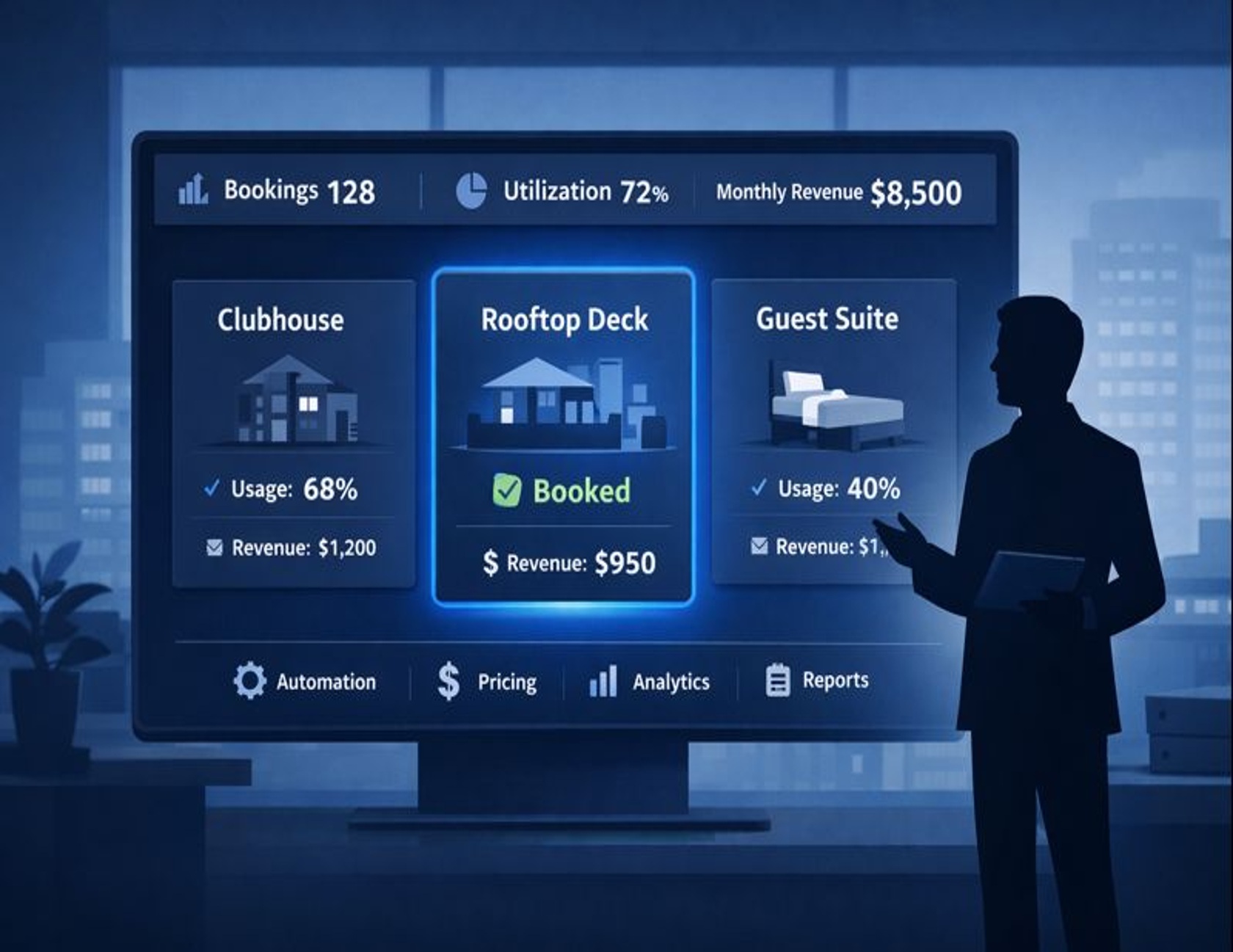
📌 Key Takeaways
Digital amenity management transforms $3M+ amenity investments from passive marketing costs into measurable revenue drivers and retention assets through software-driven booking, pricing, and reporting systems.
- Friction Costs $30K+ Annually: Manual booking systems cause revenue leakage of $30,000 or more per property yearly through abandoned reservations and underutilization alone.
- Three Pillars Create ROI: Operationalization ensures reliability, monetization creates value exchange without punitive fees, and measurement generates owner-grade performance data.
- 90-Day Launch Is Viable: A phased 30/60/90-day implementation delivers measurable utilization increases and first-month ancillary revenue without requiring year-long rollouts.
- Unified Platforms Reduce Burnout: Consolidating 5+ resident-facing apps into one branded system eliminates coordination gaps for staff and app fatigue for residents.
- Data Justifies CapEx Cycles: Utilization rates, peak demand windows, and revenue-per-square-foot metrics replace anecdotal guessing in renovation and expansion decisions.
Activation beats expansion—optimize existing spaces before adding new ones.
Property developers and asset managers evaluating amenity ROI will gain an actionable implementation framework here, preparing them for the operational details that follow.
For the developer who invested $2.3 million into a rooftop amenity, a crashed booking portal isn't just a bad user experience. It is a leak in asset value. Every friction point nudges renewal rates down and marketing costs up. The amenity built to attract residents is now quietly pushing them away.
Digital Amenity Management is the operational discipline of running shared spaces through software-driven rules, workflows, and resident-facing tools—replacing manual booking, fragmented apps, and untracked usage—so amenities become measurable drivers of retention, ancillary revenue, and staff efficiency. This isn't about adding more amenities. It's about managing the ones you already have—turning common areas from marketing checkboxes into revenue-generating assets that justify their CapEx and increase your Net Operating Income (NOI).
The Industry Shift: From Amenities as Costs to Amenities as Assets
Multifamily Amenity Management transforms marketing expenses into revenue centers. This shift occurs when property managers stop viewing lounges, gyms, and rooftop decks as "freebies" and start treating them as premium, reservable assets with real P&L impact.
For decades, the luxury multifamily playbook was simple: build impressive amenities, photograph them beautifully, and use them to win leases. The amenities themselves were purely marketing tools—their value ended the moment the lease was signed. After move-in, these spaces often sat empty or were managed passively through paper sign-up sheets and vague "first-come, first-served" policies.
But the economics have changed. Data from the NMHC/Grace Hill Renter Preferences Survey consistently indicates that satisfaction with community amenities is a top factor in lease renewal decisions. When residents actively utilize these spaces, the perceived value of the lease increases, directly supporting retention strategies. The amenity isn't just a photo op anymore—it's a retention tool. When residents actually use the spaces you built, they form emotional attachments to the building. They host birthday parties in your clubhouse. They take yoga on your rooftop. They stop seeing the building as just a place to live and start seeing it as a lifestyle.
The Old Model: Amenities as Sunk Costs
Under the traditional approach, developers poured millions into amenity construction—think $500K for a resort-style pool, $300K for a fitness center, $1.2M for a rooftop deck with grills and firepits. These were treated as loss leaders: the necessary price of entry to compete for Class A renters, with no expectation of direct ROI.
But once the ribbon was cut, the spaces were simply "open." No booking system. No usage tracking. No monetization. Site teams managed reservations manually (if at all), often through email or a binder at the front desk. The result? Chaos, double-bookings, and—most critically—no data on which amenities residents actually valued.
The New Model: Amenities as Operating Assets
The strategic pivot is to treat amenities like you'd treat any other income-generating asset on your balance sheet. A clubhouse isn't just a "free lounge"—it is a 1,200-square-foot event venue that, depending on market tier and location, typically has the potential to generate between $1,500 and $4,000 per month in private bookings. A grill station isn't a "nice-to-have"—it's a reservable resource that can command $50-$100 per session during peak months.
This shift requires three foundational changes:
- Centralized Digital Booking: Residents need one app to see availability, reserve spaces, and pay fees—all without calling the leasing office.
- Transparent Pricing Models: Some amenities remain complimentary for everyday use (e.g., the gym), but high-demand spaces available for exclusive private events (party rooms, guest suites) carry reservation fees that cover maintenance and staffing. All residents have equal access to reserve these spaces under the same terms.
- Usage Data as a Strategic Input: Digital systems track which amenities are booked most often, informing smarter decisions about future renovations and CapEx allocation.
The goal isn't to "nickel-and-dime" residents. The goal is to ensure the $3M you spent on amenities actually drives retention and adds measurable value to your asset.
Why the Old Model is Broken: The Failure of Passive Management
Passive Amenity Management causes revenue leakage and resident friction. When booking relies on paper logs or clunky staff emails, residents simply stop using the spaces you spent millions to build.
Let's be precise about what "passive management" actually looks like on the ground. A resident wants to book the clubhouse for a graduation party. She emails the leasing office on Tuesday. The office is slammed with move-outs, so the email sits in an inbox for 36 hours. When the leasing agent finally replies, the date is already taken—but the system (a shared Google Calendar) wasn't updated, so three other residents were also told "yes" for that same Saturday.
The resident tries calling. She's placed on hold. She gives up and books a restaurant off-site instead. She never uses the clubhouse she's effectively paying for through her rent.
The Hidden Costs of Unmanaged Spaces
This operational breakdown creates four silent costs that erode asset value:
- Revenue Leakage: If your clubhouse could be generating $30K annually in reservation fees but sits empty because booking is too painful, that's $30K in lost ancillary income.
- Resident Frustration: Research from the National Multifamily Housing Council shows friction in the resident experience is a leading cause of non-renewals. When residents feel ignored or encounter unnecessary barriers, they start browsing other buildings.
- Staff Burnout: Site teams—already stretched thin by package deliveries, maintenance requests, and tour schedules—become the bottleneck for every amenity interaction. This manual overhead adds hours to their workweek and contributes to high turnover in property management roles.
- Missed Strategic Insights: Without usage data, you're flying blind on CapEx decisions. Should you renovate the gym or expand the coworking lounge? You're guessing based on anecdotes, not data.
Why Paper Sign-Ups Fail at Scale
The root problem with passive systems—whether it's a clipboard, a shared spreadsheet, or even a basic calendar tool—is that they cannot handle the three requirements of modern amenity management:
- Payment Processing: How do you collect the $75 clubhouse fee when the booking happens via email?
- Conflict Resolution: Who enforces the rules when two residents both show up claiming they reserved the grill?
- Data Capture: What's your utilization rate? Which amenities justify their maintenance costs?
Manual systems weren't designed for these challenges. They were designed for a world where amenities were "nice-to-haves," not revenue-critical assets.
The shift to Digital Amenity Management solves this by removing humans from the transactional layer—freeing site staff to focus on hospitality while the platform handles logistics, payments, and reporting.
What Digital Amenity Management Actually Means
A Digital Amenity OS unifies the resident experience and property operations. By integrating with your existing PMS (Yardi/Entrata), the platform automates the entire lifecycle of a reservation without requiring site team intervention.
Think of Digital Amenity Management as the operating system for your building—the invisible layer that connects residents, amenities, payments, and staff into a single, branded experience. Just like iOS makes your phone feel cohesive (even though dozens of apps are running in the background), a branded resident app makes your building feel like a 5-star hotel.
Digital amenity management operates on three core pillars:
Pillar A: Operationalization (Make the Experience Reliable)
Operationalization converts a physical space into a repeatable service. This includes:
- Booking rules: capacity limits, available hours, lead times, buffers between reservations
- Governance: policies residents can actually follow and staff can enforce consistently
- Access workflows: who can enter, when, and under what conditions
- Staff handoffs: cleaning checks, inspections, issue escalation protocols
- Resident communications: confirmations, reminders, day-of instructions, policy visibility
This is the "boring" work that creates premium outcomes. Without it, every amenity becomes a recurring exception that drains staff time and erodes resident trust.
Pillar B: Monetization (Create Value Exchange, Not Fees)
Monetization works when residents perceive a fair exchange—premium access for special occasions, not punitive fees for everyday living.
Monetization Pathway 1: Premium Reservations for High-Demand Moments
A clubhouse, screening room, or private dining space can be monetized when demand is naturally high, scheduling conflicts are common, cleanup or reset is non-trivial, and residents perceive the booking as a special occasion. Keep standard access generous, and monetize exclusive blocks rather than basic use. These reservation opportunities are available to all residents under the same terms and conditions.
Monetization Pathway 2: Services Residents Already Purchase Elsewhere
In many markets, residents already pay out-of-pocket for housekeeping, dog walking, fitness training, and meal services. A digital services layer simply helps the property management team become the orchestrator—making it easier to buy the same outcomes through the building experience. All residents have equal access to these optional service offerings.
For deeper insight into this approach, see Why Your Building Needs a Digital Concierge, Not Just a Portal.
Monetization Pathway 3: Programming That Increases Utilization
Programming isn't just "community." It's activation. Fitness classes activate the fitness center. Pop-up tastings activate lounge and patio spaces. Workshops activate coworking areas. Programming tends to increase ongoing utilization, which then improves the economics of premium bookings and services.
Monetization Pathway 4: Perks and Partnerships
Gift cards, discounts, and local partnerships act as engagement multipliers—especially when delivered through a resident-facing platform. Learn more about our Gift Card Management System.
Fee-based amenities apply uniformly to all residents based on usage type—such as exclusive event bookings—not resident characteristics, ensuring equal access and compliance with fair housing requirements. Not every amenity should be monetized. The goal is to turn the right spaces into controllable revenue streams while keeping the overall experience generous.
For a comprehensive breakdown of monetization strategies, explore our guide on Ancillary Revenue 101: Monetizing Shared Spaces Effectively.
Pillar C: Measurement (Turn Anecdotes into Owner-Grade Reporting)
Measurement transforms amenities from "nice-to-have" into "operational assets." It tracks utilization, participation, service conversion, and resident engagement signals—then turns those into a reporting cadence that ownership and asset management can understand.
What gets measured gets managed. Without measurement, amenity performance remains subjective and impossible to optimize.
What Makes It an "Operating System"?
The key word is unified. Residents don't download five different apps to pay rent (App 1), book the gym (App 2), request maintenance (App 3), reserve a parking spot (App 4), and sign up for yoga class (App 5). They open one app—white-labeled with your building's branding—and everything is there.
For developers, this isn't just about convenience. It's about control. You own the resident relationship. You control the data. You decide which amenities to monetize and which to keep complimentary. You set the pricing, the booking rules, and the cancellation policies—all from a single management portal that syncs with your property management system.
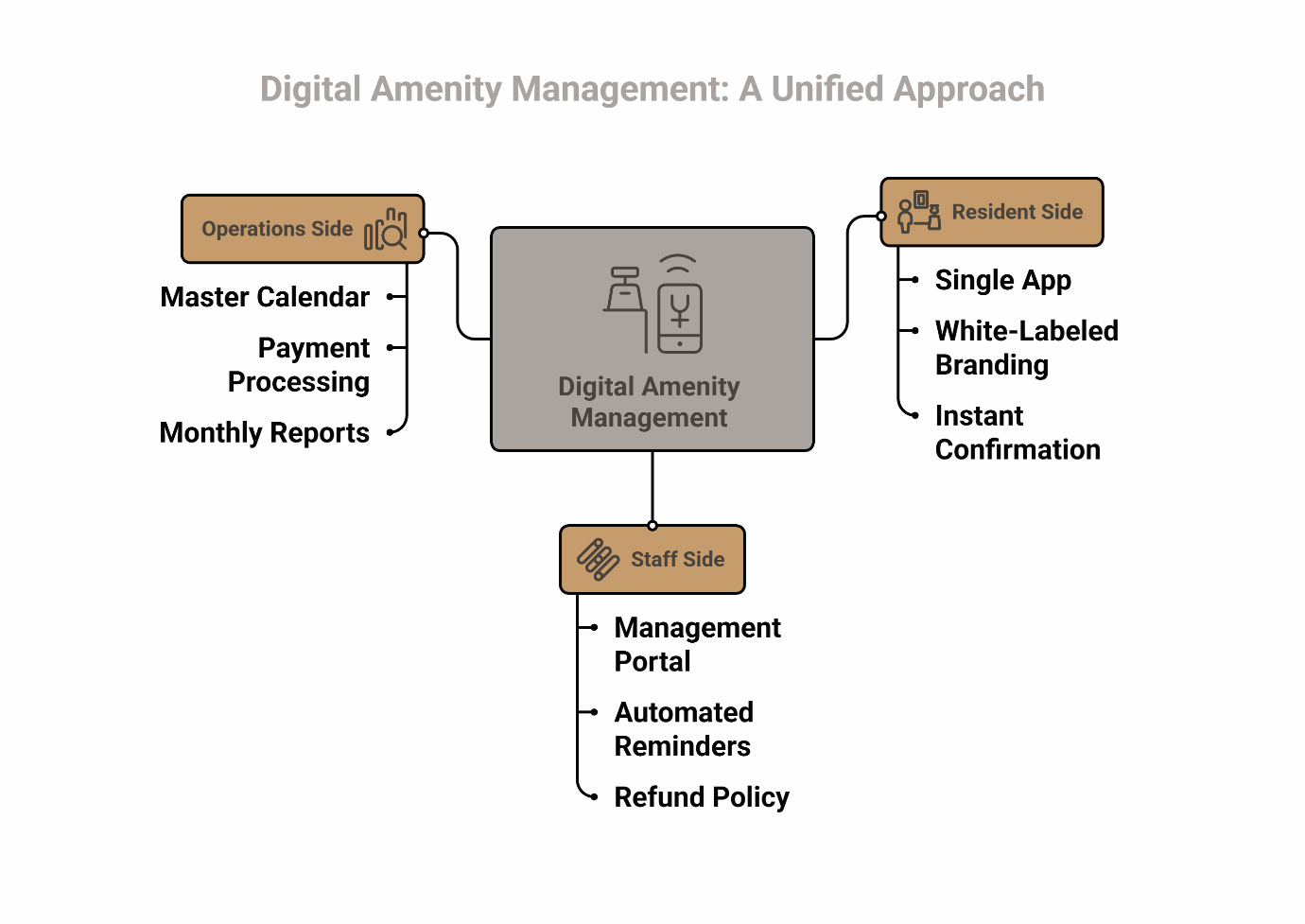
Here's what this looks like in practice:
- Resident Side: A resident opens the app on Thursday morning. She sees the rooftop deck is available Saturday at 6 PM. She taps "Reserve," pays the $50 fee via the integrated payment system, and receives instant confirmation. No phone calls. No waiting.
- Staff Side: The site manager logs into the management portal and sees the reservation automatically added to the master calendar. The payment is processed. The resident receives an automated reminder 24 hours before the event. If she cancels, the refund policy (set by management) is applied automatically.
- Operations Side: At month-end, the property manager pulls a report showing that the rooftop was booked 18 times in August, generating $900 in reservation fees and justifying the $12K annual maintenance budget.
The Integration Advantage
One of the biggest obstacles to adopting new property tech is the fear of "one more system to manage." That's why integration with your existing PMS is non-negotiable.
When the Digital Amenity OS integrates with Yardi, Entrata, or RealPage, three critical things happen:
- Resident Data Syncs Automatically: When a new resident moves in, their profile is added to the amenity system on Day 1. When they move out, their access is revoked. No manual updating.
- Payments Flow Directly to the Ledger: Reservation fees post to the resident's account just like rent. The accounting is seamless.
- Single Sign-On (SSO) for Residents: Residents log in once. They don't need to remember separate passwords for the rent portal, the amenity app, and the package tracker.
This integration model ensures Digital Amenity Management doesn't add complexity—it reduces it by consolidating workflows. For a complete view of integration capabilities, see our Integrations overview.
The Core Components of a Digital Amenity Management System
When evaluating platforms, look for these essential capabilities:
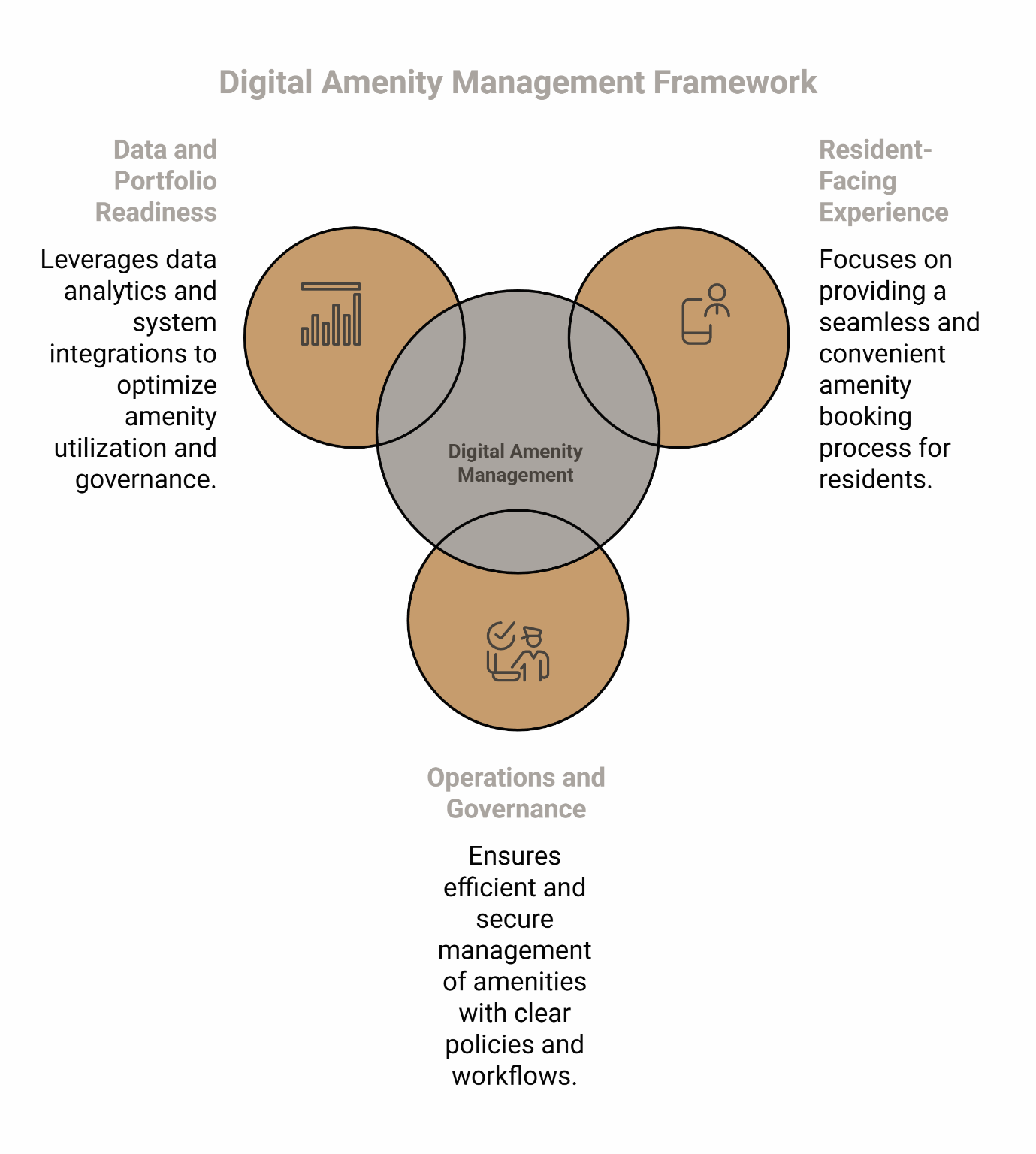
Resident-Facing Experience
- Self-serve booking with real-time availability and automatic conflict prevention
- Visible rules and capacity controls (time windows, guest limits, booking buffers)
- Automated communications (confirmations, reminders, instructions)
- Integrated payment processing for deposits and fees where applicable
- Event programming tools with RSVPs, waitlists, and reminders
- Services marketplace for hospitality-style offerings like housekeeping, pet care, and fitness training
Operations and Governance
- Staff workflows for approvals, escalations, and incident logging
- Access control alignment (door entry tied to booking windows where integrated)
- Enforceable policy management with resident acknowledgments
- No-show controls through automated reminders and deposits
- Operational dashboards showing utilization, conflicts, and activity patterns
Data and Portfolio Readiness
- Reporting and utilization analytics by amenity, time period, and resident segment
- Deep integration with property management systems for user identity and lease status
- Role-based permissions for consistent governance across portfolios
- Standard operating playbooks that enable repeatable setup across sites
For properties looking to unify their resident experience layer, combining amenity management with Events & Experiences creates a comprehensive engagement platform.
Identifying the Amenity Revenue Gap: What You're Leaving on the Table
Before you can monetize your amenities, you need to understand where the opportunity lies. Most developers dramatically underestimate the revenue potential hidden in their common areas.
The Revenue Gap Formula
Start with this simple calculation:
Potential Monthly Revenue=(Reservable Spaces)×(Avg. Fee)×(Monthly Bookings)
For a typical 300-unit Class A building with a clubhouse, rooftop deck, guest suite, and private dining room:
- Clubhouse: $100/booking × 8 bookings/month = $800
- Rooftop Deck: $75/booking × 12 bookings/month = $900
- Guest Suite: $50/night × 15 nights/month = $750
- Private Dining Room: $150/booking × 4 bookings/month = $600
Total Monthly Ancillary Revenue: $3,050
Annual Impact: $36,600
That's $36K in new revenue—not from raising rents, but from activating spaces that were already built. For properties with larger amenity footprints or higher booking demand, this number can easily exceed $50K-$75K annually.
What About Free Amenities?
Not every amenity should be monetized. The gym, the pool, and the coworking lounge are typically complimentary (included in rent) because they're high-frequency, high-visibility spaces that drive leasing. Charging for basic gym access would feel punitive and could raise fair housing concerns.
The monetization sweet spot is event-style spaces—areas that require setup, staffing, or exclusive use. These are spaces residents expect to pay for (just like they'd pay to rent a private event venue off-site), and fees apply uniformly to all residents based on the type of booking requested. Your goal is to make the booking experience so seamless that residents choose your clubhouse over the restaurant down the street.
Turning Amenities into Retention: How Engagement Becomes Stickiness
Amenities drive renewals less through novelty and more through habit and reduced friction.
A practical retention mechanism looks like this:
- Convenience creates repetition. The easier it is to book, access, and understand rules, the more likely residents are to use a space again.
- Repetition creates attachment. Once routines form (weekly class, monthly event, frequent lounge use), the building becomes part of a lifestyle.
- Attachment creates switching costs. Moving is not just changing an address—it's losing a set of small, reliable conveniences.
Here's the operating reframing: Residents rarely renew because a building is "nice." Renewals happen because living there feels easier, more predictable, and more rewarding.
The Data Advantage: Using Amenity Insights to Drive Smarter CapEx Decisions
One of the most underappreciated benefits of Digital Amenity Management is the data it generates. When every booking, cancellation, and payment flows through a centralized platform, you suddenly have visibility into patterns that were invisible under the old model.
The Amenity-to-Asset KPI Dashboard
Measurement is where owners and operators finally align, because it replaces opinions with operational reality.

What to Track
- Utilization Rate: What percentage of available time slots are being booked? A clubhouse that's reserved 60% of weekend evenings is a high-value asset. One that's booked 5% of the time may need repositioning—or could be converted to a different use (e.g., coworking space).
- Peak Demand Windows: Are residents fighting over the rooftop on Saturday evenings but ignoring it on weekday mornings? Adjust pricing to balance demand (premium rates for peak times, discounts for off-peak).
- Revenue per Square Foot: Calculate how much income each amenity generates relative to its size. A 200 sq ft guest suite generating $9,000/year ($45/sq ft) is outperforming a 2,000 sq ft clubhouse generating $10,000/year ($5/sq ft).
How to Report This to Ownership
Use a monthly cadence with a stable narrative: Utilization → Engagement → Revenue → Retention signals.
Highlight two categories:
- Optimization opportunities: spaces with low utilization, high complaints, or unclear rules
- Expansion candidates: spaces with sustained demand and clean operations
For guidance on interpreting engagement metrics, see Decoding Engagement Data: Unlocking Deeper Insights from Your Resident Experience Platform.
Strategic Applications
When it's time for your next CapEx cycle, this data becomes your justification. Instead of saying, "We think residents would like a renovated gym," you can say, "Our gym is booked at 80% capacity during peak hours, and resident survey data shows demand for more equipment. A $150K renovation will increase utilization by 30%, supporting a rent premium of $15/unit, yielding a 24-month payback."
That's the difference between guessing and knowing.
Implementation Roadmap: The 30/60/90-Day Action Plan
Transitioning from passive to active management doesn't require a 12-month implementation. With the right platform and a clear rollout plan, you can launch a fully operational Digital Amenity OS in 90 days.
A successful rollout treats digital amenity management as an operating model change—not a software launch.
First 30 Days: Audit + Governance + Quick Wins
Focus on foundation and credibility.
- Conduct an Amenity Inventory: List every reservable space in your building. Include square footage, current usage patterns (if known), and maintenance costs.
- Select 2-3 Flagship Amenities: Choose high-demand, high-friction, or high-visibility spaces to prove the concept.
- Define Your Monetization Model: Which spaces will remain complimentary? Which will carry reservation fees for exclusive use? What are the fees? (Benchmark against local event venues for market rates.) Ensure all policies apply uniformly to all residents.
- Set Booking Rules: Define policies: How far in advance can residents book? What's the cancellation policy? Are there time limits for reservations? Make sure rules are ones residents will accept and staff can enforce consistently.
- Select Your Platform: Choose a Digital Amenity Management solution that integrates with your PMS. Prioritize platforms with white-label capabilities so the app reflects your building's brand, not a third-party vendor.
For a step-by-step automation guide, see Automating Amenity Reservations: A Step-by-Step Guide for Maximizing NOI in Luxury Communities.
Next 30 Days: Integration + Launch + Adoption Loops
Turn on real usage and remove friction.
- Complete PMS Integration: Work with your platform provider to sync resident data, payment processing, and access control (if applicable).
- Launch Self-Serve Booking: Turn on bookings with guardrails (buffers, capacity, reminders).
- Implement Staff Workflows: Set up processes for exceptions (damage, disputes, special approvals). Train onsite teams on "what happens when something goes wrong."
- Beta Test with Staff: Have your site team book test reservations, process mock payments, and generate reports. Identify any workflow gaps before residents start using the system.
- Create Marketing Assets: Draft email announcements, in-app tutorials, and lobby signage explaining the new booking process. Emphasize the benefits: "Book the rooftop deck in 60 seconds—no more waiting for the office to call you back."
- Add Lightweight Programming: Stimulate repeat usage with simple events or classes.
Final 30 Days: Expand + Monetize + Dashboards
Scale beyond "it works" to "it produces outcomes."
- Soft Launch to Residents: Roll out the system with a "grace period" where fees are waived or discounted for the first two weeks. This encourages adoption and surfaces any user experience issues.
- Expand to Additional Amenities: Use reusable rules templates from your flagship spaces.
- Introduce Selective Monetization: Add fees where the value exchange is obvious (premium blocks, service add-ons), ensuring all residents can access the same amenities under uniform terms.
- Stand Up the KPI Dashboard: Establish your reporting cadence.
- Monitor & Adjust: Track key metrics: booking volume, payment collection rate, support tickets. If certain amenities aren't being booked, adjust pricing or add promotional incentives.
- Align the Story: Make sure operations, leasing/marketing, and ownership all understand the narrative and the results.
By Day 90, you should see measurable results: higher utilization rates, fewer staff hours spent on manual coordination, and the first month of ancillary revenue hitting your ledger.
For a staffing-light activation approach, see How to Activate Your Clubhouse Without Hiring More Staff.
Common Pitfalls (and How to Avoid Them)
Pitfall 1: Treating Software as the Strategy
Software enables consistency; it does not define governance, service levels, or resident value exchange. Start with operating rules, then encode them.
Pitfall 2: No Clear Ownership = Inconsistent Enforcement
Assign a single accountable role for amenity governance (even if execution is shared). Consistency matters more than sophistication.
Pitfall 3: Launching Too Many Amenities at Once
A portfolio-scale model is built through repeatable templates. Start with flagship spaces, prove adoption and operations, then expand.
Pitfall 4: Monetizing Basics Instead of Premium Moments
If everyday access becomes paywalled, trust erodes. Monetize exclusivity or convenience, not normal living. Keep monetization focused on exclusive event bookings available to all residents under the same terms, not everyday amenity access.
Pitfall 5: Weak Resident Communication
Rules hidden in PDFs are not rules. Use confirmations, reminders, and at-the-point-of-use visibility.
Pitfall 6: Too Many Tools, Not Enough Orchestration
When every function has a different app, both residents and staff disengage. A unified approach reduces friction and creates cleaner reporting. For a detailed comparison, see Resident Experience Platform vs. Point Solutions: A Comparative Decision Matrix.
Pitfall 7: No Reporting Cadence = No ROI Story
Without a monthly dashboard, amenity performance becomes subjective again. Measurement is what converts "experience" into an asset narrative.
Overcoming the False Fix: Why "More Amenities" Isn't the Answer
Here's the trap many developers fall into: when renewal rates drop or leasing slows, the instinct is to add more amenities. "Let's build a dog park. Let's add a golf simulator. Let's install a rooftop pool."
But if residents aren't using the amenities you already have, adding more won't solve the problem. It will just add more underutilized square footage to your balance sheet.
The real issue isn't quantity—it's activation.
Think about it: A $1.5M rooftop deck that is booked only twice a month represents a massive inefficiency in capital deployment. Instead of amortizing that investment over thousands of resident interactions, the effective cost-per-engagement remains exorbitantly high, turning a potential retention driver into a depreciating liability. A $300K fitness center that residents never visit because the equipment is outdated is a sunk cost. Adding a $200K dog park on top of that doesn't fix the utilization problem—it compounds it.
The Strategic Alternative: Activate What You Have
Instead of expanding your amenity footprint, focus on making your existing spaces indispensable. This means:
- Reducing Booking Friction: If reserving the clubhouse requires three emails and a phone call, residents won't bother. Make it a 30-second self-serve process.
- Programming Events: Don't wait for residents to discover the yoga studio on their own. Schedule weekly classes, promote them in the app, and make sign-ups easy.
- Enabling Ancillary Services: Partner with local vendors to offer on-demand services through the same app residents use to book amenities. Housekeeping, pet concierge, and personal training all drive engagement with the platform—and by extension, the building.
The Hospitality Shift: From Property Management to Community Architect
The philosophical shift underlying Digital Amenity Management is this: Your property management team is no longer just managing buildings. You are hospitality providers.
Residents don't want to "rent an apartment." They want to join a community. They want to feel like they're living in a place that cares about their experience—a place where booking the rooftop is as easy as ordering an Uber, where staff remember their dog's name, and where the building itself feels like an extension of their lifestyle.
This shift doesn't happen by accident. It requires intentional systems, proactive programming, and—yes—technology that gets out of the way and lets the human connection shine through. The platform isn't the end goal—it's the enabler. The real work is building a culture where every interaction, from maintenance requests to yoga sign-ups, reinforces the message: "You belong here."
Your Next Step: Calculate the Hidden Revenue in Your Building
If you've made it this far, you're ready to stop thinking about amenities as marketing expenses and start treating them as what they are: underutilized capital assets waiting to generate returns.
The first step is simple: audit your spaces. Walk through your building and ask three questions:
- Which amenities could realistically be monetized without alienating residents?
- What's the booking friction today—and how much time is your team spending managing it manually?
- If utilization doubled, what would the revenue impact be?
Those answers will give you a baseline. From there, the path forward is clear: implement a system that automates the logistics, captures the data, and gives residents the seamless experience they expect.
Additional Resources
For broader industry context on amenity management and resident preferences:
- NMHC Customer Experience Technology Report
- NMHC & Grace Hill Renter Preferences Survey
- National Apartment Association Technology Hub
- Urban Land Institute Multifamily Operations Coverage
Disclaimer: This guide is for informational and educational purposes only. It is not intended as legal, financial, or professional advice. Property owners and managers should consult qualified professionals before implementing new amenity management systems or pricing models.
Our Editorial Process:
Our expert team uses AI tools to help organize and structure our initial drafts. Every piece is then extensively rewritten, fact-checked, and enriched with first-hand insights and experiences by expert humans on our Insights Team to ensure accuracy and clarity.
About the ElevateOS Insights Team:
The ElevateOS Insights Team is our dedicated engine for synthesizing complex real estate topics into clear, helpful guides. While our content is thoroughly reviewed for clarity and accuracy, it is for informational purposes and should not replace professional advice.